We have one question for you.
Has Catholic Online given you $5 worth of value this year? Maybe you came here for a prayer. Maybe you read today's Mass readings. Maybe you researched a saint. Maybe you needed an answer about the Catholic Faith. Maybe your child used Catholic Online School. If the answer is no, you don't owe us anything. Keep using Catholic Online. But if the answer is yes, we're asking you to give $5 today.
Catholic Online School has served 2.2 million student enrollments in 193 countries, and we continue working to make Catholic education available regardless of a family's financial circumstances. We don't need every reader to give. We need the readers who recognize the value of what they've received to stand behind it. Is Catholic Online worth $5 to you?
GIVE TODAY >>The 'Black Legend': Historian Argues Anti-Catholic Bias in Spanish Conquest Narratives
FREE Catholic Classes
Historian Jorge Traslosheros, an expert in Latin American studies, contends that the "black legend" surrounding the Spanish conquest was strategically crafted as a profoundly anti-Catholic narrative. Emerging in the 18th century, the "black legend" was largely advanced by England in its colonial competition with Spain, portraying Spanish Catholicism as synonymous with cruelty and exploitation while celebrating Protestant settlers as righteous protectors of Indigenous rights. This narrative, Traslosheros argues, relied on selectively using sources, such as Friar Bartolomé de las Casas, a Spanish missionary who criticized colonial abuses, to paint Spain as uniquely tyrannical.
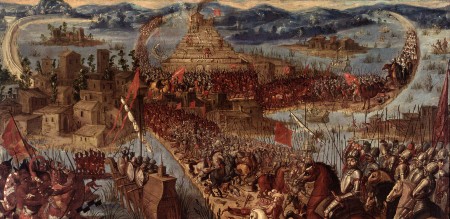
Image Credit: Wikimedia Commons
Highlights
11/5/2024 (1 year ago)
Published in Blog
Keywords: anti-Catholic narrative, Jorge Traslosheros, Indegenous
Traslosheros, a professor at the National Autonomous University of Mexico, points out that this narrative oversimplifies complex histories by attributing the "evils" of colonization solely to Spanish influence. While pre-Hispanic culture is often idealized in the "black legend" narrative, he argues that such interpretations neglect the broader historical picture, dismissing any contributions from the Catholic colonial period to the development of modern Latin America.
In particular, he explains that Indigenous communities' challenges arose not solely under Spanish rule but were exacerbated after independence during the liberal reforms of the 19th century. Unlike the Spanish viceroyalty, which allowed Indigenous communities certain degrees of autonomy, post-independence reforms restricted Indigenous self-governance, igniting socio-economic issues that persist today. Traslosheros argues that blaming Spanish colonialism exclusively for Indigenous struggles overlooks this crucial historical shift, deflecting responsibility from later political and social transformations.
For Traslosheros, understanding the past requires contextualizing these events accurately rather than projecting moral judgments rooted in contemporary politics. He stresses that historians must differentiate between genuine historical inquiry and politicized narratives like the "black legend." This reinterpretation, he believes, is essential for Latin Americans to truly reconcile with their heritage, acknowledging both the contributions and conflicts within their Spanish Catholic and Indigenous legacies.
Come Grow With Us
Sign up and walk the Catholic journey with millions around the world.
Receive inspiring emails on saints, daily readings, and free faith-building resources—no cost, ever.
Catholic Online Is Free. But We Need Your Help.
Please Watch
- 7 Morning Prayers
- Mysteries of the Rosary
- Litany of the Bl. Virgin Mary
- Popular Saints
- Popular Prayers
- Female Saints
- Saint Feast Days by Month
- Stations of the Cross
- St. Francis of Assisi
- St. Michael the Archangel
- The Apostles' Creed
- Unfailing Prayer to St. Anthony
- Pray the Rosary










Copyright 2026 Catholic Online. All materials contained on this site, whether written, audible or visual are the exclusive property of Catholic Online and are protected under U.S. and International copyright laws, © Copyright 2026 Catholic Online. Any unauthorized use, without prior written consent of Catholic Online is strictly forbidden and prohibited.
Catholic Online is a Project of Your Catholic Voice Foundation, a Not-for-Profit Corporation. Your Catholic Voice Foundation has been granted a recognition of tax exemption under Section 501(c)(3) of the Internal Revenue Code. Federal Tax Identification Number: 81-0596847. Your gift is tax-deductible as allowed by law.
