Because of You, 2.2 Million Students Are Being Formed in the Faith
Because of generous supporters like you, Catholic Online School has already delivered free, faithful Catholic education to over 2.2 million students across 193 countries. In an age of noise and algorithms, you are helping form souls with truth, prayer, Scripture, and Christ.
If everyone who reads this gave just $5 — the cost of a coffee — we could reach even more families and keep this life-changing formation free for all. Be Courageous. Be Catholic. Stand with us today.
DONATE TODAY >St. Dominic

Facts
Patron: of Astronomers; astronomy; Dominican Republic; falsely accused people; Santo Domingo Pueblo, Valletta, Birgu (Malta), Managua
Birth: 1170
Death: 1221
Author and Publisher - Catholic Online
Printable Catholic Saints PDFs
Shop St. Dominic
Discover More About St. Dominic with Journey with the Saints
Saint Dominic was born in Caleruega, in the Kingdom of Castile in Spain, sometime after 1170. He was the son of Felix and Blessed Joan of Aza and was raised in a deeply Christian family.
A famous tradition tells of a remarkable dream his mother had before his birth. She saw a dog carrying a burning torch in its mouth, seeming to set the world on fire. The image later became associated with Dominic and his Order through the Latin wordplay Domini canes, meaning "dogs of the Lord," symbolizing the Dominican mission to carry the light of the Gospel throughout the world.
Dominic was educated first by a relative who was a priest and later studied arts and theology at Palencia. During a severe famine, he demonstrated the extraordinary charity that would characterize his life. Dominic sold his possessions, including his valuable books, to provide food for the poor.
According to early accounts of his life, when others questioned why he would part with books necessary for his studies, Dominic responded that he could not bear to study from dead skins while living people were dying of hunger.
Dominic eventually joined the chapter of the Canons Regular at Osma, whose community lived according to the Rule of St. Augustine. He embraced a disciplined life of prayer, study, and service and eventually became subprior of the cathedral chapter.
In 1203 or 1204, Dominic accompanied Bishop Diego de Acebes of Osma on a diplomatic journey through northern Europe. Their travels took them through southern France, where Dominic encountered the Cathars, also known as the Albigensians.
The Cathars embraced beliefs fundamentally opposed to Christianity, including a dualistic understanding of creation that regarded the material world as evil. Catholic Christianity, by contrast, proclaims that creation is fundamentally good, that the Son of God truly became flesh, and that the human body itself is destined for resurrection.
Dominic became deeply concerned by the spread of these teachings.
He recognized that effective evangelization required more than theological arguments. Preachers also needed to demonstrate the truth of the Gospel through the way they lived.
Dominic and Bishop Diego therefore embraced an apostolic manner of life marked by poverty, prayer, simplicity, and preaching. Traveling on foot and possessing little, they sought to imitate the poverty of Christ and His Apostles while explaining and defending the Catholic faith.
Dominic became known for his preaching and for debating those who rejected Catholic teaching. His combination of theological knowledge, personal austerity, perseverance, and concern for souls helped bring a number of people back into communion with the Church.
In 1206, a religious community for women was established at Prouille in southern France under the Catholic preaching mission led by Diego and Dominic. Some of these women had converted from Catharism and desired to embrace Catholic religious life.
The Monastery of Our Lady of Prouille became an important center of prayer supporting Dominic's preaching and is regarded as the first contemplative foundation of what would become the Dominican family.
St. Dominic and the Albigensian Crusade
The conflict surrounding Catharism soon became violent.
In 1208, the murder of the papal legate Pierre de Castelnau helped precipitate the Albigensian Crusade. Political and military forces became involved in a conflict that would continue for years.
Dominic, however, devoted himself principally to preaching, conversion, reconciliation, and the salvation of souls. Rather than becoming a military leader, he continued his apostolic mission throughout the war-torn region.
His experience convinced him that the Church needed well-educated, holy, and dedicated preachers capable of proclaiming and defending the Catholic faith.
That conviction would eventually lead to the foundation of the Order of Preachers.
St. Dominic and the Inquisition
St. Dominic has sometimes been portrayed as an inquisitor or even as the founder of the Inquisition. This identification is historically misleading.
Dominic certainly devoted his life to combating heresy, but his principal means were preaching, teaching, prayer, penance, and conversion. The papal Inquisition commonly associated with Dominican inquisitors developed as an institution after Dominic's death in 1221.
Members of the Dominican Order would later serve as inquisitors, which contributed to the later association of Dominic himself with the institution.
Dominic's own mission, however, was centered upon preaching the truth of the Catholic faith and bringing people back into communion with the Church.
St. Dominic and the Holy Rosary
One of the most beloved traditions associated with St. Dominic concerns the Holy Rosary.
According to a longstanding Catholic tradition, the Blessed Virgin Mary appeared to St. Dominic during his mission against the Albigensian heresy and entrusted the Rosary to him as a powerful means of prayer, preaching, and conversion. The apparition is traditionally associated with Prouille and is often dated to 1214.
The tradition was strongly promoted in later centuries and was famously recounted by St. Louis de Montfort in The Secret of the Rosary, drawing upon accounts associated with Blessed Alan de la Roche.
The association between St. Dominic, the Dominican Order, and the Rosary became deeply rooted in Catholic devotion. Popes have repeatedly recognized the important role played by the Dominicans in promoting the Rosary throughout the Church.
Historical scholarship also recognizes that the Rosary developed gradually over time. Forms of repetitive Marian prayer and psalter-like devotions existed before Dominic, and the familiar structure of the Rosary continued developing during the centuries that followed.
St. John Paul II described the Rosary as a prayer that "gradually took form in the second millennium under the guidance of the Spirit of God."
Thus, the traditional account of Our Lady and St. Dominic remains a cherished part of Catholic devotional tradition, while the precise historical development of the Rosary into the form familiar to Catholics today took place over a longer period.
Whatever the precise historical development of its form, the connection between the Dominican tradition and the spread of the Holy Rosary has profoundly shaped Catholic spirituality for centuries.
The Order of Preachers
By 1215, Dominic had gathered a small community of men committed to his mission of preaching.
That year, Bishop Fulk of Toulouse approved Dominic's community as a religious association within his diocese. Dominic then traveled to Rome seeking approval for his new order.
Because the Fourth Lateran Council had discouraged the creation of entirely new religious rules, Dominic and his brothers adopted the Rule of St. Augustine, with which Dominic was already familiar from his years as a canon at Osma.
On December 22, 1216, Pope Honorius III formally confirmed Dominic's community. On January 21, 1217, another papal document explicitly recognized Dominic and his companions as preachers.

The Order of Preachers—the Dominicans—had been born.
Prayer, study, community life, poverty, and preaching became central characteristics of the new Order. Dominic understood that those entrusted with preaching the Gospel needed both personal holiness and serious intellectual formation.
This emphasis upon study would become one of the great characteristics of Dominican life and would eventually produce some of the Church's greatest theologians and teachers.
Dominic Sends His Friars Into the World
In 1217, Dominic made a bold decision.
Rather than keeping his small community together in one place, he dispersed his friars throughout Europe.
Some went to Paris, others to Spain, Rome, and eventually Bologna. Dominic understood that the Order could not fulfill its mission if its members remained gathered around their founder.
The decision proved decisive.
The Order began growing rapidly, particularly around important European cities and centers of learning. Dominican communities combined common prayer and religious life with serious study and active preaching.
Dominic himself continued traveling extensively, preaching, strengthening the growing Order, and seeking support for its mission.
The first General Chapters of the Order were held in Bologna in 1220 and 1221. These gatherings helped establish the laws, government, common life, and missionary structure of the rapidly expanding Dominican community.
Unlike many older forms of religious life centered primarily around monasteries, the Dominican friars were called to an active and mobile apostolate. They would study deeply, contemplate the truths of the faith, and then carry those truths into the world through preaching.
The Character of St. Dominic
Accounts of Dominic's life consistently emphasize his prayer, austerity, humility, and concern for others.
He traveled extensively on foot and frequently embraced physical hardship. He spent long periods in prayer and was known for speaking either to God or about God.
Dominic possessed little and encouraged his followers to embrace evangelical poverty. At the same time, he placed extraordinary importance upon study because he understood that preaching required knowledge of the faith.
He was also remembered for his compassion.
Dominic's opposition to heresy was ultimately motivated by his desire for the salvation of souls. He believed that truth should not merely be defended but preached persuasively and embodied through a holy life.
This combination of contemplation, study, poverty, and preaching became the foundation of Dominican spirituality.
The Death of St. Dominic
By 1221, years of travel and demanding missionary work had taken their toll on Dominic.
After returning to Bologna from a preaching mission in northern Italy, he became seriously ill with a fever.
Even as death approached, Dominic remained concerned for his brothers and the future of the Order. He encouraged them to remain faithful to humility, poverty, and charity.
Saint Dominic died in Bologna on August 6, 1221, surrounded by his Dominican brothers.
He was buried simply, according to his wishes.
His remains were later transferred to a more fitting tomb as devotion to him grew and reports of miracles associated with his intercession spread.
Pope Gregory IX canonized St. Dominic in 1234, only thirteen years after his death.
His feast day is celebrated on August 8.
The Legacy of St. Dominic
The Order St. Dominic founded would become one of the most influential religious orders in the history of the Catholic Church.
Its members have included great saints, theologians, missionaries, mystics, and Doctors of the Church, among them St. Thomas Aquinas, St. Catherine of Siena, St. Albert the Great, St. Rose of Lima, and St. Martin de Porres.
For more than eight centuries, Dominicans have continued Dominic's mission of proclaiming the Gospel through preaching, study, prayer, and service to the Church.
The Dominican tradition also became inseparably associated with devotion to the Holy Rosary, which generations of Dominican friars, sisters, nuns, and laity have preached and promoted throughout the world.
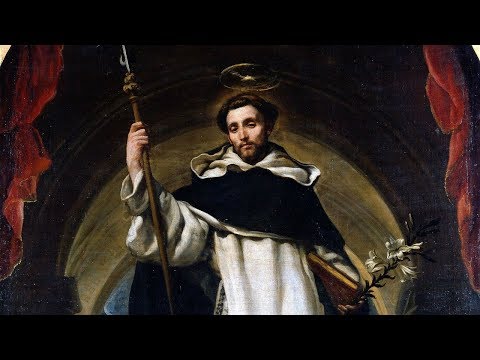
Saint Dominic is commonly depicted wearing the black-and-white habit of the Dominican Order. Traditional images may show him holding a book or lilies, accompanied by a dog carrying a burning torch, or associated with the Rosary.
He is traditionally invoked as a patron of astronomers and of the Order of Preachers.
More than eight centuries after his death, the mission that consumed Dominic's life continues: to contemplate the truth of Christ and then carry that truth into the world.
Saint Dominic, pray for us.

Come Grow With Us
Sign up and walk the Catholic journey with millions around the world.
Receive inspiring emails on saints, daily readings, and free faith-building resources—no cost, ever.
This 15-Second Video Will Change How You See Catholic Education.
Watch Now
- 7 Morning Prayers
- Mysteries of the Rosary
- Litany of the Bl. Virgin Mary
- Popular Saints
- Popular Prayers
- Female Saints
- Saint Feast Days by Month
- Stations of the Cross
- St. Francis of Assisi
- St. Michael the Archangel
- The Apostles' Creed
- Unfailing Prayer to St. Anthony
- Pray the Rosary






Copyright 2026 Catholic Online. All materials contained on this site, whether written, audible or visual are the exclusive property of Catholic Online and are protected under U.S. and International copyright laws, © Copyright 2026 Catholic Online. Any unauthorized use, without prior written consent of Catholic Online is strictly forbidden and prohibited.
Catholic Online is a Project of Your Catholic Voice Foundation, a Not-for-Profit Corporation. Your Catholic Voice Foundation has been granted a recognition of tax exemption under Section 501(c)(3) of the Internal Revenue Code. Federal Tax Identification Number: 81-0596847. Your gift is tax-deductible as allowed by law.