We ask you, urgently: don't scroll past this
Dear readers, Catholic Online was de-platformed by Shopify for our pro-life beliefs. They shut down our Catholic Online, Catholic Online School, Prayer Candles, and Catholic Online Learning Resources essential faith tools serving over 1.4 million students and millions of families worldwide. Our founders, now in their 70's, just gave their entire life savings to protect this mission. But fewer than 2% of readers donate. If everyone gave just $5, the cost of a coffee, we could rebuild stronger and keep Catholic education free for all. Stand with us in faith. Thank you.Help Now >
St. Polycarp of Smyrna
Facts
Patron: against earache, dysentery
Birth: 69
Death: 155
Author and Publisher - Catholic Online
Printable Catholic Saints PDFs
Shop St. Polycarp of Smyrna
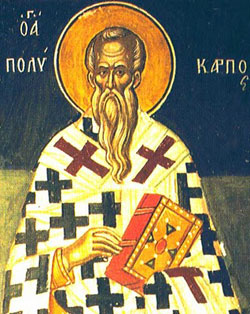
Bishop of Smyrna, martyr, and one of the foremost leaders of the Church in the second century. Few details of his life are extant with any reliability beyond his famous martyrdom, which was recounted in the Martyrium Polycarpi. It is believed, however, that he was converted to the faith by St. John the Evangelist about 80 A.D. and became bishop of Smyrna about 96 A.D. He was, as was his friend St. Ignatius of Antioch, one of the most important intermediary links between the apostolic and the patristic eras in the Church, especially in Christian Asia Minor. A defender of orthodoxy, he opposed such heretical groups as the Marcionites and Valentinians. He also authored a surviving epistle to the Philippians, exhorting them to remain strong in the faith. The letter is of great interest to scholars because it demonstrates the existence of New Testament texts, with quotes from Matthew and Luke, the Acts of the Apostles, and the first letters of Peter and John. When Ignatius was being taken to Rome to be put to death, he wrote of Polycarp being clothed “with the garment of grace." Polycarp was himself arrested by Roman officials in Smyrna soon after returning from a trip to Rome to discuss the date for Easter. He refused to abjure the faith, telling his captain that he had served Christ for eighty six years. The Romans burned him alive with twelve companions. The year of his death has been put at 155 or 156, although Eusebius of Caesarea places the year at 167 or 168, meaning it would have fallen in the reign of Marcus Aurelius. If so, changes in the year of his birth would be necessary. The most detailed account of his death was the Martyrium Polycarpi.

Come Grow With Us
Sign up and walk the Catholic journey with millions around the world.
Receive inspiring emails on saints, daily readings, and free faith-building resources—no cost, ever.
Sister Sara Has One Message for Every Catholic Family This June
- Easter / Lent
- 5 Lenten Prayers
- Ash Wednesday
- 7 Morning Prayers
- Mysteries of the Rosary
- Litany of the Bl. Virgin Mary
- Popular Saints
- Popular Prayers
- Female Saints
- Saint Feast Days by Month
- Stations of the Cross
- St. Francis of Assisi
- St. Michael the Archangel
- The Apostles' Creed
- Unfailing Prayer to St. Anthony
- Pray the Rosary









Copyright 2026 Catholic Online. All materials contained on this site, whether written, audible or visual are the exclusive property of Catholic Online and are protected under U.S. and International copyright laws, © Copyright 2026 Catholic Online. Any unauthorized use, without prior written consent of Catholic Online is strictly forbidden and prohibited.
Catholic Online is a Project of Your Catholic Voice Foundation, a Not-for-Profit Corporation. Your Catholic Voice Foundation has been granted a recognition of tax exemption under Section 501(c)(3) of the Internal Revenue Code. Federal Tax Identification Number: 81-0596847. Your gift is tax-deductible as allowed by law.