We ask you, humbly: don't scroll away.
Hi readers, it seems you use Catholic Online a lot; that's great! It's a little awkward to ask, but we need your help. If you have already donated, we sincerely thank you. We're not salespeople, but we depend on donations averaging $14.76 and fewer than 1% of readers give. If you donate just $5.00, the price of your coffee, Catholic Online School could keep thriving. Thank you.Help Now >
All Saints' Day

Learn More
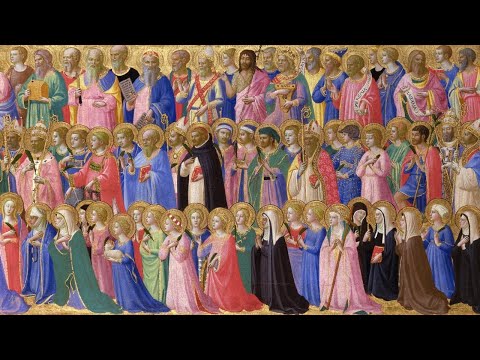
All Saints' Day is a solemn holy day of the Catholic Church celebrated annually on November 1. The day is dedicated to the saints of the Church, that is, all those who have attained heaven. It should not be confused with All Souls' Day, which is observed on November 2, and is dedicated to those who have died and not yet reached heaven.
Although millions, or even billions of people may already be saints, All Saints' Day observances tend to focus on known saints --that is those recognized in the canon of the saints by the Catholic Church.
All Saints' Day is also commemorated by members of the Eastern Orthodox Church as well as some protestant churches, such as Lutheran and Anglican churches.
Generally, All Saints' Day is a Catholic Holy Day of Obligation, meaning all Catholics are required to attend Mass on that day, unless they have an excellent excuse, such as serious illness.
Other countries have different rules according to their national bishop's conferences. The bishops of each conference have the authority to amend the rules surrounding the obligation of the day.
All Saints' Day was formally started by Pope Boniface IV, who consecrated the Pantheon at Rome to the Virgin Mary and all the Martyrs on May 13 in 609 AD. Boniface IV also established All Souls' Day, which follows All Saints.
The choice of the day may have been intended to co-opt the pagan holiday "Feast of the Lamures," a day which pagans used to placate the restless spirits of the dead.
The holy day was eventually established on November 1 by Pope Gregory III in the mid-eighth century as a day dedicated to the saints and their relics. The May 13 celebration was subsequently abandoned.
In Ireland, the Church celebrated All Saints' Day on April 20, to avoid associating the day with the traditional harvest festivals and pagan feasts associated with Samhain, celebrated at the same time.
Following the establishment of the Frankish Empire, and following the reign of Charlemagne, the holy day, which was already celebrated on November 1, became a holy day of obligation by decree of Pope Gregory IV and Louis the Pious, who was king over a portion of Charlemagne's former empire.
Following the Protestant Reformation, many Protestants retained the holy day, although they dismissed the need to pray for the dead. Instead, the day has been used to commemorate those who have recently died, usually in the past year, and to remember the examples of those who lived holy lives.
The Catholic practice however, celebrates all those who have entered heaven, including saints who are recognized by the Church and those who are not.
Holy day customs vary around the world. In the United States, the day before is Halloween and is usually celebrated by dressing in costumes with themes of death commonly associated. Children go door-to-door in costume, trick-or-treating, that is soliciting candy from their neighbors. The holiday has lost much of its connection to its religious origins.
Although nearly everyone celebrates Halloween for the fun of the secular holiday, the following religious solemnity, is not widely practiced or acknowledged by most Americans unless they are Catholic.
In other countries, such as Portugal, Spain and Mexico, traditional practices include performance of the play, "Don Juan Tenorio" and offerings made to the dead. All Saints' Say occurs on the same day as the Mexican "Dide los Innocentes" a day dedicated to deceased children.
Across much of Europe, the day is commemorated with offerings of flowers left on the graves of the dead. In Eastern Europe, candles are lit on graves instead of offerings of flowers.
In some places, such as the Philippines, graves can be painted and repaired by family members. Many of these practices blur the distinction between All Saints' Day and All Souls' Day.
We ask you, humbly: don't scroll away.
Hi readers, it seems you use Catholic Online a lot; that's great! It's a little awkward to ask, but we need your help. If you have already donated, we sincerely thank you. We're not salespeople, but we depend on donations averaging $14.76 and fewer than 1% of readers give. If you donate just $5.00, the price of your coffee, Catholic Online School could keep thriving. Thank you.Help Now >
These celebrations often blur the distinction between All Saints' Day, which is properly dedicated to those who are in heaven, and All Souls' Day, on which prayers are offered for all those who have died, but have not yet reached heaven.
In Mexico, the Day of the Dead holy days extend from October 31 through November 2.
It is important to remember these basic facts:
Halloween is a secular holiday that comes the night before All Saints' Day.
All Saints' Day is on November 1, and it is a Holy Day of Obligation.
All Souls' Day in on November 2, and it is NOT a Holy Day of Obligation.
The Day of the Dead is a Mexican holiday that has spread in popularity into parts of the United States and across Latin America. It is celebrated from October 31 through November 2, to coincide with both the American tradition and the Catholic holy days. Those three days are dedicated to all of the dead.to all of the dead.
More about All Saints' Day from Wikipedia
All Saints' Day (in the Roman Catholic Church officially the Solemnity of All Saints and also called All Hallows or Hallowmas[1]), often shortened to All Saints, is a solemnity celebrated on 1 November by parts of Western Christianity, and on the first Sunday after Pentecost in Eastern Christianity, in honor of all the saints, known and unknown.
In Western Christian theology, the day commemorates all those who have attained the beatific vision in Heaven. It is a national holiday in many historically Catholic countries. In the Roman Catholic Church, the next day, All Souls' Day, specifically commemorates the departed faithful who have not yet been purified and reached heaven. Catholics celebrate All Saints' Day and All Souls' Day in the fundamental belief that there is a prayerful spiritual communion between those in the state of grace who have died and are either being purified in purgatory or are in heaven (the 'church penitent' and the 'church triumphant', respectively), and the 'church militant' who are the living. Other Christian traditions define, remember and respond to the saints in different ways.
In the East
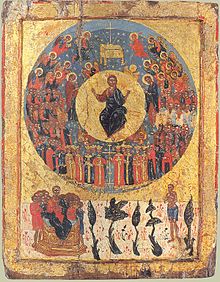 Eastern Orthodox icon of All Saints. Christ is enthroned in heaven surrounded by the ranks of angels and saints. At the bottom is Paradise with the bosom of Abraham (left), and the Good Thief (right).
Eastern Christians of the Byzantine Tradition follow the earlier tradition of commemorating all saints collectively on the first Sunday after Pentecost, All Saints' Sunday.

The feast of All Saints achieved great prominence in the ninth century, in the reign of the Byzantine Emperor, Leo VI "the Wise" (886.911). His wife, Empress Theophano.commemorated on December 16.lived a devout life. After her death in 893,[2] her husband built a church, intending to dedicate it to her. When he was forbidden to do so, he decided to dedicate it to "All Saints," so that if his wife were in fact one of the righteous, she would also be honored whenever the feast was celebrated.[3] According to tradition, it was Leo who expanded the feast from a commemoration of All Martyrs to a general commemoration of All Saints, whether martyrs or not.
This Sunday marks the close of the Paschal season. To the normal Sunday services are added special scriptural readings and hymns to all the saints (known and unknown) from the Pentecostarion.
The Sunday following All Saints' Sunday.the second Sunday after Pentecost.is set aside as a commemoration of all locally venerated saints, such as "All Saints of America", "All Saints of Mount Athos", etc. The third Sunday after Pentecost may be observed for even more localized saints, such as "All Saints of St. Petersburg", or for saints of a particular type, such as "New Martyrs of the Turkish Yoke."
In addition to the Sundays mentioned above, Saturdays throughout the year are days for general commemoration of all saints, and special hymns to all saints are chanted from the Octoechos.
In the West
The Western Christian holiday of All Saints' Day falls on November 1, followed by All Souls' Day on November 2, and is a Holy Day of Obligation in the Latin Rite of the Catholic Church.
The origin of the festival of All Saints celebrated in the West dates to May 13, 609 or 610, when Pope Boniface IV consecrated the Pantheon at Rome to the Blessed Virgin and all the martyrs; the feast of the dedicatio Sanctae Mariae ad Martyres has been celebrated at Rome ever since. There is evidence that from the fifth through the seventh centuries there existed in certain places and at sporadic intervals a feast date 13 May to celebrate the holy martyrs.[4] The origin of All Saints' Day cannot be traced with certainty, and it has been observed on various days in different places. However, there are some who maintain the belief that it has origins in the pagan observation of 13 May, the Feast of the Lemures, in which the malevolent and restless spirits of the dead were propitiated. Liturgiologists base the idea that this Lemuria festival was the origin of that of All Saints on their identical dates and on the similar theme of "all the dead".[5]

The feast of All Saints, on its current date, is traced to the foundation by Pope Gregory III (731.741) of an oratory in St. Peter's for the relics "of the holy apostles and of all saints, martyrs and confessors, of all the just made perfect who are at rest throughout the world", with the day moved to 1 November and the 13 May feast suppressed.[6]
This usually fell within a few weeks of the Celtic holiday of Samhain, which had a theme similar to the Roman festival of Lemuria, but which was also a harvest festival. The Irish, having celebrated Samhain in the past, did not celebrate All Hallows Day on this November 1 date, as extant historical documents attest that the celebration in Ireland took place in the spring: "...the Felire of Oengus and the Martyrology of Tallaght prove that the early medieval churches [in Ireland] celebrated the feast of All Saints on April 20."[7]
A November festival of all the saints was already widely celebrated on November 1 in the days of Charlemagne. It was made a day of obligation throughout the Frankish empire in 835, by a decree of Louis the Pious, issued "at the instance of Pope Gregory IV and with the assent of all the bishops", which confirmed its celebration on November 1. The octave was added by Pope Sixtus IV (1471.1484).[8]
The festival was retained after the Reformation in the calendar of the Anglican Church and in many Lutheran churches. In the Lutheran churches, such as the Church of Sweden, it assumes a role of general commemoration of the dead. In the Swedish calendar, the observance takes place on the Saturday between October 31 and November 6. In many Lutheran Churches, it is moved to the first Sunday of November. It is also celebrated by other Protestants of the English tradition, such as the United Church of Canada, the Methodist churches, and the Wesleyan Church.[9]
Protestants generally regard all true Christian believers as saints and if they observe All Saints Day at all they use it to remember all Christians both past and present. In the United Methodist Church, All Saints' Day is celebrated on the first Sunday in November. It is held, not only to remember Saints, but also to remember all those that have died that were members of the local church congregation.[10] In some congregations, a candle is lit by the Acolyte as each person's name is called out by the clergy. Prayers and responsive readings may accompany the event. Often, the names of those who have died in the past year are afixed to a memorial plaque.
In many Lutheran churches, All Saints' Day and Reformation Day are observed concurrently on the Sunday before or after those dates, given Reformation Day is observed in Protestant Churches on October 31. Typically, Martin Luther's A Mighty Fortress is Our God is sung during the service. Besides discussing Luther's role in the Protestant Reformation, some recognition of the prominent early leaders of the Reformed tradition, such as John Calvin and John Knox, occurs. The observance of Reformation Day may be immediately followed by a reading of those members of the local congregation who have died in the past year in observance of All Saints' Day. Otherwise, the recognition of deceased church members occurs at another designated portion of the service.
Roman Catholic Obligation
In the Roman Catholic Church, All Saints' Day is a Holy Day of Obligation in many (but not all) countries, meaning going to Mass on the date is required unless one has a good reason to be excused from that obligation, such as illness. However, in a number of countries that do list All Saints' Day as a Holy Day of Obligation, including England & Wales, the solemnity of All Saints' Day is transferred to the adjacent Sunday if 1 November falls on a Monday or a Saturday, while in the same circumstances in the United States the Solemnity is still celebrated on November 1 but the obligation to attend Mass is abrogated.
Customs
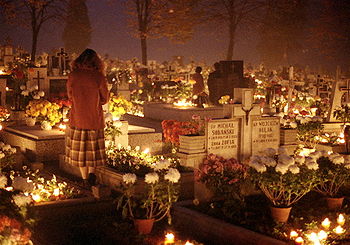 All Saints' Day at a cemetery in O.wi.cim, Poland, 1 November 1984
In Portugal, Spain, and Mexico, offerings (Portuguese: oferendas, Spanish: ofrendas) are made on this day. In Spain, the play Don Juan Tenorio is traditionally performed. In Mexico, All Saints Day coincides with the celebration of "DĂde los Inocentes" (Day of the Innocents), the first day of the Day of the Dead (Dia de los Muertos) celebration, honoring deceased children and infants. In Portugal, children celebrate the PĂŁpor-Deus tradition, and go door to door where they receive cakes, nuts and pomegranates. This only occurs in some areas around Lisbon.
In Austria, Belgium, France, Hungary, Italy, Luxembourg, Malta, Portugal, Spain, and American Cities such as New Orleans people take flowers to the graves of dead relatives.
In Poland, the Czech Republic, Sweden, Finland, Slovenia, Slovakia, Lithuania, Croatia, Austria, Romania, Moldova, Hungary and Catholic parts of Germany, the tradition is to light candles and visit the graves of deceased relatives.
In the Philippines, this day, called "Undas", "Todos los Santos" (literally "All Saints"), and sometimes "Araw ng mga Patay" (approximately "Day of the dead") is observed as All Souls' Day. This day and the one before and one after it is spent visiting the graves of deceased relatives, where prayers and flowers are offered, candles are lit and the graves themselves are cleaned, repaired and repainted.
In English-speaking countries, the festival is traditionally celebrated with the hymn "For All the Saints" by William Walsham How. The most familiar tune for this hymn is Sine Nomine by Ralph Vaughan Williams. Catholics generally celebrate with a day of rest consisting of avoiding physical exertion.
Notes
- ^ "Hallows" meaning "saints," and "mas" meaning "Mass"; the preceding evening (Halloween) is the "Vigil or Eve of All Hallows".
- ^ The date in Vita Euthymii, not printed until 1888 "makes it seem practically (though not absolutely) certain that she died on 10 Nov. 893". Glanville Downey, "The Church of All Saints (Church of St. Theophano) near the Church of the Holy Apostles at Constantinople" Dumbarton Oaks Papers, Vol. 9/10, (1956:301-305).
- ^ Downey 1956.
- ^ C. Smith The New Catholic Encyclopedia 1967: s.v. "Feast of All Saints", p. 318.
- ^ For example, Violet Alford ("The Cat Saint", Folklore 52.3 [September 1941:161-183] p. 181 note 56) observes that "Saints were often confounded with the Lares or Dead. Repasts for both were prepared in early Christian times, and All Saints' Day was transferred in 835 to November 1st from one of the days in May which were the old Lemuralia"; Alford notes Pierre Saintyves, Les saints successeurs des dieux, Paris 1906 (sic, i.e. 1907).
- ^ "All Saints Day," The Oxford Dictionary of the Christian Church, 3rd edition, ed. E. A. Livingstone (Oxford: Oxford University Press, 1997), 41-42; The New Catholic Encyclopedia, eo.loc.
- ^ Hutton, Ronald (1996). Stations of the Sun: A History of the Ritual Year in Britain. New York: Oxford Paperbacks. ISBNÂ 0-19-285448-8.
- ^ The Catholic Encyclopedia (New York, Robert Appleton Company, 1907), s.v. "All Saints' Day" (see External links, below).
- ^ Religions in Canada
- ^ [1][dead link]
- ^ "New Orleans Saints FAQ", NewOrleansSaints.com, March 2010, NOLA-S-FAQ.
 Hi readers, it seems you use Catholic Online a lot; that's great! It's a little awkward to ask, but we need your help. If you have already donated, we sincerely thank you. We're not salespeople, but we depend on donations averaging $14.76 and fewer than 1% of readers give. If you donate just $5.00, the price of your coffee, Catholic Online School could keep thriving. Thank you. Help Now >
Join the Movement
When you sign up below, you don't just join an email list - you're joining an entire movement for Free world class Catholic education.


-

-
Mysteries of the Rosary
-
St. Faustina Kowalska
-
Litany of the Blessed Virgin Mary
-
Saint of the Day for Wednesday, Oct 4th, 2023
-
Popular Saints
-
St. Francis of Assisi
-
Bible
-
Female / Women Saints
-
7 Morning Prayers you need to get your day started with God
-
Litany of the Blessed Virgin Mary


Sacrifices of Faith: The Pro-Life Legacies of St. Gianna and Jessica Hanna
-
How to love God by caring for our bodies
-
Pope Francis calls for negotiations to End Russia-Ukraine War
-
Pope Francis Contemplates Return to U.S. for United Nations Assembly Address
-
Pope Francis Calls on Faithful to Embrace Faith, Hope, and Charity in New Teaching Series


Daily Catholic
- Daily Readings for Saturday, April 27, 2024
- St. Zita: Saint of the Day for Saturday, April 27, 2024
- Prayer for the Dead # 2: Prayer of the Day for Saturday, April 27, 2024
- Daily Readings for Friday, April 26, 2024
- St. Cletus: Saint of the Day for Friday, April 26, 2024
- Prayer before the Closing of the Day: Prayer of the Day for Friday, April 26, 2024
 Daily Readings for Saturday, April 27, 2024
 St. Zita: Saint of the Day for Saturday, April 27, 2024
 Prayer for the Dead # 2: Prayer of the Day for Saturday, April 27, 2024
We ask you, humbly: don't scroll away.
Hi readers, it seems you use Catholic Online a lot; that's great! It's a little awkward to ask, but we need your help. If you have already donated, we sincerely thank you. We're not salespeople, but we depend on donations averaging $14.76 and fewer than 1% of readers give. If you donate just $5.00, the price of your coffee, Catholic Online School could keep thriving. Thank you.Help Now >

Copyright 2024 Catholic Online. All materials contained on this site, whether written, audible or visual are the exclusive property of Catholic Online and are protected under U.S. and International copyright laws, © Copyright 2024 Catholic Online. Any unauthorized use, without prior written consent of Catholic Online is strictly forbidden and prohibited.
Catholic Online is a Project of Your Catholic Voice Foundation, a Not-for-Profit Corporation. Your Catholic Voice Foundation has been granted a recognition of tax exemption under Section 501(c)(3) of the Internal Revenue Code. Federal Tax Identification Number: 81-0596847. Your gift is tax-deductible as allowed by law.