Because of You, 2.2 Million Students Are Being Formed in the Faith
Because of generous supporters like you, Catholic Online School has already delivered free, faithful Catholic education to over 2.2 million students across 193 countries. In an age of noise and algorithms, you are helping form souls with truth, prayer, Scripture, and Christ.
If everyone who reads this gave just $5 — the cost of a coffee — we could reach even more families and keep this life-changing formation free for all. Be Courageous. Be Catholic. Stand with us today.
DONATE TODAY >St. Sabas of Serbia
Facts
Patron: of Serbian schools
Birth: 1174
Death: 1236
Author and Publisher - Catholic Online
Printable Catholic Saints PDFs
Shop St. Sabas of Serbia
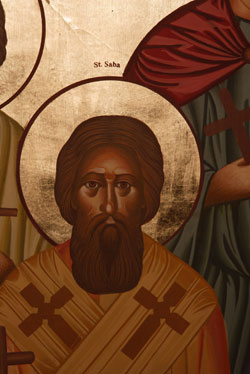
The son of a Serbian king who was also a saint, St. Sabas was born Rastko c. 1173/ 76; at 17, to avoid marriage, he fled to Mt. Athos, where he became a monk and founded the Hilander Monastery. In 1196, King Stephen I of Serbia abdicated, and taking the name Symeon, joined his son on Mt. Athos. Symeon died three years later, and Sabas, Archbishop of Serbia, translated his father's relics to their native land in 1208. Sabas wrote a history of his father's reign and a service to his father, the earliest known Serbian hynmography in Church Slavonic. Sabas copied books of law and compiled the Nomocanon, a book of canon laws. He was responsible for having liturgical documents translated from Greek into Serbian and for compiling two Serbian Typica. Because of his experience with Roman bishops and leaders on Athos after the Venetian sack of Constantinople in 1204, Sabas opposed the pro-Roman policies of his brother, Stephen II, the only Serbian king crowned by a pope. From 1217- 1219/ 20, Sabas was in exile, during which he persuaded the patriarch of Constantinople to grant the Serbian and Bulgarian churches autocephaly. When he returned to Serbia, he recrowned his brother. Sabas resigned as archbishop in 1230 /33 and travelled to the Holy Land, where he visited monasteries at Sketis, the Thebiad, and Mt. Sinai. He died in Bulgaria on his trip back from the Holy Land c. 1235/ 1237 King Ladislas of Serbia translated the relics of St. Sabas to Milesevo, a monastery the saint had founded shortly before his death. The Turks burned the relics in 1594.
Come Grow With Us
Sign up and walk the Catholic journey with millions around the world.
Receive inspiring emails on saints, daily readings, and free faith-building resources—no cost, ever.
Sister Sara Has One Message for Every Catholic Family This June
- 7 Morning Prayers
- Mysteries of the Rosary
- Litany of the Bl. Virgin Mary
- Popular Saints
- Popular Prayers
- Female Saints
- Saint Feast Days by Month
- Stations of the Cross
- St. Francis of Assisi
- St. Michael the Archangel
- The Apostles' Creed
- Unfailing Prayer to St. Anthony
- Pray the Rosary





Copyright 2026 Catholic Online. All materials contained on this site, whether written, audible or visual are the exclusive property of Catholic Online and are protected under U.S. and International copyright laws, © Copyright 2026 Catholic Online. Any unauthorized use, without prior written consent of Catholic Online is strictly forbidden and prohibited.
Catholic Online is a Project of Your Catholic Voice Foundation, a Not-for-Profit Corporation. Your Catholic Voice Foundation has been granted a recognition of tax exemption under Section 501(c)(3) of the Internal Revenue Code. Federal Tax Identification Number: 81-0596847. Your gift is tax-deductible as allowed by law.