St. Ansgar
Facts
Patron: of Scandinavia
Birth: 801
Death: 865
Author and Publisher - Catholic Online
Printable Catholic Saints PDFs
Shop St. Ansgar
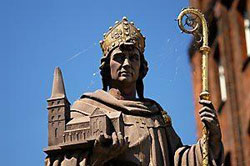
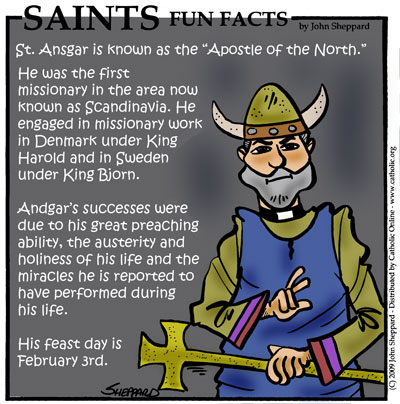
Ansgar was born of a noble family near Amiens. He became a monk at Old Corbie monastery in Picardy and later at New Corbie in Westphalia. He accompanied King Harold to Denmark when the exiled King returned to his native land and engaged in missionary work there. Ansgar's success caused King Bjorn of Sweden to invite him to that country, and he built the first Christian Church in Sweden. He became Abbot of New Corbie and first Archbishop of Hamburg about 831, and Pope Gregory IV appointed him Legate to the Scandinavian countries. He labored at his missionary works for the next fourteen years but saw all he had accomplished destroyed when invading pagan Northmen in 845 destroyed Hamburg and overran the Scandinavian countries, which lapsed into paganism. He was appointed first Archbishop of Bremen about 848, and the See was united with that of Hamburg by Pope Nicholas I. Ansgar again returned to Denmark and Sweden in 854 and resumed his missionary activities, converting Erik, King of Jutland. Ansgar's success was due to his great preaching ability, the austerity and holiness of his life, and the miracles he is reputed to have performed. Though called "the Apostle of the North" and the first Christian missionary in Scandinavia, the whole area lapsed into paganism again after his death at Bremen on February 3rd. His name is also spelled Anskar.
Come Grow With Us
Sign up and walk the Catholic journey with millions around the world.
Receive inspiring emails on saints, daily readings, and free faith-building resources—no cost, ever.
URGENT: Catholic Online School needs your help NOW.
- 7 Morning Prayers
- Mysteries of the Rosary
- Litany of the Bl. Virgin Mary
- Popular Saints
- Popular Prayers
- Female Saints
- Saint Feast Days by Month
- Stations of the Cross
- St. Francis of Assisi
- St. Michael the Archangel
- The Apostles' Creed
- Unfailing Prayer to St. Anthony
- Pray the Rosary






Copyright 2026 Catholic Online. All materials contained on this site, whether written, audible or visual are the exclusive property of Catholic Online and are protected under U.S. and International copyright laws, © Copyright 2026 Catholic Online. Any unauthorized use, without prior written consent of Catholic Online is strictly forbidden and prohibited.
Catholic Online is a Project of Your Catholic Voice Foundation, a Not-for-Profit Corporation. Your Catholic Voice Foundation has been granted a recognition of tax exemption under Section 501(c)(3) of the Internal Revenue Code. Federal Tax Identification Number: 81-0596847. Your gift is tax-deductible as allowed by law.
