 Dear readers, Catholic Online was de-platformed by Shopify for our pro-life beliefs. They shut down our Catholic Online, Catholic Online School, Prayer Candles, and Catholic Online Learning Resources essential faith tools serving over 1.4 million students and millions of families worldwide. Our founders, now in their 70's, just gave their entire life savings to protect this mission. But fewer than 2% of readers donate. If everyone gave just $5, the cost of a coffee, we could rebuild stronger and keep Catholic education free for all. Stand with us in faith. Thank you. Help Now >
St. Daniel the Stylite
Facts
Author and Publisher - Catholic Online
Printable Catholic Saints PDFs
Shop St. Daniel the Stylite
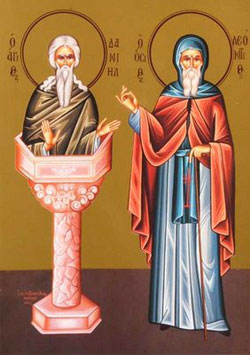
St. Daniel, the Stylite, Priest. Feast day is December 11. Daniel was born in Maratha, Syria in 409 and became a monk in nearby Samosata on the Upper Euphrates. He learned of St. Simeon Stylites the Elder, living on a pillar at Antioch and got to see him twice. At the age of forty-two, Daniel decided that he too wanted to become a stylite (from the Greek word "stylos", meaning pillar) and live on a pillar at a spot near Constantinople. Therefore, Emperor Leo I, built a series of pillars with a platform on top for him, and Daniel was ordained there by St. Gennadius. The saint quickly became an attraction for the people. He celebrated the Eucharist on his pillar, preached sermons, dispensed spiritual advice, and cured the sick who were brought up to him. He also gave prudent counsel to Emperors Leo and Zeno and the patriarch of Constantinople. All the while, Daniel lived his particular type of pillar spirituality. He came down from his perch only once in thirty-three years - to turn Emperor Baliscus away from backing the heresy of Monophysitism. Daniel died in 493 and became the best known Stylite after St. Simeon Stylites the Elder. The life of St. Daniel the Stylite is an apt reminder that there are many ways to live the spiritual life. All of us have our own way to be close to God every day. Our task is to find that way and follow it to the very end.
Come Grow With Us
Sign up and walk the Catholic journey with millions around the world.
Receive inspiring emails on saints, daily readings, and free faith-building resources—no cost, ever.
Sister Sara just dropped the truth about the future of Catholic education… and It’s Not What You Think
- Easter / Lent
- 5 Lenten Prayers
- Ash Wednesday
- 7 Morning Prayers
- Mysteries of the Rosary
- Litany of the Bl. Virgin Mary
- Popular Saints
- Popular Prayers
- Female Saints
- Saint Feast Days by Month
- Stations of the Cross
- St. Francis of Assisi
- St. Michael the Archangel
- The Apostles' Creed
- Unfailing Prayer to St. Anthony
- Pray the Rosary







Copyright 2026 Catholic Online. All materials contained on this site, whether written, audible or visual are the exclusive property of Catholic Online and are protected under U.S. and International copyright laws, © Copyright 2026 Catholic Online. Any unauthorized use, without prior written consent of Catholic Online is strictly forbidden and prohibited.
Catholic Online is a Project of Your Catholic Voice Foundation, a Not-for-Profit Corporation. Your Catholic Voice Foundation has been granted a recognition of tax exemption under Section 501(c)(3) of the Internal Revenue Code. Federal Tax Identification Number: 81-0596847. Your gift is tax-deductible as allowed by law.