New Year's Day
FREE Catholic Classes
The word year is etymologically the same as hour (Skeat), and signifies a going, movement etc. In Semitic, the word for "year" signifies repetition, sc. of the course of the sun (Gesenius). Since there was no necessary starting-point in the circle of the year, we find among different nations, and among the same at different epochs of their history, a great variety of dates with which the new year began. The opening of spring was a natural beginning, and in the Bible itself there is a close relationship between the beginning of the year and the seasons. The ancient Roman year began in March, but Julius Caesar, in correcting the calendar (46 B.C.), made January the first month. Though this custom has been universally adopted among Christian nations, the names, September, October, November, and December (i.e., the seventh, eight, ninth, and tenth), remind us of the past, when March began the year. Christian writers and councils condemned the heathen orgies and excesses connected with the festival of the Saturnalia , which were celebrated at the beginning of the year: Tertullian blames Christians who regarded the customary presents -- called strenae (Fr. étrennes ) from the goddess Strenia, who presided over New Year's Day (cf. Ovid, Fasti , 185-90) -- as mere tokens of friendly intercourse (De Idol. xiv), and towards the end of the sixth century the Council of Auxerre (can. I) forbade Christians strenas diabolicas observare . The II Council of Tours held in 567 (can. 17) prescribes prayers and a Mass of expiation for New Year's Day, adding that this is a practice long in use ( patres nostri statuerunt ). Dances were forbidden, and pagan crimes were to be expiated by Christian fasts (St. Augustine, Serm., cxcvii-viii in P.L., XXXVIII, 1024; Isidore of Seville , De Div. Off. Eccl. , I, xli; Trullan Council, 692, can. lxii). When Christmas was fixed on 25 Dec., New Year's Day was sanctified by commemorating on it the Circumcision, for which feast the Gelasian Sacramentary gives a Mass ( In Octabas Domini ). Christians did not wish to make the celebration of this feast very solemn, lest they might seem to countenance in any way the pagan extravagance of the opening year.
Among the Jews the first day of the seventh month, Tishri (end of September), began the civil or economic year with the sound of trumpets ( Leviticus 23:24 ; Numbers 29:1 ). In the Bible the day is not mentioned as New Year's Day, but the Jews so regarded it, so named it, and so consider it now (Mishnah, Rosh Hash., I, 1). The sacred year began with Nisan (early in April), a later name for the Biblical abhibh , i.e. "month of new corn", and was memorable because in this month the Lord thy God brought thee out of Egypt by night ( Deuteronomy 16:1 ). Barley ripens in Palestine during the early part of April; and thus the sacred year began with the harvest, the civil year with the sowing of the crops. From Biblical data Josephus and many modern scholars hold that the twofold beginning of the year was pre-exilic, or even Mosaic (cf. Antiq. , I, iii, 3). Since Jewish months were regulated by the moon, while the ripening barley of Nisan depended upon the sun, the Jews resorted to intercalation to bring sun and moon dates into harmony, and to keep the months in the seasons to which they belonged (for method of adjustment, see Edersheim, The Temple, Its Ministry and Services at the Time of Jesus Christ , x).
Christian nations did not agree in the date of New Year's Day. They were not opposed to 1 January as the beginning of the year, but rather to the pagan extravagances which accompanied it. Evidently the natural opening of the year, the springtime, together with the Jewish opening of the sacred year, Nisan, suggested the propriety of putting the beginning in that beautiful season. Also, the Dionysian method (so named from the Abbot Dionysius, sixth century) of dating events from the coming of Christ became an important factor in New Year calculations. The Annunciation, with which Dionysius began the Christian era, was fixed on 25 March, and became New Year's Day for England, in early times and from the thirteenth century to 1 Jan., 1752, when the present custom was introduced there. Some countries (e.g., Germany ) began with Christmas, thus being almost in harmony with the ancient Germans, who made the winter solstice their starting-point. Notwithstanding the movable character of Easter, France and the Low Countries took it as the first day of the year, while Russia, up to the eighteenth century, made September the first month. The western nations, however, since the sixteenth, or, at the latest, the eighteenth century, have adopted and retained the first of January. In Christian liturgy the Church does not refer to the first of the year, any more than she does to the fact that the first Sunday of Advent is the first day of the ecclesiastical year.

In the United States of America the great feast of the Epiphany has ceased to be a holyday of obligation, but New Year continues in force. Since the mysteries of the Epiphany are commemorated on Christmas -- the Orientals consider the fests one and the same in import -- it was thought advisable to retain by preference, under the title Circumcision of Our Lord Jesus Christ , New Year's Day as one of the six feast of obligation. The Fathers of the Third Plenary Council of Baltimore petitioned Rome to this effect, and their petition was granted (Con. Plen. Balt., III, pp. 105 sqq.). (See CHRONOLOGY; CHRISTMAS.).
 Hi readers, it seems you use Catholic Online a lot; that's great! It's a little awkward to ask, but we need your help. If you have already donated, we sincerely thank you. We're not salespeople, but we depend on donations averaging $14.76 and fewer than 1% of readers give. If you donate just $5.00, the price of your coffee, Catholic Online School could keep thriving. Thank you. Help Now >
We ask you, humbly: don't scroll away.
Hi readers, it seems you use Catholic Online a lot; that's great! It's a little awkward to ask, but we need your help. If you have already donated, we sincerely thank you. We're not salespeople, but we depend on donations averaging $14.76 and fewer than 1% of readers give. If you donate just $5.00, the price of your coffee, Catholic Online School could keep thriving. Thank you.Help Now >
Join the Movement
When you sign up below, you don't just join an email list - you're joining an entire movement for Free world class Catholic education.


-

-
Mysteries of the Rosary
-
St. Faustina Kowalska
-
Litany of the Blessed Virgin Mary
-
Saint of the Day for Wednesday, Oct 4th, 2023
-
Popular Saints
-
St. Francis of Assisi
-
Bible
-
Female / Women Saints
-
7 Morning Prayers you need to get your day started with God
-
Litany of the Blessed Virgin Mary


Sacrifices of Faith: The Pro-Life Legacies of St. Gianna and Jessica Hanna
-
How to love God by caring for our bodies
-
Pope Francis calls for negotiations to End Russia-Ukraine War
-
Pope Francis Contemplates Return to U.S. for United Nations Assembly Address
-
Pope Francis Calls on Faithful to Embrace Faith, Hope, and Charity in New Teaching Series


Daily Catholic
- Daily Readings for Monday, April 29, 2024
- St. Catherine of Siena: Saint of the Day for Monday, April 29, 2024
- Prayer for the Dead # 3: Prayer of the Day for Monday, April 29, 2024
- Daily Readings for Sunday, April 28, 2024
- St. Peter Chanel: Saint of the Day for Sunday, April 28, 2024
- Prayer before a Crucifix: Prayer of the Day for Sunday, April 28, 2024
 Daily Readings for Monday, April 29, 2024
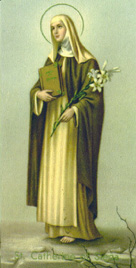 St. Catherine of Siena: Saint of the Day for Monday, April 29, 2024
 Prayer for the Dead # 3: Prayer of the Day for Monday, April 29, 2024


Copyright 2024 Catholic Online. All materials contained on this site, whether written, audible or visual are the exclusive property of Catholic Online and are protected under U.S. and International copyright laws, © Copyright 2024 Catholic Online. Any unauthorized use, without prior written consent of Catholic Online is strictly forbidden and prohibited.
Catholic Online is a Project of Your Catholic Voice Foundation, a Not-for-Profit Corporation. Your Catholic Voice Foundation has been granted a recognition of tax exemption under Section 501(c)(3) of the Internal Revenue Code. Federal Tax Identification Number: 81-0596847. Your gift is tax-deductible as allowed by law.