Because of You, 2.2 Million Students Are Being Formed in the Faith
Because of generous supporters like you, Catholic Online School has already delivered free, faithful Catholic education to over 2.2 million students across 193 countries. In an age of noise and algorithms, you are helping form souls with truth, prayer, Scripture, and Christ.
If everyone who reads this gave just $5 — the cost of a coffee — we could reach even more families and keep this life-changing formation free for all. Be Courageous. Be Catholic. Stand with us today.
DONATE TODAY >St. Francis Borgia

Facts
Patron: against earthquakes; Portugal; Rota, Marianas
Birth: 1510
Death: 1572
Author and Publisher - Catholic Online
Printable Catholic Saints PDFs
Shop St. Francis Borgia
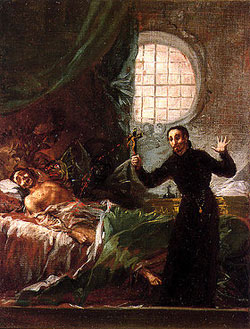
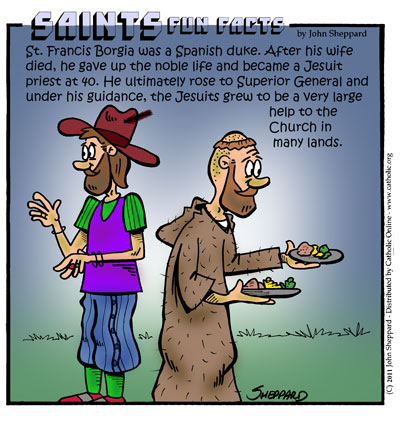
Francis was a young nobleman at the court of the King of Spain. He became a Duke when he was only thirty-three and lived a happy, peaceful life with his wife Eleanor and their eight children. But unlike so many other powerful nobles, Francis was a perfect Christian gentleman, a true man of God and his great joy was to receive Holy Communion often. This happy life ended when his beloved wife died. Francis did something that astonished all the nobles of Spain; he gave up his Dukedom to his son Charles and became a Jesuit priest. So many people came to his first Mass that they had to set up an altar outdoors, but his Superior tested him by treating him in exactly the opposite way he had been used to all his forty-one years of life. He who had once been a Duke had to help the cook, carrying wood for the fire and sweeping the kitchen. When he served food to the priests and brothers, he had to kneel down in front of them all and beg them to forgive him for being so clumsy! Still he never once complained or grumbled. The only time he became angry was when anyone treated him with respect as if he was still a Duke. Once a doctor who had to take care of a painful wound Francis had gotten said to him: "I am afraid, my lord, that I have to hurt your grace." The saint answered that he would not hurt him more than he was right then by calling him "my lord" and "your grace." It was not too long before the humble priest accomplished wonderful works for God's glory as he preached everywhere and advised many important people. He spread the Society of Jesus all over Spain and in Portugal. When he was made Superior General of the Jesuits, he sent missionaries all over the world. Under his guidance, the Jesuits grew to be a very great help to the Church in many lands. Through all such success, St. Francis Borgia remained completely humble. His feast day is October 10.
Come Grow With Us
Sign up and walk the Catholic journey with millions around the world.
Receive inspiring emails on saints, daily readings, and free faith-building resources—no cost, ever.
This could change the future of Catholic Online.
Watch Now
- 7 Morning Prayers
- Mysteries of the Rosary
- Litany of the Bl. Virgin Mary
- Popular Saints
- Popular Prayers
- Female Saints
- Saint Feast Days by Month
- Stations of the Cross
- St. Francis of Assisi
- St. Michael the Archangel
- The Apostles' Creed
- Unfailing Prayer to St. Anthony
- Pray the Rosary








Copyright 2026 Catholic Online. All materials contained on this site, whether written, audible or visual are the exclusive property of Catholic Online and are protected under U.S. and International copyright laws, © Copyright 2026 Catholic Online. Any unauthorized use, without prior written consent of Catholic Online is strictly forbidden and prohibited.
Catholic Online is a Project of Your Catholic Voice Foundation, a Not-for-Profit Corporation. Your Catholic Voice Foundation has been granted a recognition of tax exemption under Section 501(c)(3) of the Internal Revenue Code. Federal Tax Identification Number: 81-0596847. Your gift is tax-deductible as allowed by law.
