We ask you, urgently: don't scroll past this
Dear readers, Catholic Online was de-platformed by Shopify for our pro-life beliefs. They shut down our Catholic Online, Catholic Online School, Prayer Candles, and Catholic Online Learning Resources essential faith tools serving over 1.4 million students and millions of families worldwide. Our founders, now in their 70's, just gave their entire life savings to protect this mission. But fewer than 2% of readers donate. If everyone gave just $5, the cost of a coffee, we could rebuild stronger and keep Catholic education free for all. Stand with us in faith. Thank you.Help Now >
St. Braulio
Facts
Patron: of Aragon
Birth: 590
Death: 651
Author and Publisher - Catholic Online
Printable Catholic Saints PDFs
Shop St. Braulio
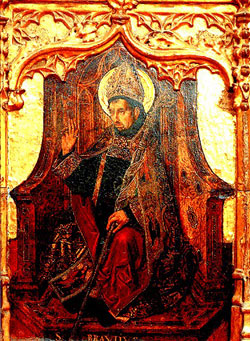
ST BRAULIO, BISHOP OF SARAGOSSA (A.D. 651) At the college founded in Seville by St Isidore, one of the more promising of the alumni was a boy of noble birth called Braulio, who grew up to be so eminent a scholar that Isidore regarded him as a friend and disciple rather than a pupil, and used to send him his own writings to correct and revise. Braulio prepared for the priesthood and was ordained, and when in 631 the see of Saragossa became vacant at the death of his brother Bishop John, the neighbouring prelates assembled to elect a successor and their choice fell upon Braulio. As a pastor, St Braulio laboured zealously to teach and encourage his people, and at the same time to extirpate the Arian heresy which continued to flourish even after the conversion of King Reccared. He kept in close touch with St Isidore, whom he assisted in his task of restoring church order and regularizing ecclesiastical discipline: a small portion of the correspondence between the two saints has survived. He took part in the fourth Council of Toledo, which was presided over by his friend and master St Isidore, and also in the fifth and sixth. The last-named assembly charged him to write an answer to Pope Honorius I, who had accused the Spanish bishops of negligence in the fulfilment of their duties. His defence was dignified and convincing. The good bishop s duties did not prevent his constant ministrations in his cathedral church and in that of our Lady ‘del Pilar , where he spent many hours of the day and night in prayer. Luxury of all kinds he abhorred: his garments were rough and plain, his food simple and his life austere. An eloquent preacher and a keen controversialist, he could carry conviction by his telling arguments and absolute sincerity. His liberality to the poor was only matched by his tender care of all his flock. The close of his life was saddened by failing eyesight—a heavy trial to anyone, but especially to a scholar. As his end drew near, he realized that he was dying, and the last day of his life was spent in the recitation of psalms. His feast day is the March 26.
St. Patrick: Man, Myth & Holiday
Learn interesting facts and tidbits about the beloved St. Patrick.
Come Grow With Us
Sign up and walk the Catholic journey with millions around the world.
Receive inspiring emails on saints, daily readings, and free faith-building resources—no cost, ever.
Our Important Lenten Message - Please Watch
- Easter / Lent
- 5 Lenten Prayers
- Ash Wednesday
- 7 Morning Prayers
- Mysteries of the Rosary
- Litany of the Bl. Virgin Mary
- Popular Saints
- Popular Prayers
- Female Saints
- Saint Feast Days by Month
- Stations of the Cross
- St. Francis of Assisi
- St. Michael the Archangel
- The Apostles' Creed
- Unfailing Prayer to St. Anthony
- Pray the Rosary








Copyright 2026 Catholic Online. All materials contained on this site, whether written, audible or visual are the exclusive property of Catholic Online and are protected under U.S. and International copyright laws, © Copyright 2026 Catholic Online. Any unauthorized use, without prior written consent of Catholic Online is strictly forbidden and prohibited.
Catholic Online is a Project of Your Catholic Voice Foundation, a Not-for-Profit Corporation. Your Catholic Voice Foundation has been granted a recognition of tax exemption under Section 501(c)(3) of the Internal Revenue Code. Federal Tax Identification Number: 81-0596847. Your gift is tax-deductible as allowed by law.