We ask you, urgently: don't scroll past this
Dear readers, Catholic Online was de-platformed by Shopify for our pro-life beliefs. They shut down our Catholic Online, Catholic Online School, Prayer Candles, and Catholic Online Learning Resources essential faith tools serving over 1.4 million students and millions of families worldwide. Our founders, now in their 70's, just gave their entire life savings to protect this mission. But fewer than 2% of readers donate. If everyone gave just $5, the cost of a coffee, we could rebuild stronger and keep Catholic education free for all. Stand with us in faith. Thank you.Help Now >
St. Hugh of Lincoln


Facts
Patron: of sick children, sick people, shoemakers, and swans
Author and Publisher - Catholic Online
Printable Catholic Saints PDFs
Shop St. Hugh of Lincoln

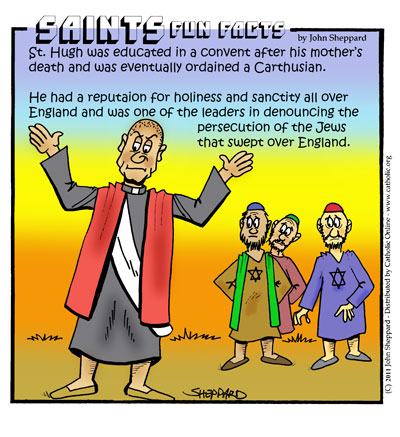
Hugh of Lincoln was the son of William, Lord of Avalon. He was born at Avalon Castle in Burgundy and was raised and educated at a convent at Villard-Benoit after his mother died when he was eight. He was professed at fifteen, ordained a deacon at nineteen, and was made prior of a monastery at Saint-Maxim. While visiting the Grande Chartreuse with his prior in 1160. It was then he decided to become a Carthusian there and was ordained. After ten years, he was named procurator and in 1175 became Abbot of the first Carthusian monastery in England. This had been built by King Henry II as part of his penance for the murder of Thomas Becket.
His reputation for holiness and sanctity spread all over England and attracted many to the monastery. He admonished Henry for keeping Sees vacant to enrich the royal coffers. Income from the vacant Sees went to the royal treasury. He was then named bishop of the eighteen year old vacant See of Lincoln in 1186 - a post he accepted only when ordered to do so by the prior of the Grande Chartreuse. Hugh quickly restored clerical discipline, labored to restore religion to the diocese, and became known for his wisdom and justice.
He was one of the leaders in denouncing the persecution of the Jews that swept England, 1190-91, repeatedly facing down armed mobs and making them release their victims. He went on a diplomatic mission to France for King John in 1199, visiting the Grande Chartreuse, Cluny, and Citeaux, and returned from the trip in poor health. A few months later, while attending a national council in London, he was stricken and died two months later at the Old Temple in London on November 16. He was canonized twenty years later, in 1220, the first Carthusian to be so honored.
Join the Movement
When you sign up below, you don't just join an email list - you're joining an entire movement for Free world class Catholic education.
A Lenten Message from Sister Catherine - Please Watch
- Easter / Lent
- 5 Lenten Prayers
- Ash Wednesday
- 7 Morning Prayers
- Mysteries of the Rosary
- Litany of the Bl. Virgin Mary
- Popular Saints
- Popular Prayers
- Female Saints
- Saint Feast Days by Month
- Stations of the Cross
- St. Francis of Assisi
- St. Michael the Archangel
- The Apostles' Creed
- Unfailing Prayer to St. Anthony
- Pray the Rosary








Copyright 2026 Catholic Online. All materials contained on this site, whether written, audible or visual are the exclusive property of Catholic Online and are protected under U.S. and International copyright laws, © Copyright 2026 Catholic Online. Any unauthorized use, without prior written consent of Catholic Online is strictly forbidden and prohibited.
Catholic Online is a Project of Your Catholic Voice Foundation, a Not-for-Profit Corporation. Your Catholic Voice Foundation has been granted a recognition of tax exemption under Section 501(c)(3) of the Internal Revenue Code. Federal Tax Identification Number: 81-0596847. Your gift is tax-deductible as allowed by law.
