We ask you, humbly: don't scroll away.
Hi readers, it seems you use Catholic Online a lot; that's great! It's a little awkward to ask, but we need your help. If you have already donated, we sincerely thank you. We're not salespeople, but we depend on donations averaging $14.76 and fewer than 1% of readers give. If you donate just $5.00, the price of your coffee, Catholic Online School could keep thriving. Thank you.Help Now >
John of Ragusa
FREE Catholic Classes
(Sometimes confounded with John of Segovia ).
A Dominican theologian, president of the Council of Basle, legate to Constantinople, b. at Ragusa about 1380; d. at Argos, in the Peloponnesus, probably 1443. He entered the Dominican Order and devoted himself to the observance of the rule of his order and the study of the sacred sciences . By reason of his great attainments in theology, Scripture, and the Oriental languages, he was considered an oracle in his native Dalmatia. At the University of Paris he shone conspicuously and there received the doctor's cap about the beginning of the fifteenth century. In the year 1426 he was appointed procurator general of the Dominican Order, and went to reside at Rome under Pope Martin V. There he received marks of honour and esteem from the pope and the College of Cardinals, and the former eventually named him papal theologian for the General Council of Basle. John was, moreover, chosen to open the council, in place of Cardinal Julian Cesarini, who was detained by other business. Arriving at Basle on 19 May, 1431, he on the same day arranged with the Bishop of Basle for the opening of the council on the 23rd of the same month. The opening did not take place, however, until 23 July, 1431, in the cathedral church, when John preached from the text: "Et angelus testamenti, quem vos vultis. Ecce venit" ( Malachi 3:1 ). In the council he exonerated the absent cardinals from the charge of contempt (Feb., 1433). On eight mornings he spoke against the doctrines of the Hussites and crushed all that was reprehensible in that heresy.
Having been sent as a legate of the council to Conatantinople to urge the reunion of the Eastern and Western Churches, John of Ragusa induced the Emperor John Paleologus and the Patriarch Joseph to send an embassy to the council through the treaty which they made with Pope Eugenius IV was broken by the Greeks. John afterwards sojourned at Constantinople to study the Greek language and to become better acquainted with the situation of ecclesiastical affairs. Here he completed an etymological work bearing upon the Greek text of Scripture and destined to be of service to Catholic controversialists in treating of the doctrine of the Procession of the Holy Ghost against the Greek schismatics. He returned to Bologna as a member of a deputation, to obtain from Eugenius IV an assurance that the pope would be present at the council. Having acceded to this request, Eugenius employed John once more to be the bearer of a document (dated 15 July, 1437) to the Greek emperor in which the emperor's assistance was invited at a meeting of the council to be held in some Italian city. John's subsequent course has been a subject of dispute: some authors assert that he remained in sympathy with the council, while others insist that he allied himself with Eugenius IV, who made him Bishop of Argos. It is probable that he took the side of Eugenius. His extant writings are: (1) Discourse against the Hussites delivered at the Council of Basle ; (2) the Acts, or Reports, of his embassies to Constantinople, to be found among the Acts of the Council of Basle ; (3) an account of his travels in the East, preserved by Leo Allatius . His work on Greek indeclinable nouns and Scriptural Greek etymology seems to have been lost.
We ask you, humbly: don't scroll away.
Hi readers, it seems you use Catholic Online a lot; that's great! It's a little awkward to ask, but we need your help. If you have already donated, we sincerely thank you. We're not salespeople, but we depend on donations averaging $14.76 and fewer than 1% of readers give. If you donate just $5.00, the price of your coffee, Catholic Online School could keep thriving. Thank you.Help Now >

Join the Movement
When you sign up below, you don't just join an email list - you're joining an entire movement for Free world class Catholic education.


-

-
Mysteries of the Rosary
-
St. Faustina Kowalska
-
Litany of the Blessed Virgin Mary
-
Saint of the Day for Wednesday, Oct 4th, 2023
-
Popular Saints
-
St. Francis of Assisi
-
Bible
-
Female / Women Saints
-
7 Morning Prayers you need to get your day started with God
-
Litany of the Blessed Virgin Mary

U.S. Catholic Parishes Experience Resurgence of Traditional Practices
-
Pope Francis Urges Faith and Prayers for Peace
-
Florida Welcomes Volunteer Chaplains to Public Schools
-
10 Fascinating Details About St. Joseph the Worker: Celebrating His Feast Day - May 1
-
St. Joseph the Worker: Model for Men, Young and Old

Daily Catholic
- Daily Readings for Thursday, May 02, 2024
- St. Athanasius: Saint of the Day for Thursday, May 02, 2024
- The Our Father: Prayer of the Day for Thursday, May 02, 2024
- Daily Readings for Wednesday, May 01, 2024
- St. Marculf: Saint of the Day for Wednesday, May 01, 2024
- To Saint Peregrine: Prayer of the Day for Wednesday, May 01, 2024
 Daily Readings for Thursday, May 02, 2024
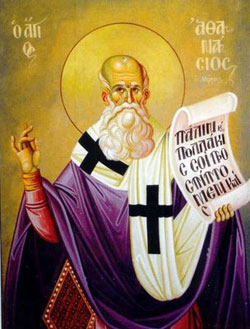 St. Athanasius: Saint of the Day for Thursday, May 02, 2024
 The Our Father: Prayer of the Day for Thursday, May 02, 2024
 Hi readers, it seems you use Catholic Online a lot; that's great! It's a little awkward to ask, but we need your help. If you have already donated, we sincerely thank you. We're not salespeople, but we depend on donations averaging $14.76 and fewer than 1% of readers give. If you donate just $5.00, the price of your coffee, Catholic Online School could keep thriving. Thank you. Help Now >


Copyright 2024 Catholic Online. All materials contained on this site, whether written, audible or visual are the exclusive property of Catholic Online and are protected under U.S. and International copyright laws, © Copyright 2024 Catholic Online. Any unauthorized use, without prior written consent of Catholic Online is strictly forbidden and prohibited.
Catholic Online is a Project of Your Catholic Voice Foundation, a Not-for-Profit Corporation. Your Catholic Voice Foundation has been granted a recognition of tax exemption under Section 501(c)(3) of the Internal Revenue Code. Federal Tax Identification Number: 81-0596847. Your gift is tax-deductible as allowed by law.