 Hi readers, it seems you use Catholic Online a lot; that's great! It's a little awkward to ask, but we need your help. If you have already donated, we sincerely thank you. We're not salespeople, but we depend on donations averaging $14.76 and fewer than 1% of readers give. If you donate just $5.00, the price of your coffee, Catholic Online School could keep thriving. Thank you. Help Now >
Elect
FREE Catholic Classes
Denotes in general one chosen or taken by preference from among two or more; as a theological term it is equivalent to "chosen as the object of mercy or Divine favour, as set apart for eternal life". In order to determine the meaning of the word more accurately, we shall have to study its usage both in the Old Testament and the New.
I. THE OLD TESTAMENT
The Old Testament applies the term elect , or chosen , only to the Israelites in as far as they are called to be the people of God, or are faithful to their Divine call. The idea of such an election is common in the Book of Deuteronomy and in Is., xl-lxvi. In Ps. civ, 6 and 43, and cv, 5, the chosen ones are the Hebrew people in as far as it is the recipient of God's temporal and spiritual blessings ; in Is., lxv, 9, 15 and 23, they are the repentant Israelites, as few in number "as if a grain can be found in a cluster" (ibid., 8); in Tob., xiii, 10, they are the Israelites remaining faithful during their captivity; in Wisd., iii, 9, and iv, 15, they are God's true servants; in Ecclus., xxiv, 4, 13, and xlvi, 2, these servants of God belong to the chosen people.

II. THE NEW TESTAMENT
The New Testament transfers (excepting perhaps in Acts 13:17 ) the meaning of the term from its connection with the people of Israel to the members of the Church of Christ, either militant on earth or triumphant in heaven. Thus I Pet., I, 1, speaks of the elect among the "strangers dispersed" through the various parts of the world; I Pet., ii, 9, represents them as "a chosen generation, a kingly priesthood, a holy nation, a purchased people", called from darkness into God's marvellous light. St. Paul, too, speaks of the elect ( Romans 8:33 ) and describes the five degrees of their election: they are foreknown, predestined, called, justified, and glorified (loc. cit., 29, 30). He returns to the idea gain and again: II Thess., ii, 12 sq.; Col., iii, 12; Tit., I, 1, 2; II Tim., ii, 10. St. John gives the title of elect to those who fight on the side of the Lamb against the powers of darkness ( Revelation 17:14 ). According to St. Luke (xviii, 7), God hears the cries of his elect for vengeance; according to the first two Evangelists he will shorten the last days for the sake of the elect ( Matthew 24:22, 24, 31 ; Mark 13:20, 22, 27 ).
If it be asked why the name elect was given to the members of the Church Militant, we may assign a double reason : first, they were freely chosen by God's goodness ( Romans 11:5-7, 28 ); secondly, they must show in their conduct that they are choice men ( Ephesians 4:17 ). In the sentence "many are called, but few are chosen", the latter expression renders a word in the Greek and Latin text which is elsewhere translated by elect ( Matthew 20:16 ; 22:14 ). It is agreed on all sides that the term refers to members of the Church Triumphant, but there is some doubt as to whether it refers to mere membership, or to a more exalted degree. This distinction is important; if the word implies mere membership in the Church Triumphant, then the chosen ones, or those who will be saved, are few, and the non-members in the Church Triumphant are many; if the word denotes a special degree of glory, then few will attain this rank, and many will fail to do so, though many are called to it. The sentence "many are called, but few chosen" does not, therefore, settle the question as to the relative number of the elect and the lost; theologians are divided on this point, and while Christ in the Gospels urges the importance of saving one's soul ( Luke 13:23, 24 ), he alternately so strengthens our hope and excites our fear as not to leave us any solid ground for either presumption or despair.

We ask you, humbly: don't scroll away.
Hi readers, it seems you use Catholic Online a lot; that's great! It's a little awkward to ask, but we need your help. If you have already donated, we sincerely thank you. We're not salespeople, but we depend on donations averaging $14.76 and fewer than 1% of readers give. If you donate just $5.00, the price of your coffee, Catholic Online School could keep thriving. Thank you.Help Now >

Join the Movement
When you sign up below, you don't just join an email list - you're joining an entire movement for Free world class Catholic education.


-

-
Mysteries of the Rosary
-
St. Faustina Kowalska
-
Litany of the Blessed Virgin Mary
-
Saint of the Day for Wednesday, Oct 4th, 2023
-
Popular Saints
-
St. Francis of Assisi
-
Bible
-
Female / Women Saints
-
7 Morning Prayers you need to get your day started with God
-
Litany of the Blessed Virgin Mary


Sacrifices of Faith: The Pro-Life Legacies of St. Gianna and Jessica Hanna
-
How to love God by caring for our bodies
-
Pope Francis calls for negotiations to End Russia-Ukraine War
-
Pope Francis Contemplates Return to U.S. for United Nations Assembly Address
-
Pope Francis Calls on Faithful to Embrace Faith, Hope, and Charity in New Teaching Series


Daily Catholic
- Daily Readings for Saturday, April 27, 2024
- St. Zita: Saint of the Day for Saturday, April 27, 2024
- Prayer for the Dead # 2: Prayer of the Day for Saturday, April 27, 2024
- Daily Readings for Friday, April 26, 2024
- St. Cletus: Saint of the Day for Friday, April 26, 2024
- Prayer before the Closing of the Day: Prayer of the Day for Friday, April 26, 2024
 Daily Readings for Saturday, April 27, 2024
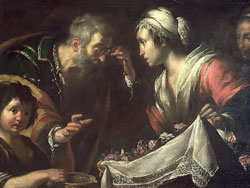 St. Zita: Saint of the Day for Saturday, April 27, 2024
 Prayer for the Dead # 2: Prayer of the Day for Saturday, April 27, 2024
Hi readers, it seems you use Catholic Online a lot; that's great! It's a little awkward to ask, but we need your help. If you have already donated, we sincerely thank you. We're not salespeople, but we depend on donations averaging $14.76 and fewer than 1% of readers give. If you donate just $5.00, the price of your coffee, Catholic Online School could keep thriving. Thank you. Help Now >
Prayer for the Dead # 2: Prayer of the Day for Saturday, April 27, 2024
Hi readers, it seems you use Catholic Online a lot; that's great! It's a little awkward to ask, but we need your help. If you have already donated, we sincerely thank you. We're not salespeople, but we depend on donations averaging $14.76 and fewer than 1% of readers give. If you donate just $5.00, the price of your coffee, Catholic Online School could keep thriving. Thank you. Help Now >

Copyright 2024 Catholic Online. All materials contained on this site, whether written, audible or visual are the exclusive property of Catholic Online and are protected under U.S. and International copyright laws, © Copyright 2024 Catholic Online. Any unauthorized use, without prior written consent of Catholic Online is strictly forbidden and prohibited.
Catholic Online is a Project of Your Catholic Voice Foundation, a Not-for-Profit Corporation. Your Catholic Voice Foundation has been granted a recognition of tax exemption under Section 501(c)(3) of the Internal Revenue Code. Federal Tax Identification Number: 81-0596847. Your gift is tax-deductible as allowed by law.