Because of You, 2.2 Million Students Are Being Formed in the Faith
Because of generous supporters like you, Catholic Online School has already delivered free, faithful Catholic education to over 2.2 million students across 193 countries. In an age of noise and algorithms, you are helping form souls with truth, prayer, Scripture, and Christ.
If everyone who reads this gave just $5 — the cost of a coffee — we could reach even more families and keep this life-changing formation free for all. Be Courageous. Be Catholic. Stand with us today.
DONATE TODAY >St. John of Capistrano


Facts
Patron: of Jurists
Birth: 1386
Death: 1456
Author and Publisher - Catholic Online
Printable Catholic Saints PDFs
Shop St. John of Capistrano
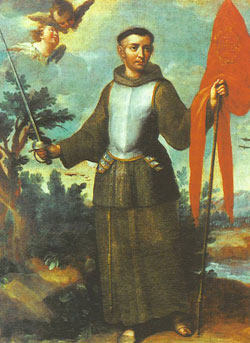
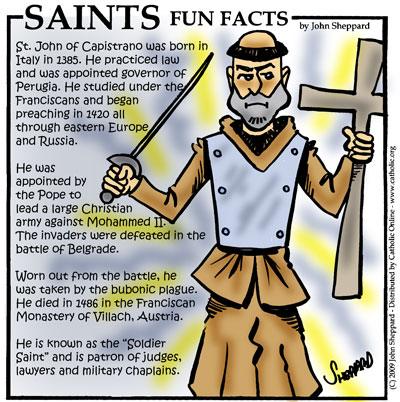
St. John was born at Capistrano, Italy in 1385, the son of a former German knight in that city. He studied law at the University of Perugia and practiced as a lawyer in the courts of Naples. King Ladislas of Naples appointed him governor of Perugia. During a war with a neighboring town he was betrayed and imprisoned. Upon his release he entered the Franciscan community at Perugia in 1416. He and St. James of the March were fellow students under St. Bernardine of Siena, who inspired him to institute the devotion to the holy Name of Jesus and His Mother. John began his brilliant preaching apostolate with a deacon in 1420. After his ordination he traveled throughout Italy, Germany, Bohemia, Austria, Hungary, Poland, and Russia preaching penance and establishing numerous communities of Franciscan renewal. When Mohammed II was threatening Vienna and Rome, St. John, at the age of seventy, was commissioned by Pope Callistus III to preach and lead a crusade against the invading Turks. Marching at the head of seventy thousand Christians, he gained victory in the great battle of Belgrade against the Turks in 1456. Three months later he died at Illok, Hungary. His feast day is October 23. He is the patron of jurists.
Come Grow With Us
Sign up and walk the Catholic journey with millions around the world.
Receive inspiring emails on saints, daily readings, and free faith-building resources—no cost, ever.
Sister Sara Has One Message for Every Catholic Family This June
- 7 Morning Prayers
- Mysteries of the Rosary
- Litany of the Bl. Virgin Mary
- Popular Saints
- Popular Prayers
- Female Saints
- Saint Feast Days by Month
- Stations of the Cross
- St. Francis of Assisi
- St. Michael the Archangel
- The Apostles' Creed
- Unfailing Prayer to St. Anthony
- Pray the Rosary






Copyright 2026 Catholic Online. All materials contained on this site, whether written, audible or visual are the exclusive property of Catholic Online and are protected under U.S. and International copyright laws, © Copyright 2026 Catholic Online. Any unauthorized use, without prior written consent of Catholic Online is strictly forbidden and prohibited.
Catholic Online is a Project of Your Catholic Voice Foundation, a Not-for-Profit Corporation. Your Catholic Voice Foundation has been granted a recognition of tax exemption under Section 501(c)(3) of the Internal Revenue Code. Federal Tax Identification Number: 81-0596847. Your gift is tax-deductible as allowed by law.
