 Dear readers, Catholic Online was de-platformed by Shopify for our pro-life beliefs. They shut down our Catholic Online, Catholic Online School, Prayer Candles, and Catholic Online Learning Resources essential faith tools serving over 2.2 million students and millions of families worldwide. Our founders, now in their 70's, just gave their entire life savings to protect this mission. But fewer than 2% of readers donate. If everyone gave just $5, the cost of a coffee, we could rebuild stronger and keep Catholic education free for all. Stand with us in faith. Thank you. DONATE TODAY >
St. Joseph of Arimathea
Facts
Patron: of funeral directors
Death: 1st century
Author and Publisher - Catholic Online
Printable Catholic Saints PDFs
Shop St. Joseph of Arimathea

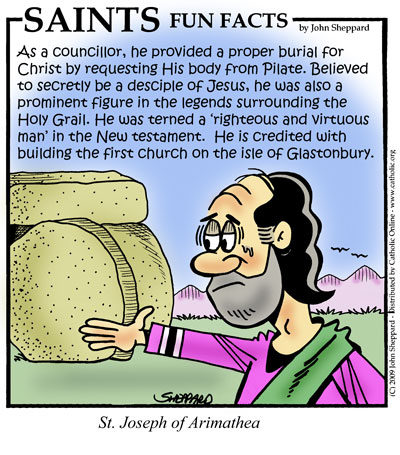
The councillor (Lk 23:50) who, after the Crucifixion, requested the body of Christ from Pontius Pilate and provided for a proper burial for Christ. An immensely popular figure in Christian lore, Joseph was termed in the New Testament the “virtuous and righteous man” (Lk 23:50) and the man “who was himself awaiting the kingdom of God” (Mk 15:43). Described as .... . secretly a disciple of Jesus for fear of the Jews, [he] asked Pilate if he could remove the body of Jesus. And Pilate permitted it” (In 19:38). According to the apocryphal Gospel of Nicodemus, he helped establish the community of Lydda. He also was a prominent figure in the legends surrounding the Holy Grail, appearing in Robert de Barron’s early thirteenth-century romance Joseph d ‘Arirnathea, William of Malmesbury’s twelfth-century De Antiquitate Glastoniensis Ecclesiae, and Thomas Mallory’s famed Morte D ‘Arthur; William of almesbury’s tale recounts Joseph’s arrival in England with the Holy Grail and the building of the first church on the isle at Glastonbury; the passage on Joseph, however, was added in the thirteenth century.
Come Grow With Us
Sign up and walk the Catholic journey with millions around the world.
Receive inspiring emails on saints, daily readings, and free faith-building resources—no cost, ever.
This could change the future of Catholic Online.
Watch Now
- 7 Morning Prayers
- Mysteries of the Rosary
- Litany of the Bl. Virgin Mary
- Popular Saints
- Popular Prayers
- Female Saints
- Saint Feast Days by Month
- Stations of the Cross
- St. Francis of Assisi
- St. Michael the Archangel
- The Apostles' Creed
- Unfailing Prayer to St. Anthony
- Pray the Rosary







Copyright 2026 Catholic Online. All materials contained on this site, whether written, audible or visual are the exclusive property of Catholic Online and are protected under U.S. and International copyright laws, © Copyright 2026 Catholic Online. Any unauthorized use, without prior written consent of Catholic Online is strictly forbidden and prohibited.
Catholic Online is a Project of Your Catholic Voice Foundation, a Not-for-Profit Corporation. Your Catholic Voice Foundation has been granted a recognition of tax exemption under Section 501(c)(3) of the Internal Revenue Code. Federal Tax Identification Number: 81-0596847. Your gift is tax-deductible as allowed by law.