Nomocanon
FREE Catholic Classes
(From the Greek nomos , law, and kanon , a rule)
A collection of ecclesiastical law, the elements of which are borrowed from secular and canon law. When we recall the important place given to ecclesiastical discipline in the imperial laws such as the Theodosian Code, the Justinian collections, and the subsequent "Novellæ", and "Basilica", the utility of comparing laws and canons relating to the same subjects will be readily recognized. Collections of this kind are found only in Eastern law. The Greek Church has two principal collections. The first, dating from the end of the sixth century, is ascribed, though without certainty, to John Scholasticus, whose canons it utilizes and completes. He had drawn up (about 550) a purely canonical compilation in fifty titles, and later composed an extract from the "Novellæ" in eighty-seven chapters (for the canonical collection see Voellus and Justellus, "Bibliotheca juris canonici", Paris, 1661, II, 449 sqq.; for the eighty-seven chapters, Pitra, "Juris ecclesiastici Græcorum historia et monumenta", Rome, 1864, II, 385). To each of the fifty titles were added the texts of the imperial laws on the same subject, with twenty-one additional chapters nearly all borrowed from John's eighty-seven (Voellus and Justellus, op. cit., II, 603). In its earliest form this collection dates from the reign of Emperor Heraclius (610-40), at which time Latin was replaced by Greek as the official language of the imperial laws. Its two sections include the ecclesiastical canons and the imperial laws the latter in fourteen titles.

This collection was long held in esteem and passed into the Russian Church, but was by degrees supplanted by that of Photius. The first part of Photius's collection contains the conciliar canons and the decisions of the Fathers. It is in substance the Greek collection of 692, as it is described by canon ii of the Trullan Council (see LAW, CANON), with the addition of 102 canons of that council, 17 canons of the Council of Constantinople of 861 (against Ignatius), and of 3 canons substituted by Photius for those of the œcumenical council of 869. The nomocanon in fourteen titles was completed by additions from the more recent imperial laws. This whole collection was commentated about 1170 by Theodore Balsamon, Greek Patriarch of Antioch residing at Constantinople (Nomocanon with Balsamon's commentary in Voellus and Justellus, II, 815; P. G., CIV, 441). Supplemented by this commentary the collection of Photius has become a part of the "Pidalion" ( pedalion , rudder), a sort of Corpus Juris of the Orthodox Church , printed in 1800 by Patriarch Neophytus VIII. In the eleventh century it had been also translated into Slavonic for the Russian Church ; it is retained in the law of the Orthodox Church of Greece, and included in the "Syntagma" published by Rhallis and Potlis (Athens, 1852-9). Though called the "Syntagma", the collection of ecclesiastical law of Matthew Blastares (c. 1339) is a real nomocanon, in which the texts of the canons and of the laws are arranged in alphabetical order (P. G., loc. cit.; Beveridge, "Synodicon", Oxford, 1672). A remarkable nomocanon was composed by John Barhebræus (1226-86) for the Syrian Church of Antioch (Latin version by Assemani in Mai, "Script. vet, nova collectio", X, 3 sqq.). Several Russian manuals published at Kiev and Moscow in the seventeenth century were also nomocanons.

 Hi readers, it seems you use Catholic Online a lot; that's great! It's a little awkward to ask, but we need your help. If you have already donated, we sincerely thank you. We're not salespeople, but we depend on donations averaging $14.76 and fewer than 1% of readers give. If you donate just $5.00, the price of your coffee, Catholic Online School could keep thriving. Thank you. Help Now >
Join the Movement
When you sign up below, you don't just join an email list - you're joining an entire movement for Free world class Catholic education.


-

-
Mysteries of the Rosary
-
St. Faustina Kowalska
-
Litany of the Blessed Virgin Mary
-
Saint of the Day for Wednesday, Oct 4th, 2023
-
Popular Saints
-
St. Francis of Assisi
-
Bible
-
Female / Women Saints
-
7 Morning Prayers you need to get your day started with God
-
Litany of the Blessed Virgin Mary


Sacrifices of Faith: The Pro-Life Legacies of St. Gianna and Jessica Hanna
-
How to love God by caring for our bodies
-
Pope Francis calls for negotiations to End Russia-Ukraine War
-
Pope Francis Contemplates Return to U.S. for United Nations Assembly Address
-
Pope Francis Calls on Faithful to Embrace Faith, Hope, and Charity in New Teaching Series


Daily Catholic
- Daily Readings for Tuesday, April 30, 2024
- St. Pius V, Pope: Saint of the Day for Tuesday, April 30, 2024
- Prayer to Saint Joseph for Success in Work: Prayer of the Day for Tuesday, April 30, 2024
- Daily Readings for Monday, April 29, 2024
- St. Catherine of Siena: Saint of the Day for Monday, April 29, 2024
- Prayer for the Dead # 3: Prayer of the Day for Monday, April 29, 2024
 Daily Readings for Tuesday, April 30, 2024
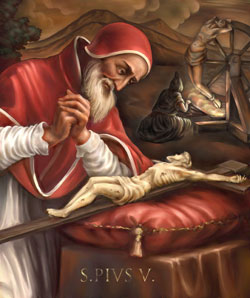 St. Pius V, Pope: Saint of the Day for Tuesday, April 30, 2024
 Prayer to Saint Joseph for Success in Work: Prayer of the Day for Tuesday, April 30, 2024
We ask you, humbly: don't scroll away.
Hi readers, it seems you use Catholic Online a lot; that's great! It's a little awkward to ask, but we need your help. If you have already donated, we sincerely thank you. We're not salespeople, but we depend on donations averaging $14.76 and fewer than 1% of readers give. If you donate just $5.00, the price of your coffee, Catholic Online School could keep thriving. Thank you.Help Now >

Copyright 2024 Catholic Online. All materials contained on this site, whether written, audible or visual are the exclusive property of Catholic Online and are protected under U.S. and International copyright laws, © Copyright 2024 Catholic Online. Any unauthorized use, without prior written consent of Catholic Online is strictly forbidden and prohibited.
Catholic Online is a Project of Your Catholic Voice Foundation, a Not-for-Profit Corporation. Your Catholic Voice Foundation has been granted a recognition of tax exemption under Section 501(c)(3) of the Internal Revenue Code. Federal Tax Identification Number: 81-0596847. Your gift is tax-deductible as allowed by law.