Miguel de Molinos
FREE Catholic Classes
Founder of Quietism, born at Muniesa, Spain, 21 December, 1640; died at Rome, 28 December, 1696. In his youth he went to Valencia, where, having been ordained priest and received the degree of doctor, he held a benefice in the church of Santo Tomas and was confessor to a community of nuns. He pretended to be a disciple of the Jesuits and quoted them as his authority in his differences with the university. In 1662 he went to Rome as procurator in the cause of the beatification of Venerable Jerónimo Simón. Here, after residing in various other places, he finally took up his abode at the church of Sant' Alfonso which belonged to the Spanish Discalced Augustinians. The Jesuits and Dominicans having accused him of pernicious teachings, the Inquisition ordered his books to be examined. He defended himself well and was acquitted; but again Cardinal d'Estrées, French ambassador at Rome, acting on instructions from Paris, denounced him to the authorities In May, 1685, the Holy Office formulated charges against him and ordered his arrest. The report of the process was read on 3 September, 1687, in the Dominican church of Santa Maria sopra Minerva, in the presence of an immense concourse of people gathered for the occasion by means of grants of indulgences ; he was declared a dogmatic heretic, sentenced to life imprisonment, to be perpetually clothed in the penitential garb, to recite the Credo and one-third of the Rosary, and to make confession four times every year. He received the sacraments on his death bed. He taught interior annihilation, asserting that this is the means of attaining purity of soul, perfect contemplation, and the rich treasure of interior peace: hence follows the licitness of impure carnal acts, inasmuch as only the lower, sensual man, instigated by the demon, is concerned in them. In the cases of seventeen penitents he excused their lascivious acts, and claimed that those committed by himself were not blameworthy, as free will had no part in them.

Innocent XI, in the Bull "Coelestis Pastor" (2 November, 1687), condemned as heretical, suspect, erroneous, scandalous, etc., sixty-eight propositions which Molinos admitted to be his, being convicted of having asserted them in speech and in writing, communicated them to others, and believed them--propositions which are not those of the "Guía Espiritual" alone. Moreover, the pope prohibited and condemned all his works, printed or in manuscript. Molinos had followers in abundance; when he was arrested, it is said that twelve thousand letters from persons who consulted him were found in his possession. More than two hundred persons at Rome found themselves implicated in the affair; several communities of nuns practised the "prayer of quiet", while the inquisitorial proceedings in Italy lasted until the eighteenth century. In Spain, the Bishop of Oviedo, taken to Rome and imprisoned in the Castle of Sant' Angelo, the priest Juan de Causadas, and the Carmelite lay brother Juan de Longas, who corrupted a convent of religious women, were all punished as disciples of Molinism. In France, the semiquietism of Fénelon and Jeanne Guyon took from Molinos only the teaching of "pure love ".
Among the writings of Molinos may be mentioned the following:
- "La devoción de la buena muerte" (published at Valencia, 1662, under the name of Juan Bautista Catalá);
- "La Guía espiritual" (published first in Italian, at Rome, 1675, then, in Spanish at Madrid, 1676), approved by various theologians and by ecclesiastical authority, so much so that twenty editions appeared in twelve years, in Latin (1687), French, English (1685), German (1699), etc.;
- "Tratado de la Comunión cuotidiana" (1687).

Join the Movement
When you sign up below, you don't just join an email list - you're joining an entire movement for Free world class Catholic education.


-

-
Mysteries of the Rosary
-
St. Faustina Kowalska
-
Litany of the Blessed Virgin Mary
-
Saint of the Day for Wednesday, Oct 4th, 2023
-
Popular Saints
-
St. Francis of Assisi
-
Bible
-
Female / Women Saints
-
7 Morning Prayers you need to get your day started with God
-
Litany of the Blessed Virgin Mary


Sacrifices of Faith: The Pro-Life Legacies of St. Gianna and Jessica Hanna
-
How to love God by caring for our bodies
-
Pope Francis calls for negotiations to End Russia-Ukraine War
-
Pope Francis Contemplates Return to U.S. for United Nations Assembly Address
-
Pope Francis Calls on Faithful to Embrace Faith, Hope, and Charity in New Teaching Series


Daily Catholic
- Daily Readings for Monday, April 29, 2024
- St. Catherine of Siena: Saint of the Day for Monday, April 29, 2024
- Prayer for the Dead # 3: Prayer of the Day for Monday, April 29, 2024
- Daily Readings for Sunday, April 28, 2024
- St. Peter Chanel: Saint of the Day for Sunday, April 28, 2024
- Prayer before a Crucifix: Prayer of the Day for Sunday, April 28, 2024
 Daily Readings for Monday, April 29, 2024
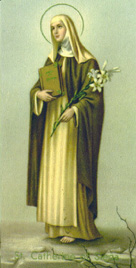 St. Catherine of Siena: Saint of the Day for Monday, April 29, 2024
 Prayer for the Dead # 3: Prayer of the Day for Monday, April 29, 2024
We ask you, humbly: don't scroll away.
Hi readers, it seems you use Catholic Online a lot; that's great! It's a little awkward to ask, but we need your help. If you have already donated, we sincerely thank you. We're not salespeople, but we depend on donations averaging $14.76 and fewer than 1% of readers give. If you donate just $5.00, the price of your coffee, Catholic Online School could keep thriving. Thank you.Help Now >


Copyright 2024 Catholic Online. All materials contained on this site, whether written, audible or visual are the exclusive property of Catholic Online and are protected under U.S. and International copyright laws, © Copyright 2024 Catholic Online. Any unauthorized use, without prior written consent of Catholic Online is strictly forbidden and prohibited.
Catholic Online is a Project of Your Catholic Voice Foundation, a Not-for-Profit Corporation. Your Catholic Voice Foundation has been granted a recognition of tax exemption under Section 501(c)(3) of the Internal Revenue Code. Federal Tax Identification Number: 81-0596847. Your gift is tax-deductible as allowed by law.
