 Hi readers, it seems you use Catholic Online a lot; that's great! It's a little awkward to ask, but we need your help. If you have already donated, we sincerely thank you. We're not salespeople, but we depend on donations averaging $14.76 and fewer than 1% of readers give. If you donate just $5.00, the price of your coffee, Catholic Online School could keep thriving. Thank you. Help Now >
Pneumatomachi
FREE Catholic Classes
(Macedonians)
A heretical sect which flourished in the countries adjacent to the Hellespont during the latter half of the fourth, and the beginning of the fifth century. They denied the divinity of the Holy Ghost, hence the name Pneumatomachi or Combators against the Spirit.
Macedonius, their founder, was intruded into the See of Constantinople by the Arians (342 A.D.), and enthroned by Constantius, who had for the second time expelled Paul, the Catholic bishop. He is known in history for his persecution of Novatians and Catholics ; as both maintained the consubstantiality of the Son with the Father. He not only expelled those who refused to hold communion with him, but imprisoned some and brought others before the tribunals. In many cases he used torture to compel the unwilling to communicate, forced baptism on unbaptized women and children and destroyed many churches. At last his cruelty provoked a rebellion of the Novatians at Mantinium, in Paphlagonia, in which four imperial cohorts were defeated and nearly all slain. His disinterment of the body of Constantine was looked upon as an indignity to the Protector of the Council of Nicaea, and led to a conflict between Arians and anti-Arians, which filled the church and neighbourhood with carnage. As the disinterment had taken place without the emperor's sanction, Macedonius fell into disgrace, and Constantius caused him to be deposed by the Acacian party and succeeded by Eudoxius in 360. This deposition, however, was not for doctrinal reasons, but on the ground that he had caused much bloodshed and had admitted to communion a deacon guilty of fornication. Macedonius continued for some time to live near Constantinople and cause trouble. He died about 364. It is thought that during these last years he formulated his rejection of the Divinity of the Holy Ghost and founded his sect. His intimacy with Eleusius of Cysicus makes this probable. Some scholars, however, reject the identification of Macedonians and Pneumatomachians, apparently on insufficient grounds and against the authority of Socrates, a contemporary historian living at Constantinople. The Council of Nicaea had used all its energies in defending the Homoousion of the Son and with regard to the Spirit had already added the words: "We believe in the Holy Ghost " without any qualification. The Macedonians took advantage of the vagueness and hesitancy of statement in some of the early Fathers to justify and propagate their error. The majority of this sect were clearly orthodox on the Consubstantiality of the Son; they had sent a deputation from the Semi-Arian council of Lampsacus (364 A.D.) to Pope Liberius, who after some hesitation acknowledged the soundness of their faith ; but with regard to the Third Person, both pope and bishops were satisfied with the phrase: "We believe in the Holy Ghost." While hiding in the desert during his third exile, Athanasius learned form his friend Serapion of Thumis of a sect acknowledging Nicaea, and yet declaring the Holy Ghost a mere creature and a ministering angel (on the strength of Hebrews 1:14 ). Athanasius wrote at once to Serapion in defence of the true Doctrine, and on his return from exile (362 A.D.) held a council at Alexandria which resulted in the first formal condemnation of the Pneumatomachi. A synodal letter was sent to the people of Antioch advising them to require of all converts from Arianism a condemnation against "those who say that the Holy Spirit is a creature and separate from the essence of Christ. For those who while pretending to cite the faith confessed at Nicaea, venture to blaspheme the Holy Spirit, deny Arianism in words only, while in thought they return to it." Nevertheless, during the following decade the heresy seems to have gone on almost unchecked except in the Patriarchate of Antioch where at a synod held in 363 Meletius had proclaimed the orthodox faith. In the East the moving spirit for the repression of the error was Amphilochius of Iconium, who in 374 besought St. Basil of Caesarea to write a treatise on the true doctrine of the Holy Ghost. This he did, and his treatise is the classical work on the subject ( peri tou hagiou II. M. 32). It is possible that he influenced his brother Gregory of Nyssa to write his treatise against the Macedonians, of which only a part has come down to us and which appears to be based on the words: "Lord and life-giver who proceeds from the Father." These words, apparently taken from the Creed of Jerusalem, had been used by St. Epiphanius of Salamis in his "Ancoratus" when combating this error (374 A. D.). Amphilochius of Iconium, as Metropolitan of Lycaonia, wrote in concurrence with his bishops a synodal letter to the bishops of Lycia, which contains and excellent statement of the true doctrine (377 A. D.). In Constantinople (379) Gregory of Nazianzus pronounced his brilliant theological oration on this subject. The West likewise upheld the truth in a synod held in Illyria and mentioned by Theodoret (H. E., IV, 8) and by Pope Damasus in his letter to Paulinus of Antioch. The heresy was condemned in the First Council of Constantinople, and internal divisions soon led to its extinction. Socrates (H. E., V, 24) states that a certain Macedonian presbyter, Eutropius, held conventicles of his own while others followed Bishop Carterius. Eustathius of Sebaste, Sabinus, and Eleusius of Cyricus seem to have been leaders whom the sect repudiated (for Eustathis, see Basil, Ep., CCLXIII, 3). In June 383 Theodosius tried by means of a conference to bring the Arian factions to submission. Eleusius handed in his symbol of faith as representing the Macedonians, as he had represented them with Marcianus of Lampsacus at the Council of Constantinople. After this fruitless attempt at reconciliation the Macedonians with other heretics incurred all the severities of the Theodosian code and with a generation disappeared from history. Socrates and Sozomus mention a certain Marathonius, made Bishop of Nicomedia by Macedonius, who obtained such a leading position in the sect that they were often styled after him Marathonians. Through St. Jerome, St. Augustine, St. Damasus, and Rufinus, the name Macedonians became the customary designation in the West. No writings of Macedonius are extant, but Pneumatomachian writings are mentioned by Didymus the Blind, who wrote an excellent treatise on the Holy Ghost in thirty-six chapters (translated into Latin by St. Jerome at the command of Pope Damasus ), and who refers in his later work (379) on the Trinity (II, 7, 8, 10) to some "Brief Expositions" of Macedonian doctrines which he possessed.
Hi readers, it seems you use Catholic Online a lot; that's great! It's a little awkward to ask, but we need your help. If you have already donated, we sincerely thank you. We're not salespeople, but we depend on donations averaging $14.76 and fewer than 1% of readers give. If you donate just $5.00, the price of your coffee, Catholic Online School could keep thriving. Thank you. Help Now >
We ask you, humbly: don't scroll away.
Hi readers, it seems you use Catholic Online a lot; that's great! It's a little awkward to ask, but we need your help. If you have already donated, we sincerely thank you. We're not salespeople, but we depend on donations averaging $14.76 and fewer than 1% of readers give. If you donate just $5.00, the price of your coffee, Catholic Online School could keep thriving. Thank you.Help Now >
Join the Movement
When you sign up below, you don't just join an email list - you're joining an entire movement for Free world class Catholic education.


-

-
Mysteries of the Rosary
-
St. Faustina Kowalska
-
Litany of the Blessed Virgin Mary
-
Saint of the Day for Wednesday, Oct 4th, 2023
-
Popular Saints
-
St. Francis of Assisi
-
Bible
-
Female / Women Saints
-
7 Morning Prayers you need to get your day started with God
-
Litany of the Blessed Virgin Mary


Sacrifices of Faith: The Pro-Life Legacies of St. Gianna and Jessica Hanna
-
How to love God by caring for our bodies
-
Pope Francis calls for negotiations to End Russia-Ukraine War
-
Pope Francis Contemplates Return to U.S. for United Nations Assembly Address
-
Pope Francis Calls on Faithful to Embrace Faith, Hope, and Charity in New Teaching Series


Daily Catholic
- Daily Readings for Monday, April 29, 2024
- St. Catherine of Siena: Saint of the Day for Monday, April 29, 2024
- Prayer for the Dead # 3: Prayer of the Day for Monday, April 29, 2024
- Daily Readings for Sunday, April 28, 2024
- St. Peter Chanel: Saint of the Day for Sunday, April 28, 2024
- Prayer before a Crucifix: Prayer of the Day for Sunday, April 28, 2024
 Daily Readings for Monday, April 29, 2024
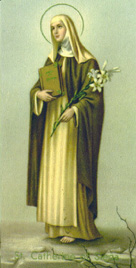 St. Catherine of Siena: Saint of the Day for Monday, April 29, 2024
 Prayer for the Dead # 3: Prayer of the Day for Monday, April 29, 2024
We ask you, humbly: don't scroll away.
Hi readers, it seems you use Catholic Online a lot; that's great! It's a little awkward to ask, but we need your help. If you have already donated, we sincerely thank you. We're not salespeople, but we depend on donations averaging $14.76 and fewer than 1% of readers give. If you donate just $5.00, the price of your coffee, Catholic Online School could keep thriving. Thank you.Help Now >

Copyright 2024 Catholic Online. All materials contained on this site, whether written, audible or visual are the exclusive property of Catholic Online and are protected under U.S. and International copyright laws, © Copyright 2024 Catholic Online. Any unauthorized use, without prior written consent of Catholic Online is strictly forbidden and prohibited.
Catholic Online is a Project of Your Catholic Voice Foundation, a Not-for-Profit Corporation. Your Catholic Voice Foundation has been granted a recognition of tax exemption under Section 501(c)(3) of the Internal Revenue Code. Federal Tax Identification Number: 81-0596847. Your gift is tax-deductible as allowed by law.