We ask you, humbly: don't scroll away.
Hi readers, it seems you use Catholic Online a lot; that's great! It's a little awkward to ask, but we need your help. If you have already donated, we sincerely thank you. We're not salespeople, but we depend on donations averaging $14.76 and fewer than 1% of readers give. If you donate just $5.00, the price of your coffee, Catholic Online School could keep thriving. Thank you.Help Now >
Sts. Cyrus and John
FREE Catholic Classes
Celebrated martyrs of the Coptic Church, surnamed thaumatourgoi anargyroi because they healed the sick gratis ( Nilles, Kallendarium utriusque Ecclesiæ, Innsbruck, 1896, I, 89). Their feast day is celebrated by the Copts on the sixth day of Emsir, corresponding to 31 January, the day also observed by the Greeks; on the same day they are commemorated in the Roman Martyrology, regarding which see the observation of Cardinal Baronio (Martyrologium Romanum, Venice, 1586). The Greeks celebrate also the finding and translation of the relics on 28 June (see "Menologium Basil." and "Menaia"). The principal source of information regarding the life, passion and miracles of Sts. John and Cyrus is the encomium written by Sophronius, Patriarch of Jerusalem (d. 638). Of the birth, parents, and first years of the saints we know nothing. According to the Arabic "Synaxarium" (Forget, Synax. Alexandrinum, Beirut, 1906, II, 252), compiled by Michael, Bishop of Athrib and Malig, Cyrus and John were both Alexandrians; this, however, is contradicted by other documents in which it is said that Cyrus was a native of Alexandria and John of Edessa. Cyrus practised the art of medicine, and had a work-shop ( ergasterium ) which was afterwards transformed into a temple dedicated to the three boy-saints, Ananias, Misael, and Azarias. He ministered to the sick gratis and at the same time laboured with all the ardour of an apostle of the Faith, and won many from pagan superstition. This took place under the Emperor Diocletian. Denounced to the prefect of the city he fled to Arabia of Egypt where he took refuge in a town near the sea called Tzoten. There, having shaved his head and assumed the monastic habit, he abandoned medicine and began a life of asceticism.
 Hi readers, it seems you use Catholic Online a lot; that's great! It's a little awkward to ask, but we need your help. If you have already donated, we sincerely thank you. We're not salespeople, but we depend on donations averaging $14.76 and fewer than 1% of readers give. If you donate just $5.00, the price of your coffee, Catholic Online School could keep thriving. Thank you. Help Now >
John belonged to the army, in which he held a high rank; the "Synaxarium" cited above adds that he was one of the familiars of the emperor. Hearing of the virtues and wonders of Cyrus, he betook himself to Jerusalem in fulfillment of a vow, and thence passed into Egypt where he became the companion of St. Cyrus in the ascetic life. During the persecution of Diocletian three holy virgins, Theoctista (Theopista), fifteen years old, Theodota (Theodora), thirteen years old, and Theodossia (Theodoxia), eleven years old, together with their mother Athanasia, were arrested at Canopus and brought to Alexandria. Cyrus and John, fearing lest these girls, on account of their tender age, might, in the midst of torments, deny the Faith, resolved to go into the city to comfort them and encourage them in undergoing martyrdom. This fact becoming known they also were arrested and after dire torments they were all beheaded on the 31st of January. The bodies of the two martyrs were placed in the church of St. Mark the Evangelist where they remained up to the time of St. Cyril, Patriarch of Alexandria (412-444). At Menuthis ( Menouthes or Menouthis ) near Canopus there existed at that time a pagan temple reputed for its oracles and cures which attracted even some simple Christians of the vicinity. St. Cyril thought to extirpate this idolatrous cult by establishing in that town the cultus of Sts. Cyrus and John. For this purpose he transferred thither their relics (28 June, 414) and placed them in the church built by his predecessor, Theophilus, in honour of the Evangelists. Before the finding and transfer of the relics by St. Cyril it seems that the names of the two saints were unknown; certain it is that no written records of them existed ( Migne, P.G., LXXXVII, 3508 sq.). In the fifth century, during the pontificate of Innocent I, their relics were brought to Rome by two monks, Grimaldus and Arnulfus—this according to a manuscript in the archives of the deaconry of Santa Maria in the Via Lata, cited by Antonio Bosio (Roma Sotterranea, Rome, 1634, p. 123). Mai, however, for historical reasons, justly assigns a later date, namely 634, under Pope Honorius and the Emperor Heraclius (Spicilegium Rom., III, V). The relics were placed in the suburban church of St. Passera (Abbas Cyrus) on the Via Portuense. In the time of Bosio the pictures of the two saints were still visible in this church (Bosio, op. cit., ib.) Upon the door of the hypogeum, which still remains, is the following inscription in marble:--
Corpora sancta Cyri renitent hic atque Joannis
Quæ quondam Romæ dedit Alexandria magna
( Bosio, ib.; Mai, Spic. Rom., loc. cit.). At Rome three churches were dedicated to these martyrs, Abbas Cyrus de Militiis, Abbas Cyrus de Valeriis, and Abbas Cyrus ad Elephantum—all of which were transformed afterwards by the vulgar pronunciation into S. Passera, a corruption of Abbas Cyrus; in the Coptic Difnar, Apakiri, Apakyri, Apakyr; in Arabic, 'Abaqir, 'Abuqir (see Armellini, Le Chiese di Roma, Rome, 1891, 179 sq., 563 sq., 681, 945 sq.).
We ask you, humbly: don't scroll away.
Hi readers, it seems you use Catholic Online a lot; that's great! It's a little awkward to ask, but we need your help. If you have already donated, we sincerely thank you. We're not salespeople, but we depend on donations averaging $14.76 and fewer than 1% of readers give. If you donate just $5.00, the price of your coffee, Catholic Online School could keep thriving. Thank you.Help Now >

Join the Movement
When you sign up below, you don't just join an email list - you're joining an entire movement for Free world class Catholic education.


-

-
Mysteries of the Rosary
-
St. Faustina Kowalska
-
Litany of the Blessed Virgin Mary
-
Saint of the Day for Wednesday, Oct 4th, 2023
-
Popular Saints
-
St. Francis of Assisi
-
Bible
-
Female / Women Saints
-
7 Morning Prayers you need to get your day started with God
-
Litany of the Blessed Virgin Mary

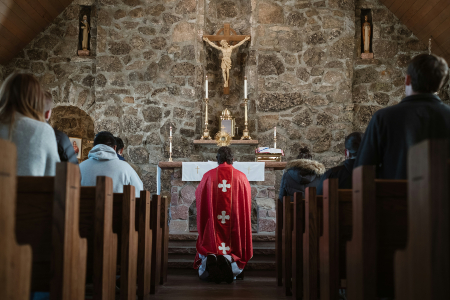
U.S. Catholic Parishes Experience Resurgence of Traditional Practices
-
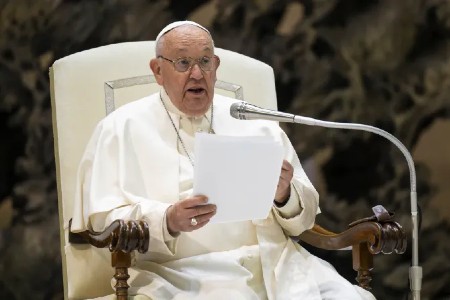
Pope Francis Urges Faith and Prayers for Peace
-
Florida Welcomes Volunteer Chaplains to Public Schools
-
10 Fascinating Details About St. Joseph the Worker: Celebrating His Feast Day - May 1
-
St. Joseph the Worker: Model for Men, Young and Old

Daily Catholic
- Daily Readings for Thursday, May 02, 2024
- St. Athanasius: Saint of the Day for Thursday, May 02, 2024
- The Our Father: Prayer of the Day for Thursday, May 02, 2024
- Daily Readings for Wednesday, May 01, 2024
- St. Marculf: Saint of the Day for Wednesday, May 01, 2024
- To Saint Peregrine: Prayer of the Day for Wednesday, May 01, 2024
 Daily Readings for Thursday, May 02, 2024
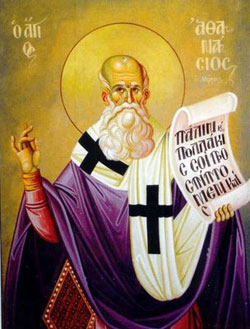 St. Athanasius: Saint of the Day for Thursday, May 02, 2024
 The Our Father: Prayer of the Day for Thursday, May 02, 2024


Copyright 2024 Catholic Online. All materials contained on this site, whether written, audible or visual are the exclusive property of Catholic Online and are protected under U.S. and International copyright laws, © Copyright 2024 Catholic Online. Any unauthorized use, without prior written consent of Catholic Online is strictly forbidden and prohibited.
Catholic Online is a Project of Your Catholic Voice Foundation, a Not-for-Profit Corporation. Your Catholic Voice Foundation has been granted a recognition of tax exemption under Section 501(c)(3) of the Internal Revenue Code. Federal Tax Identification Number: 81-0596847. Your gift is tax-deductible as allowed by law.