Garland
FREE Catholic Classes
A wreath of flowers or evergreens formerly used in connection with baptismal, nuptial, and funeral rites, as well as in solemn processions. The earliest certain reference to the baptismal garland, as worn by neophytes, occurs in a seventh-century description of the Alexandrine ritual, written by the patriarch Severus, who says that, after the baptism and unction (i.e. confirmation ), the priest administered Holy Communion, and crowned the newly- baptized with garlands. This custom was still observed at Alexandria in eighteenth century. A similar rite has also been inferred from a passage in the Gallican liturgy ( baptizati et in Christo coronati ), but more probably this expression is merely metaphorical. The bridal crown or wreath is said to be of pre-Christian Greek origin, adopted later by the Romans. Tertullian refers to it as a sign of paganism, but this prejudice was afterwards set aside, and it was in common use among Christians by the time of St. John Chrysostom. the bride and bridegroom were crowned to symbolize their victory over the temptations of the flesh. (For the continued use of garlands at the marriage ceremony during the early medieval period at Rome, see Duchesne, "Christian Worship", tr. London, 1903, 428-434.) The rite has been retained by the Greek Church, silver crowns taking the place of floral wreaths.
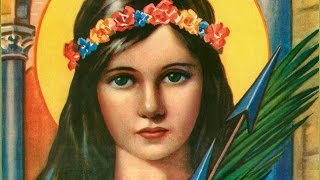
Funeral garlands were used in primitive times, in connection with the burial of virgins, and especially of virgin martyrs, to symbolize their victory, and by analogy they came also to be used for all martyrs. Hence they are constantly found represented in painting or sculpture, on the tombs of the early Christians. In later times a crown, consisting of a wooden hoop, with two half-circles crossing each other at right angles and covered with flowers and streaming ribbons, used to be carried before the bier of an unmarried woman, and afterwards suspended over or near to the grave. This custom was continued in England all through the middle ages and Reformation period, and it survives even now in certain remote places, especially in Devon and Cornwall. The iron hook upon which such wreaths were hung, in the seventeenth century, may still be seen in the south aisle of St. Alban's Abbey. In medieval times the clergy were wont to wear floral garlands or crowns on their heads, on the occasions of solemn processions. Stow mentions one at St. Paul's, London, when the dean and chapter "apparelled in copes and vestments, with garlands of roses on their heads, issued out at the west door" (Survey of London, ed. 1750); and in the inventories and church-wardens' accounts of many an English church, items of expenditure on similar ornaments occur. The same custom prevailed also in German, France and Italy. Martene (De Ant. Eccl. Rit., III, iv) mentions an illuminated missal belonging to a church a Melun, in which such floral garlands are pictured in a Corpus Christi procession, and the same is recorded at Angers, Laon, and elsewhere. According to Martene also, in certain places in France, a priest celebrating his first Mass was similarly decked, which custom still survives in certain parts of Germany and Bavaria. The term garland was also technically used to signify a crown of precious metal, often adorned with gems, made for the arrangement of natural or artificial flowers before the altar or sacred image at festival times.

Come Grow With Us
Sign up and walk the Catholic journey with millions around the world.
Receive inspiring emails on saints, daily readings, and free faith-building resources—no cost, ever.
World Catholic Education Alliance
Your Child Needs Help Tonight—Could the Answer Be Right Here?
Watch the Video.

- 7 Morning Prayers
- Mysteries of the Rosary
- Litany of the Bl. Virgin Mary
- Popular Saints
- Popular Prayers
- Female Saints
- Saint Feast Days by Month
- Stations of the Cross
- St. Francis of Assisi
- St. Michael the Archangel
- The Apostles' Creed
- Unfailing Prayer to St. Anthony
- Pray the Rosary








Copyright 2026 Catholic Online. All materials contained on this site, whether written, audible or visual are the exclusive property of Catholic Online and are protected under U.S. and International copyright laws, © Copyright 2026 Catholic Online. Any unauthorized use, without prior written consent of Catholic Online is strictly forbidden and prohibited.
Catholic Online is a Project of Your Catholic Voice Foundation, a Not-for-Profit Corporation. Your Catholic Voice Foundation has been granted a recognition of tax exemption under Section 501(c)(3) of the Internal Revenue Code. Federal Tax Identification Number: 81-0596847. Your gift is tax-deductible as allowed by law.
