Because of You, 2.2 Million Students Are Being Formed in the Faith
Because of generous supporters like you, Catholic Online School has already delivered free, faithful Catholic education to over 2.2 million students across 193 countries. In an age of noise and algorithms, you are helping form souls with truth, prayer, Scripture, and Christ.
If everyone who reads this gave just $5 — the cost of a coffee — we could reach even more families and keep this life-changing formation free for all. Be Courageous. Be Catholic. Stand with us today.
DONATE TODAY >Pope Saint Martin I
Facts
Death: 655
Author and Publisher - Catholic Online
Printable Catholic Saints PDFs
Shop Pope Saint Martin I
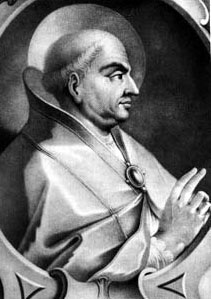
Martin I lay too sick to fight on a couch in front of the altar when the soldiers burst into the Lateran basilica. He had come to the church when he heard the soldiers had landed. But the thought of kidnapping a sick pope from the house of God didn't stop the soldiers from grabbing him and hustling him down to their ship.
Elected pope in 649, Martin I had gotten in trouble for refusing to condone silence in the face of wrong. At that time there existed a popular heresy that held that Christ didn't have a human will, only a divine will. The emperor had issued an edict that didn't support Monothelism (as it was known) directly, but simply commanded that no one could discuss Jesus' will at all.
Monothelism was condemned at a council convened by Martin I. The council affirmed, once again, that since Jesus had two natures, human and divine, he had two wills, human and divine. The council then went further and condemned Constans edict to avoid discussion stating, "The Lord commanded us to shun evil and do good, but not to reject the good with the evil."
In his anger at this slap in the face, the emperor sent his soldiers to Rome to bring the pope to him. When Martin I arrived in Constantinople after a long voyage he was immediately put into prison. There he spent three months in a filthy, freezing cell while he suffered from dysentery. He was not allowed to wash and given the most disgusting food. After he was condemned for treason without being allowed to speak in his defense he was imprisoned for another three months.
From there he was exiled to the Crimea where he suffered from the famine of the land as well as the roughness of the land and its people. But hardest to take was the fact that the pope found himself friendless. His letters tell how his own church had deserted him and his friends had forgotten him. They wouldn't even send him oil or corn to live off of.
He died two years later in exile in the year 656, a martyr who stood up for the right of the Church to establish doctrine even in the face of imperial power.
Come Grow With Us
Sign up and walk the Catholic journey with millions around the world.
Receive inspiring emails on saints, daily readings, and free faith-building resources—no cost, ever.
This could change the future of Catholic Online.
Watch Now
- 7 Morning Prayers
- Mysteries of the Rosary
- Litany of the Bl. Virgin Mary
- Popular Saints
- Popular Prayers
- Female Saints
- Saint Feast Days by Month
- Stations of the Cross
- St. Francis of Assisi
- St. Michael the Archangel
- The Apostles' Creed
- Unfailing Prayer to St. Anthony
- Pray the Rosary







Copyright 2026 Catholic Online. All materials contained on this site, whether written, audible or visual are the exclusive property of Catholic Online and are protected under U.S. and International copyright laws, © Copyright 2026 Catholic Online. Any unauthorized use, without prior written consent of Catholic Online is strictly forbidden and prohibited.
Catholic Online is a Project of Your Catholic Voice Foundation, a Not-for-Profit Corporation. Your Catholic Voice Foundation has been granted a recognition of tax exemption under Section 501(c)(3) of the Internal Revenue Code. Federal Tax Identification Number: 81-0596847. Your gift is tax-deductible as allowed by law.