We have one question for you.
Has Catholic Online given you $5 worth of value this year? Maybe you came here for a prayer. Maybe you read today's Mass readings. Maybe you researched a saint. Maybe you needed an answer about the Catholic Faith. Maybe your child used Catholic Online School. If the answer is no, you don't owe us anything. Keep using Catholic Online. But if the answer is yes, we're asking you to give $5 today.
Catholic Online School has served 2.2 million student enrollments in 193 countries, and we continue working to make Catholic education available regardless of a family's financial circumstances. We don't need every reader to give. We need the readers who recognize the value of what they've received to stand behind it. Is Catholic Online worth $5 to you?
GIVE TODAY >>St. Sabas
Facts
Birth: 439
Death: 532
Author and Publisher - Catholic Online
Printable Catholic Saints PDFs
Shop St. Sabas
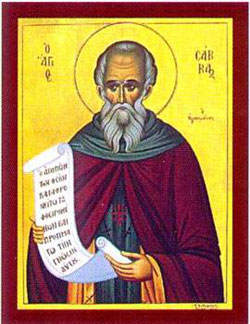
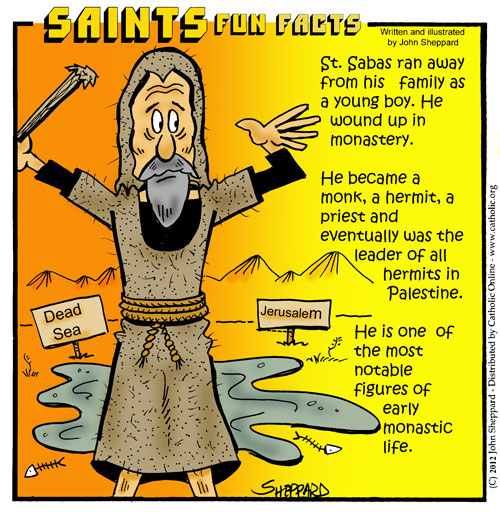
Sabas was born at Mutalaska, Cappadocia, near Caesarea. He was the son of an army officer there who when assigned to Alexandria, left him in the care of an uncle. Mistreated by his uncle's wife, Sabas ran away to another uncle, though he was only eight. When the two uncles became involved in a lawsuit over his estate, he again ran away, this time to a monastery near Mutalaska. In time the uncles were reconciled and wanted him to marry, but he remained in the monastery. In 456, he went to Jerusalem and there entered a monastery under St. Theoctistus. When he was thirty, he became a hermit under the guidance of St. Euthymius, and after Euthymius' death, spent four years alone in the desert near Jericho. Despite his desire for solitude, he attracted disciples, organized them into a laura in 483, and when his one hundred fifty monks asked for a priest and despite his opposition to monks being ordained, he was obliged to accept ordination by Patriarch Sallust of Jerusalem in 491. He attracted disciples from Egypt and Armenia, allowed them a liturgy in their own tongue, and built several hospitals and another monastery near Jericho. He was appointed archimandrite of all hermits in Palestine who lived in separate cells, but his custom of going off by himself during Lent caused dissension in the monastery, and sixty of his monks left to revive a ruined monastery at Thecuna. He bore them no illwill and aided them with food and supplies. In 511, he was one of a delegation of abbots sent to Emperor Anastasius I, a supporter of Eutychianism, which Sabas opposed, to plead with the Emperor to mitigate his persecution of orthodox bishops and religious. They were unsuccessful. Sabas supported Elias of Jerusalem when the Emperor exiled him, was a strong supporter of theological orthodoxy, and persuaded many to return to orthodoxy. He was a vigorous opponent of Origenism and monophysitism. In 531, when he was ninety-one, he again went to Constantinople, this time to plead with Emperor Justinian to suppress a Samaritan revolt and protect the people of Jerusalem from further harassment by the Samritans. He fell ill soon after his return to his laura from this trip and died on December 5 at Laura Mar Saba, after naming his successor. Sabas is one of the most notable figures of early monasticism and is considered one of the founders of Eastern monasticism. The laura he founded in the desolate, wild country between Jerusalem and the Dead Sea, named Mar Saba after him, was often called the Great Laura for its preeminence and produced many great saints. It is still inhabited by monks of the Eastern Orthodox Church and is one of the three or four oldest monasteries in the world. His feast day is December 5th.
Come Grow With Us
Sign up and walk the Catholic journey with millions around the world.
Receive inspiring emails on saints, daily readings, and free faith-building resources—no cost, ever.
Catholic Online Is Free. But We Need Your Help.
Please Watch
- 7 Morning Prayers
- Mysteries of the Rosary
- Litany of the Bl. Virgin Mary
- Popular Saints
- Popular Prayers
- Female Saints
- Saint Feast Days by Month
- Stations of the Cross
- St. Francis of Assisi
- St. Michael the Archangel
- The Apostles' Creed
- Unfailing Prayer to St. Anthony
- Pray the Rosary








Copyright 2026 Catholic Online. All materials contained on this site, whether written, audible or visual are the exclusive property of Catholic Online and are protected under U.S. and International copyright laws, © Copyright 2026 Catholic Online. Any unauthorized use, without prior written consent of Catholic Online is strictly forbidden and prohibited.
Catholic Online is a Project of Your Catholic Voice Foundation, a Not-for-Profit Corporation. Your Catholic Voice Foundation has been granted a recognition of tax exemption under Section 501(c)(3) of the Internal Revenue Code. Federal Tax Identification Number: 81-0596847. Your gift is tax-deductible as allowed by law.