Because of You, 2.2 Million Students Are Being Formed in the Faith
Because of generous supporters like you, Catholic Online School has already delivered free, faithful Catholic education to over 2.2 million students across 193 countries. In an age of noise and algorithms, you are helping form souls with truth, prayer, Scripture, and Christ.
If everyone who reads this gave just $5 — the cost of a coffee — we could reach even more families and keep this life-changing formation free for all. Be Courageous. Be Catholic. Stand with us today.
DONATE TODAY >St. Finbar
Facts
Patron: of Cork, Diocese of Cork
Birth: 550
Death: 620
Author and Publisher - Catholic Online
Printable Catholic Saints PDFs
Shop St. Finbar
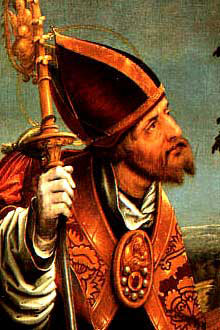
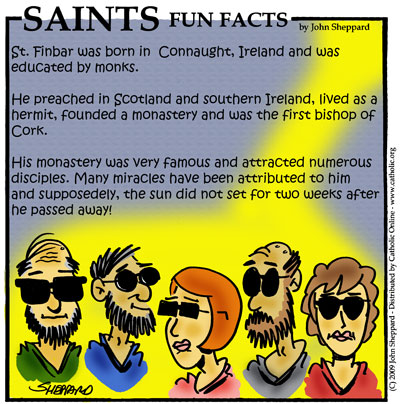
He was the son of an artisan and a lady of the Irish royal court. Born in Connaught, Ireland, and baptized Lochan, he was educated at Kilmacahil, Kilkenny, where the monks named him Fionnbharr (white head) because of his light hair; he is also known as Bairre and Barr. He went on pilgrimage to Rome with some of the monks, visiting St. David in Wales on the way back. Supposedly, on another visit to Rome the Pope wanted to consecrate him a bishop but was deterred by a vision, notifying the pope that God had reserved that honor to Himself, and Finbar was consecrated from heaven and then returned to Ireland. At any rate, he may have preached in Scotland, definitely did in southern Ireland, lived as a hermit on a small island at Lough Eiroe, and then, on the river Lee, founded a monastery that developed into the city of Cork, of which he was the first bishop. His monastery became famous in southern Ireland and attracted numerous disciples. Many extravagant miracles are attributed to him, and supposedly, the sun did not set for two weeks after he died at Cloyne about the year 633. His feast day is September 25th.
Come Grow With Us
Sign up and walk the Catholic journey with millions around the world.
Receive inspiring emails on saints, daily readings, and free faith-building resources—no cost, ever.
Thank You for Being Part of Our Catholic Family.
Watch Sister Sara's Special Message
- 7 Morning Prayers
- Mysteries of the Rosary
- Litany of the Bl. Virgin Mary
- Popular Saints
- Popular Prayers
- Female Saints
- Saint Feast Days by Month
- Stations of the Cross
- St. Francis of Assisi
- St. Michael the Archangel
- The Apostles' Creed
- Unfailing Prayer to St. Anthony
- Pray the Rosary






Copyright 2026 Catholic Online. All materials contained on this site, whether written, audible or visual are the exclusive property of Catholic Online and are protected under U.S. and International copyright laws, © Copyright 2026 Catholic Online. Any unauthorized use, without prior written consent of Catholic Online is strictly forbidden and prohibited.
Catholic Online is a Project of Your Catholic Voice Foundation, a Not-for-Profit Corporation. Your Catholic Voice Foundation has been granted a recognition of tax exemption under Section 501(c)(3) of the Internal Revenue Code. Federal Tax Identification Number: 81-0596847. Your gift is tax-deductible as allowed by law.
