We ask you, humbly: don't scroll away.
Hi readers, it seems you use Catholic Online a lot; that's great! It's a little awkward to ask, but we need your help. If you have already donated, we sincerely thank you. We're not salespeople, but we depend on donations averaging $14.76 and fewer than 1% of readers give. If you donate just $5.00, the price of your coffee, Catholic Online School could keep thriving. Thank you.Help Now >
Nectarius
FREE Catholic Classes
( Nechtarios ), Patriarch of Constantinople, (381-397), died 27 Sept, 397, eleventh bishop of that city since Metrophanes, and may be counted its first patriarch. He came frorn Tarsus of a senatorial family and was praetor at Constantinople at the time of the second general council (381). When St. Gregory Nazianzen resigned his occupation of that see the people called for Nectarius to succeed him and their choice as ratified by the Council ( Socrates, "H.E.", V), before August, 381. Sozomen (H.E., VII, 8) adds that Nectorius, about to return to Tarsus, asked Diodorus, Bishop of Tarsus, if he could carry any letters for him. Diodorus, who saw that his visitor was the most suitable person to become Bishop of Constantinoble, persuaded Meletius, Bishop of Antioch, to add his name to the list of candidates presented by the council to the emperor. The emperor then to every one's surprise, chose Nectarius, who was not yet baptized, and in neophyte's robe he was consecrated bishop. Tillemont (Mémoires, IX, 486) doubts this story. Soon after Nectarius' election the Council passed the famous third canon giving Constantinople rank immediately after Rome. A man of no very great power, Nectarius had an uneventful reign with which St. Gregory was not altogether pleased ("Ep." 88, 91, 151, etc; Tillemont, op. cit. , IX, 488). Suspected of concessions to the Novatians ( Socrates, V, 10; Sozomen, VII, I2), he made none to the Arians, who in 388 burnt his house ( Socrates, V, 13). Palsamon says that in 394 he held a synod at Constantinople which decreed that no bishop should be deposed without the consent of several other bishops of the same province (Harduin, I, 955). The most important event, however, is that, according to Socrates (V, 19) and Sozomen (VII, 16), as a result of a public scandal Nectarius abolished the discipline of public penance and the office of penitentiary hitherto held by a priest of his diocese. The incident is important for the history of Penance. Nectarius preached a sermon about the martyr Theodore still extant (P.G. XXXIX, 1821-40, Nilles "Kalendarium manuale", II, 96-100). He was succeeded by St. John Chrysostom and appears as St. Nectarius in the Orthodox Menaion for 11 October ( Nilles, op. cit. I, 300; "Acta SS". May, II, 421).
 Hi readers, it seems you use Catholic Online a lot; that's great! It's a little awkward to ask, but we need your help. If you have already donated, we sincerely thank you. We're not salespeople, but we depend on donations averaging $14.76 and fewer than 1% of readers give. If you donate just $5.00, the price of your coffee, Catholic Online School could keep thriving. Thank you. Help Now >
We ask you, humbly: don't scroll away.
Hi readers, it seems you use Catholic Online a lot; that's great! It's a little awkward to ask, but we need your help. If you have already donated, we sincerely thank you. We're not salespeople, but we depend on donations averaging $14.76 and fewer than 1% of readers give. If you donate just $5.00, the price of your coffee, Catholic Online School could keep thriving. Thank you.Help Now >

Join the Movement
When you sign up below, you don't just join an email list - you're joining an entire movement for Free world class Catholic education.


-

-
Mysteries of the Rosary
-
St. Faustina Kowalska
-
Litany of the Blessed Virgin Mary
-
Saint of the Day for Wednesday, Oct 4th, 2023
-
Popular Saints
-
St. Francis of Assisi
-
Bible
-
Female / Women Saints
-
7 Morning Prayers you need to get your day started with God
-
Litany of the Blessed Virgin Mary


Sacrifices of Faith: The Pro-Life Legacies of St. Gianna and Jessica Hanna
-
How to love God by caring for our bodies
-
Pope Francis calls for negotiations to End Russia-Ukraine War
-
Pope Francis Contemplates Return to U.S. for United Nations Assembly Address
-
Pope Francis Calls on Faithful to Embrace Faith, Hope, and Charity in New Teaching Series


Daily Catholic
- Daily Readings for Monday, April 29, 2024
- St. Catherine of Siena: Saint of the Day for Monday, April 29, 2024
- Prayer for the Dead # 3: Prayer of the Day for Monday, April 29, 2024
- Daily Readings for Sunday, April 28, 2024
- St. Peter Chanel: Saint of the Day for Sunday, April 28, 2024
- Prayer before a Crucifix: Prayer of the Day for Sunday, April 28, 2024
 Daily Readings for Monday, April 29, 2024
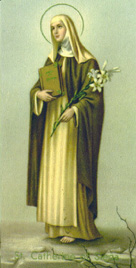 St. Catherine of Siena: Saint of the Day for Monday, April 29, 2024
 Prayer for the Dead # 3: Prayer of the Day for Monday, April 29, 2024


Copyright 2024 Catholic Online. All materials contained on this site, whether written, audible or visual are the exclusive property of Catholic Online and are protected under U.S. and International copyright laws, © Copyright 2024 Catholic Online. Any unauthorized use, without prior written consent of Catholic Online is strictly forbidden and prohibited.
Catholic Online is a Project of Your Catholic Voice Foundation, a Not-for-Profit Corporation. Your Catholic Voice Foundation has been granted a recognition of tax exemption under Section 501(c)(3) of the Internal Revenue Code. Federal Tax Identification Number: 81-0596847. Your gift is tax-deductible as allowed by law.