We ask you, humbly: don't scroll away.
Hi readers, it seems you use Catholic Online a lot; that's great! It's a little awkward to ask, but we need your help. If you have already donated, we sincerely thank you. We're not salespeople, but we depend on donations averaging $14.76 and fewer than 1% of readers give. If you donate just $5.00, the price of your coffee, Catholic Online School could keep thriving. Thank you.Help Now >
Benedictus Arias Montanus
FREE Catholic Classes
Orientalist, exegete, and editor of the "Antwerp Polyglot", born at Frejenal de la Sierra in Estremadura, Spain, 1527; died at Seville, 1598. Passing through the schools of Seville, he studied theology and the Oriental languages at Alcalá, later gaining proficiency in the various European languages by means of extended travel. He became a clerical member of the Military Order of St. James, and accompanied the Bishop of Segovia to the Council of Trent (1562) where he won great distinction. On his return he retired to a hermitage at Aracena whence he was summoned by Philip II (1568) to supervise a new polyglot edition of the Bible , with the collaboration of many learned men. The work was issued from the Plantin press (1572, 8 volumes) under the title "Biblia sacra hebraice chaldaice, graece et latine, Philippi II regis catholici pietate et studio ad sacrosanctae Ecclesiae usum", several volumes being devoted to a scholarly apparatus biblicus . Arias was responsible for a large part of the actual matter, besides the general superintendence, and in obedience to the command of the king took the work to Rome for the approbation of Gregory XIII. Leon de Castro professor of Oriental languages at Salamanca, to whose translation of the Vulgate Arias had opposed the original Hebrew text, denounced Arias to the Roman, and later to the Spanish Inquisition for having altered the Biblical text, making too liberal use of the rabbinical writings, in disregard of the decree of the Council of Trent concerning the authenticity of the Vulgate, and confirming the Jews in their beliefs by his Chaldaic paraphrases. After several journeys to Rome Arias was freed of the charges (1580) and returned to his hermitage, refusing the episcopal honours offered him by the King. He accepted, however, the post of a royal chaplain, but was only induced to leave his retirement for the purpose of a superintending the Escorial library and of teaching Oriental languages. He led the life of an ascerlc, dividing his time between prayer and study. In addition to the works written in connection with polyglot, the most celebrated of which is "Antiquitatum judaicarum libri IX" (Leyden, 1593), Arias left many commentaries on various books of the Bible ; also: "Humanae salutis monumenta" (Antwerp, 1571); a Latin translation of the "Itinerary" of Benjamin of Tudela, and other works on widely varying subjects. He was also celebrated as a poet, his verses being chiefly of a religious nature.
We ask you, humbly: don't scroll away.
Hi readers, it seems you use Catholic Online a lot; that's great! It's a little awkward to ask, but we need your help. If you have already donated, we sincerely thank you. We're not salespeople, but we depend on donations averaging $14.76 and fewer than 1% of readers give. If you donate just $5.00, the price of your coffee, Catholic Online School could keep thriving. Thank you.Help Now >

Join the Movement
When you sign up below, you don't just join an email list - you're joining an entire movement for Free world class Catholic education.


-

-
Mysteries of the Rosary
-
St. Faustina Kowalska
-
Litany of the Blessed Virgin Mary
-
Saint of the Day for Wednesday, Oct 4th, 2023
-
Popular Saints
-
St. Francis of Assisi
-
Bible
-
Female / Women Saints
-
7 Morning Prayers you need to get your day started with God
-
Litany of the Blessed Virgin Mary


Sacrifices of Faith: The Pro-Life Legacies of St. Gianna and Jessica Hanna
-
How to love God by caring for our bodies
-
Pope Francis calls for negotiations to End Russia-Ukraine War
-
Pope Francis Contemplates Return to U.S. for United Nations Assembly Address
-
Pope Francis Calls on Faithful to Embrace Faith, Hope, and Charity in New Teaching Series


Daily Catholic
- Daily Readings for Monday, April 29, 2024
- St. Catherine of Siena: Saint of the Day for Monday, April 29, 2024
- Prayer for the Dead # 3: Prayer of the Day for Monday, April 29, 2024
- Daily Readings for Sunday, April 28, 2024
- St. Peter Chanel: Saint of the Day for Sunday, April 28, 2024
- Prayer before a Crucifix: Prayer of the Day for Sunday, April 28, 2024
 Daily Readings for Monday, April 29, 2024
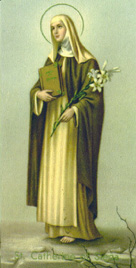 St. Catherine of Siena: Saint of the Day for Monday, April 29, 2024
 Prayer for the Dead # 3: Prayer of the Day for Monday, April 29, 2024
We ask you, humbly: don't scroll away.
Hi readers, it seems you use Catholic Online a lot; that's great! It's a little awkward to ask, but we need your help. If you have already donated, we sincerely thank you. We're not salespeople, but we depend on donations averaging $14.76 and fewer than 1% of readers give. If you donate just $5.00, the price of your coffee, Catholic Online School could keep thriving. Thank you.Help Now >


Copyright 2024 Catholic Online. All materials contained on this site, whether written, audible or visual are the exclusive property of Catholic Online and are protected under U.S. and International copyright laws, © Copyright 2024 Catholic Online. Any unauthorized use, without prior written consent of Catholic Online is strictly forbidden and prohibited.
Catholic Online is a Project of Your Catholic Voice Foundation, a Not-for-Profit Corporation. Your Catholic Voice Foundation has been granted a recognition of tax exemption under Section 501(c)(3) of the Internal Revenue Code. Federal Tax Identification Number: 81-0596847. Your gift is tax-deductible as allowed by law.