Guitmund
FREE Catholic Classes
A Bishop of Aversa, a Benedictine monk, theologian, and opponent of Berengarius ; born at an unknown place in Normandy during the first quarter of the eleventh century; died between 1090-95, at Aversa, near Naples. In his youth he entered the Benedictine monastery of La-Croix-St-Leufroy in the Diocese of Evreux, and about 1060 he was studying theology at the monastery of Bec, where he had Lanfranc as teacher and St. Anselm of Canterbury as fellow-student. In 1070 King William the Conqueror called him to England and, as an inducement to remain there, offered him a diocese. The humble monk, however, not only refused the offer, but fearlessly denounced the conquest of England by the Normans as an act of robbery ("Oratio ad Guillelmum I" in P. L., CXLIX, 1509). He then returned to Normandy and became a stanch defender of the Catholic doctrine of Transubstantiation against the heretical Berengarius of Tours. Some time between 1073-77 he wrote, at the instance of one of his fellow-monks by the name of Roger, his famous treatise on the Holy Eucharist , entitled "De corporis et sanguinis Jesu Christi veritate in Eucharistia". It is written in the form of a dialogue between himself and Roger and contains an exposition as well as a refutation of the doctrines of Berengarius concerning the Holy Eucharist. Guitmund ably defends Transubstantiation against Berengarius, but his notion of the manner of the Real Presence is obscure. Moreover, he does not well distinguish between substance and accident, and hence concludes that the corruptibility of the species is merely a deception of our senses. The work has often appeared in print. The first printed edition was brought out by Erasmus (Freiburg, 1530). Shortly after Guitmund had published his treatise against Berengarius, he obtained permission from his abbot, Odilo, to make a pilgrimage to Rome. Because the name Guitmund had become too well known to suit the humble monk, he exchanged it for that of Christianus and lived for some time in the obscurity of a Roman monastery. When Urban II, who had previously been a monk at Cluny, became pope, he appointed Guitmund Bishop of Aversa, near Naples, in 1088. A few historians hold that he afterwards became a cardinal, but there seems not to be sufficient evidence for this assumption. Besides the work mentioned above, Guitmund is the author of a short treatise on the Trinity and of an epistle to a certain Erfastus, which deals with the same subject. His works are published in "Bibl. Patr. Lugd.", XVIII, 440 sqq.; in Gallandi, "Bibl. veterum Patr.", XIV, 240 sqq., and Migne, "P. L.", CXLIX, 1427-1513.
We ask you, humbly: don't scroll away.
Hi readers, it seems you use Catholic Online a lot; that's great! It's a little awkward to ask, but we need your help. If you have already donated, we sincerely thank you. We're not salespeople, but we depend on donations averaging $14.76 and fewer than 1% of readers give. If you donate just $5.00, the price of your coffee, Catholic Online School could keep thriving. Thank you.Help Now >
 Hi readers, it seems you use Catholic Online a lot; that's great! It's a little awkward to ask, but we need your help. If you have already donated, we sincerely thank you. We're not salespeople, but we depend on donations averaging $14.76 and fewer than 1% of readers give. If you donate just $5.00, the price of your coffee, Catholic Online School could keep thriving. Thank you. Help Now >

Join the Movement
When you sign up below, you don't just join an email list - you're joining an entire movement for Free world class Catholic education.


-

-
Mysteries of the Rosary
-
St. Faustina Kowalska
-
Litany of the Blessed Virgin Mary
-
Saint of the Day for Wednesday, Oct 4th, 2023
-
Popular Saints
-
St. Francis of Assisi
-
Bible
-
Female / Women Saints
-
7 Morning Prayers you need to get your day started with God
-
Litany of the Blessed Virgin Mary

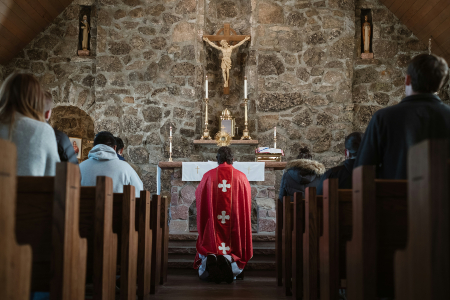
U.S. Catholic Parishes Experience Resurgence of Traditional Practices
-
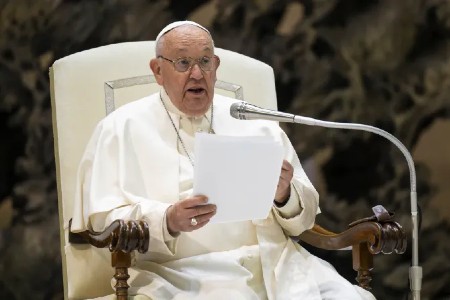
Pope Francis Urges Faith and Prayers for Peace
-
Florida Welcomes Volunteer Chaplains to Public Schools
-
10 Fascinating Details About St. Joseph the Worker: Celebrating His Feast Day - May 1
-
St. Joseph the Worker: Model for Men, Young and Old

Daily Catholic
- Daily Readings for Thursday, May 02, 2024
- St. Athanasius: Saint of the Day for Thursday, May 02, 2024
- The Our Father: Prayer of the Day for Thursday, May 02, 2024
- Daily Readings for Wednesday, May 01, 2024
- St. Marculf: Saint of the Day for Wednesday, May 01, 2024
- To Saint Peregrine: Prayer of the Day for Wednesday, May 01, 2024
 Daily Readings for Thursday, May 02, 2024
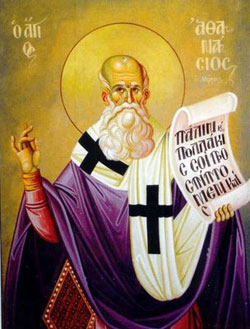 St. Athanasius: Saint of the Day for Thursday, May 02, 2024
 The Our Father: Prayer of the Day for Thursday, May 02, 2024
We ask you, humbly: don't scroll away.
Hi readers, it seems you use Catholic Online a lot; that's great! It's a little awkward to ask, but we need your help. If you have already donated, we sincerely thank you. We're not salespeople, but we depend on donations averaging $14.76 and fewer than 1% of readers give. If you donate just $5.00, the price of your coffee, Catholic Online School could keep thriving. Thank you.Help Now >


Copyright 2024 Catholic Online. All materials contained on this site, whether written, audible or visual are the exclusive property of Catholic Online and are protected under U.S. and International copyright laws, © Copyright 2024 Catholic Online. Any unauthorized use, without prior written consent of Catholic Online is strictly forbidden and prohibited.
Catholic Online is a Project of Your Catholic Voice Foundation, a Not-for-Profit Corporation. Your Catholic Voice Foundation has been granted a recognition of tax exemption under Section 501(c)(3) of the Internal Revenue Code. Federal Tax Identification Number: 81-0596847. Your gift is tax-deductible as allowed by law.