 Dear readers, Catholic Online was de-platformed by Shopify for our pro-life beliefs. They shut down our Catholic Online, Catholic Online School, Prayer Candles, and Catholic Online Learning Resources essential faith tools serving over 1.4 million students and millions of families worldwide. Our founders, now in their 70's, just gave their entire life savings to protect this mission. But fewer than 2% of readers donate. If everyone gave just $5, the cost of a coffee, we could rebuild stronger and keep Catholic education free for all. Stand with us in faith. Thank you. Help Now >
St. Godeberta
FREE Catholic Classes
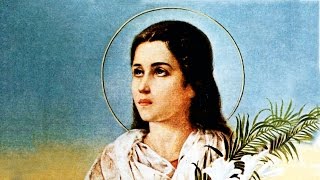
Born about the year 640, at Boves, a few leagues from Amiens, in France ; died about the beginning of the eighth century, at Noyon (Oise), the ancient Noviomagus. She was very carefully educated, her parents being of noble rank and attached to the court of King Clovis II. When the question of her marriage was being discussed in presence of the king, the saintly Bishop of Noyon, Eligius, as if by inspiration, presented Godeberta with a golden ring and expressed the hope that she might devote her life to the service of God. Godeberta, moved by the Holy Spirit and feeling her heart suddenly filled with Divine love, turned away from the bright prospects before her and refused the advantageous offers that had been made by her noble suitors. She declared her willingness to be the spouse of Christ and asked the holy prelate to allow her to assume the veil. In a short time all opposition to her wishes disappeared and she entered on her new life under the guidance of St. Eligius. The King of the Franks was impressed by her conduct and her zeal that he made her a present of the small palace which he had at Noyon, together with a little chapel dedicated to St. George. Godeberta's example inspired a number of young women to follow in the same path, and she founded in her new home a convent, of which she became the superioress. Here she passed the remainder of her life in prayer and solitude, save when the call of charity or religion brought her forth among the people, many of whom were still sunk in the vices of paganism. She was remarkable in particular for the constant penances and fasts to which she subjected herself. She had a wonderful faith in the efficacy of that ancient practice of the early Christians --the sign of the cross, and it is recorded, that on one occasion, in 676, during the episcopacy of St. Mommelinus, when the town was threatened with total destruction by fire, she made the sign of the cross over the flames, and the conflagration was forthwith extinguished. The exact year of her death is unknown, but it is said to have occurred on 11 June, on which day her feast is marked in the Proprium of Beauvais. In Noyon, however, by virtue of an indult, dated 2 April, 1857, it is kept on the fifth Sunday after Easter. The body of the saint was interred in the church of St. George, which was afterwards called by her name.
In 1168 Godeberta's body was solemnly translated from the ruined church where it had rested for over 450 years by Bishop Baudoin to the cathedral of Noyon. Providentially her relics have escaped the ravages of time and fire, and the malice of the irreligious. At the period of the Revolution a pious townsman secretly buried them near the cathedral. When the storm had passed they were recovered from their hiding place and their authenticity being canonically established they were replaced in the church. A bell is still preserved which tradition avers to have been the one actually used by Godeberta in her convent. It is certainly very ancient and there seems no good reason, in particular from an archaeological point of view, for doubting the trustworthiness of the legend. In the treasury of the cathedral likewise may be seen a gold ring, said to have been that presented by St. Eligius to the saint. Mention is made in a record of the year 1167 of this relic having been then in the possession of the church of Noyon.
Unfortunately the most ancient documents we have giving details of Godeberta's life do not, in all probability, date back beyond the eleventh century, as the oldest "Vita", which, in truth, is rather a panegyric for her feast than a biography, is believed to have been composed by Radbodus, who became Bishop of Noyon in 1067. In those days, too, the aim of such writers was the edification rather than the instruction of the faithful, so we find in this life the usual wonders related in such pious works of that period with but few historic facts. It is certain, however, that St. Godeberta was looked upon as a protector in the time of plagues and catastrophes and we have every reason to hold that this practice was justified by the results that followed her solemn invocation. In 1866 a violent outbreak of typhoid fever occurred in Noyon, decimating the town. On 23 May in that year, one of the leading citizens, whose child had just been stricken down, approached the cure of the church and recalling the favours that had been granted in ages past to the clients of the saint, earnestly asked that the shrine containing her relics should be exposed and a novena of intercession begun. This was done the following day, and forthwith the scourge ceased; it was officially certified that not another case of typhoid occurred. In thanksgiving a solemn procession took place under the guidance of the bishop, Mgr Gignoux, a few weeks later, the relics of St. Godeberta being carried triumphantly through the town. A beautiful statue of the saint, the cathedral of Noyon, which was blessed by the bishop on 25 February, 1867, perpetuated the memory of this wonderful event.


Come Grow With Us
Sign up and walk the Catholic journey with millions around the world.
Receive inspiring emails on saints, daily readings, and free faith-building resources—no cost, ever.
Sister Sara just dropped the truth about the future of Catholic education… and It’s Not What You Think
- Easter / Lent
- 5 Lenten Prayers
- Ash Wednesday
- 7 Morning Prayers
- Mysteries of the Rosary
- Litany of the Bl. Virgin Mary
- Popular Saints
- Popular Prayers
- Female Saints
- Saint Feast Days by Month
- Stations of the Cross
- St. Francis of Assisi
- St. Michael the Archangel
- The Apostles' Creed
- Unfailing Prayer to St. Anthony
- Pray the Rosary









Copyright 2026 Catholic Online. All materials contained on this site, whether written, audible or visual are the exclusive property of Catholic Online and are protected under U.S. and International copyright laws, © Copyright 2026 Catholic Online. Any unauthorized use, without prior written consent of Catholic Online is strictly forbidden and prohibited.
Catholic Online is a Project of Your Catholic Voice Foundation, a Not-for-Profit Corporation. Your Catholic Voice Foundation has been granted a recognition of tax exemption under Section 501(c)(3) of the Internal Revenue Code. Federal Tax Identification Number: 81-0596847. Your gift is tax-deductible as allowed by law.