We ask you, humbly: don't scroll away.
Hi readers, it seems you use Catholic Online a lot; that's great! It's a little awkward to ask, but we need your help. If you have already donated, we sincerely thank you. We're not salespeople, but we depend on donations averaging $14.76 and fewer than 1% of readers give. If you donate just $5.00, the price of your coffee, Catholic Online School could keep thriving. Thank you.Help Now >
St. Cajetan
FREE Catholic Classes
(GAETANO.)
Founder of the Theatines, born October, 1480 at Vicenza in Venetian territory; died at Naples in 1547. Under the care of a pious mother he passed a studious and exemplary youth, and took his degree as doctor utriusque juris at Padua in his twenty-fourth year. In 1506 he became at Rome a prothonotary Apostolic in the court of Julius II, and took an important share in reconciling the Republic of Venice with that pontiff. On the death of Julius in 1523 he withdrew from the court, and is credited with founding, shortly after, an association of pious priests and prelates called the Oratory of Divine Love, which spread to other Italian towns. Though remarkable for his intense love of God, he did not advance to the priesthood till 1516. Recalled to Vicenza in the following year by the death of his mother, he founded there a hospital for incurables, thus giving proof of the active charity that filled his whole life. But his zeal was more deeply moved by the spiritual diseases that, in those days of political disorder, infected the clergy of all ranks, and, like St. Augustine in earlier times, he strove to reform them by instituting a body of regular clergy, who should combine the spirit of monasticism with the exercises of the active ministry.

Returning to Rome in 1523 he laid the foundations of his new congregation, which was canonically erected by Clement VII in 1524. One of his four companions was Giovanni Pietro Caraffa, Bishop of Chieti (in Latin Theate ), afterwards Paul IV, who was elected first superior, and from whose title arose the name Theatines. The order grew but slowly. During the sack of Rome in 1527 the Theatines, then twelve in number, escaped to Venice after enduring many outrages from the heretic invaders. There Cajetan met St. Hieronymus Æmiliani (see SOMASCHI), whom he assisted in the establishment of his Congregation of Clerks Regular. In 1533 Cajetan founded a house in Naples, where he was able to check the advances of Lutheranism. In 1540 he was again at Venice, whence he extended his work to Verona and Vicenza. He passed the last four years of his life, a sort of seraphic existence, at Naples where he died finally of grief at the discords of the city, suffering in his last moments a kind of mystical crucifixion. He was beatified by Urban VIII in 1629, and canonized by Clement X in 1671. His feast is kept on the 7th of August.
We ask you, humbly: don't scroll away.
Hi readers, it seems you use Catholic Online a lot; that's great! It's a little awkward to ask, but we need your help. If you have already donated, we sincerely thank you. We're not salespeople, but we depend on donations averaging $14.76 and fewer than 1% of readers give. If you donate just $5.00, the price of your coffee, Catholic Online School could keep thriving. Thank you.Help Now >
We ask you, humbly: don't scroll away.
Hi readers, it seems you use Catholic Online a lot; that's great! It's a little awkward to ask, but we need your help. If you have already donated, we sincerely thank you. We're not salespeople, but we depend on donations averaging $14.76 and fewer than 1% of readers give. If you donate just $5.00, the price of your coffee, Catholic Online School could keep thriving. Thank you.Help Now >
Join the Movement
When you sign up below, you don't just join an email list - you're joining an entire movement for Free world class Catholic education.


-

-
Mysteries of the Rosary
-
St. Faustina Kowalska
-
Litany of the Blessed Virgin Mary
-
Saint of the Day for Wednesday, Oct 4th, 2023
-
Popular Saints
-
St. Francis of Assisi
-
Bible
-
Female / Women Saints
-
7 Morning Prayers you need to get your day started with God
-
Litany of the Blessed Virgin Mary


Sacrifices of Faith: The Pro-Life Legacies of St. Gianna and Jessica Hanna
-
How to love God by caring for our bodies
-
Pope Francis calls for negotiations to End Russia-Ukraine War
-
Pope Francis Contemplates Return to U.S. for United Nations Assembly Address
-
Pope Francis Calls on Faithful to Embrace Faith, Hope, and Charity in New Teaching Series


Daily Catholic
- Daily Readings for Monday, April 29, 2024
- St. Catherine of Siena: Saint of the Day for Monday, April 29, 2024
- Prayer for the Dead # 3: Prayer of the Day for Monday, April 29, 2024
- Daily Readings for Sunday, April 28, 2024
- St. Peter Chanel: Saint of the Day for Sunday, April 28, 2024
- Prayer before a Crucifix: Prayer of the Day for Sunday, April 28, 2024
 Daily Readings for Monday, April 29, 2024
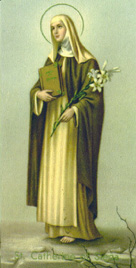 St. Catherine of Siena: Saint of the Day for Monday, April 29, 2024
 Prayer for the Dead # 3: Prayer of the Day for Monday, April 29, 2024


Copyright 2024 Catholic Online. All materials contained on this site, whether written, audible or visual are the exclusive property of Catholic Online and are protected under U.S. and International copyright laws, © Copyright 2024 Catholic Online. Any unauthorized use, without prior written consent of Catholic Online is strictly forbidden and prohibited.
Catholic Online is a Project of Your Catholic Voice Foundation, a Not-for-Profit Corporation. Your Catholic Voice Foundation has been granted a recognition of tax exemption under Section 501(c)(3) of the Internal Revenue Code. Federal Tax Identification Number: 81-0596847. Your gift is tax-deductible as allowed by law.
