 Hi readers, it seems you use Catholic Online a lot; that's great! It's a little awkward to ask, but we need your help. If you have already donated, we sincerely thank you. We're not salespeople, but we depend on donations averaging $14.76 and fewer than 1% of readers give. If you donate just $5.00, the price of your coffee, Catholic Online School could keep thriving. Thank you. Help Now >
William Walsh
FREE Catholic Classes
Bishop of Meath, Ireland (1554-77); b. at Dunboyne, Co. Meath, about 1512; d. at Alcalá de Henares, 4 Jan., 1577. He joined the Cistercians at Bective, Co. Meath, and being sent to study at Oxford took a doctor's degree in divinity either there or elsewhere. The suppression of religious houses must have driven him from Oxford in 1536, and the confiscation of Bective in 1537 left him homeless. Going abroad, he became chaplain to Cardinal Pole at Rome. It was now probably that by papal dispensation he exchanged into the Canons Regular of St. Augustine, and was made prior of their suppressed monasteries of Dulchek and Colpe. Walsh returned when Pole came as legate to England, for in 1554 he was in the Irish commission for depriving married clergy. Staples, Bishop of Meath, being thus deprived, Walsh, already nominated by the Crown, was appointed by the legate, 18 Oct., 1554, subject to seeking papal confirmation within twelve months. He assumed his charge immediately, retaining, as the see was impoverished, the rectory of Loughsewdy and his priories. Henceforward he was busied in ecclesiastical and civil affairs, and the Government employed him in many commissions until the second year of Queen Elizabeth. But when she introduced a Protestant liturgy into Ireland, Walsh resisted strenuously in Convocatio, and preached at Trim against the Boo of Common Prayer. On 4 Feb., 1560, he refused the oath of supremacy, was depirved of his temporalities, and by the Queen's order committed to custody. Divested of royal favour and withdrawn from secular affairs, he recalled the condition of his appointment, and when released, some eighteen months later, he submitted his case at Rome. In consistory held 6 Sept., 1564, the legate's provision was declared void, and the pope, in the circumstances, reappointed Dr. Walsh. About the time when this would have been known in Ireland, Walsh was cited before the Ecclesiastical Commission , and on refusing the oath of supremacy or to answer interrogatories, was committed to Dublin Castle, 143 July, 1565.

Loftus, the Protestant primate, advised his removal to England that the learned bishops there might win him to conformity; he was, he said, of great credit among his countrymen, who depended wholly on him in religious concerns. Nevertheless he was left in Dublin, and lay fettered in a dark and filthy cell in Christmas, 1572, when his friends contrived his escape to Nantes in Brittany. After six months of destitution he was aided by the nuncio in France to proceed to Spain. He reached Alcalá almost moribund through privations, fatigues, and festering wounds form his fetters, and was first received in the house of a pious lady, who herself dressed his sores and nursed him with tender solicitude. Afterwards he removed to the Cistercian convent and expired among his former brethren, esteemed a martyr to the Faith. He was buried in the Church of St. Secundinus and the Bishop of Grenada erected a monument to his memory.
We ask you, humbly: don't scroll away.
Hi readers, it seems you use Catholic Online a lot; that's great! It's a little awkward to ask, but we need your help. If you have already donated, we sincerely thank you. We're not salespeople, but we depend on donations averaging $14.76 and fewer than 1% of readers give. If you donate just $5.00, the price of your coffee, Catholic Online School could keep thriving. Thank you.Help Now >
Hi readers, it seems you use Catholic Online a lot; that's great! It's a little awkward to ask, but we need your help. If you have already donated, we sincerely thank you. We're not salespeople, but we depend on donations averaging $14.76 and fewer than 1% of readers give. If you donate just $5.00, the price of your coffee, Catholic Online School could keep thriving. Thank you. Help Now >
Join the Movement
When you sign up below, you don't just join an email list - you're joining an entire movement for Free world class Catholic education.


-

-
Mysteries of the Rosary
-
St. Faustina Kowalska
-
Litany of the Blessed Virgin Mary
-
Saint of the Day for Wednesday, Oct 4th, 2023
-
Popular Saints
-
St. Francis of Assisi
-
Bible
-
Female / Women Saints
-
7 Morning Prayers you need to get your day started with God
-
Litany of the Blessed Virgin Mary


Sacrifices of Faith: The Pro-Life Legacies of St. Gianna and Jessica Hanna
-
How to love God by caring for our bodies
-
Pope Francis calls for negotiations to End Russia-Ukraine War
-
Pope Francis Contemplates Return to U.S. for United Nations Assembly Address
-
Pope Francis Calls on Faithful to Embrace Faith, Hope, and Charity in New Teaching Series


Daily Catholic
- Daily Readings for Monday, April 29, 2024
- St. Catherine of Siena: Saint of the Day for Monday, April 29, 2024
- Prayer for the Dead # 3: Prayer of the Day for Monday, April 29, 2024
- Daily Readings for Sunday, April 28, 2024
- St. Peter Chanel: Saint of the Day for Sunday, April 28, 2024
- Prayer before a Crucifix: Prayer of the Day for Sunday, April 28, 2024
 Daily Readings for Monday, April 29, 2024
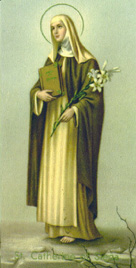 St. Catherine of Siena: Saint of the Day for Monday, April 29, 2024
 Prayer for the Dead # 3: Prayer of the Day for Monday, April 29, 2024


Copyright 2024 Catholic Online. All materials contained on this site, whether written, audible or visual are the exclusive property of Catholic Online and are protected under U.S. and International copyright laws, © Copyright 2024 Catholic Online. Any unauthorized use, without prior written consent of Catholic Online is strictly forbidden and prohibited.
Catholic Online is a Project of Your Catholic Voice Foundation, a Not-for-Profit Corporation. Your Catholic Voice Foundation has been granted a recognition of tax exemption under Section 501(c)(3) of the Internal Revenue Code. Federal Tax Identification Number: 81-0596847. Your gift is tax-deductible as allowed by law.