 Dear readers, Catholic Online was de-platformed by Shopify for our pro-life beliefs. They shut down our Catholic Online, Catholic Online School, Prayer Candles, and Catholic Online Learning Resources essential faith tools serving over 2.2 million students and millions of families worldwide. Our founders, now in their 70's, just gave their entire life savings to protect this mission. But fewer than 2% of readers donate. If everyone gave just $5, the cost of a coffee, we could rebuild stronger and keep Catholic education free for all. Stand with us in faith. Thank you. DONATE TODAY >
St. Sophronius of Jerusalem
Facts
Birth: 560
Death: 638
Author and Publisher - Catholic Online
Printable Catholic Saints PDFs
Shop St. Sophronius of Jerusalem
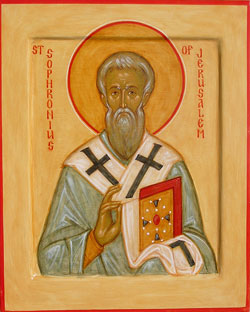
Patriarch St. Sophronius of Jerusalem was called the Sophist because of his knowledge of Greek. He was an ardent opponent of monothelitism. Many of his writings, including the Florilegium and the life of St. John the Almsgiver, are no longer extant. He wrote an encomium on John of Cyrus and composed 23 anacreontic odes on the feasts of the church. His Christmas homily of 634 suggests that the Saracens held Bethlehem at that time. (Historians had dated the event later). The Orthodox remember St. Sophronius chiefly as the author of the life of St. Mary of Egypt. Sophronius was born in Damascus around 560. He and his friend John Moschus became ascetics together while they were in their late teens or early twenties. Some say they lived near the Jordan; some say they lived in Egypt. In 605, Sophronius fled to Alexandria in the wake of Persian invaders, and when the Persians invaded Alexandria in 616, he fled to Rome. In 619, he returned to Palestine and lived in the Theodosius monastery in Jerusalem. When Patriarch Cyrus of Alexandria began to preach monothelitism, St. Sophronius travelled to that city to argue against him; in 633, when Patriarch Sergius of Constantinople began to preach monothelitism, St. Sophronius travelled to that city to argue against him. Neither visit was successful. After Sophronius was elected Patriarch of Jerusalem in 634, he wrote the Synodical Letter to teach the two wills of Christ. In 637, the Muslims captured Jerusalem; St. Sophronius died a year later of grief at the fall of his city.

Come Grow With Us
Sign up and walk the Catholic journey with millions around the world.
Receive inspiring emails on saints, daily readings, and free faith-building resources—no cost, ever.
This could change the future of Catholic Online.
Watch Now
- 7 Morning Prayers
- Mysteries of the Rosary
- Litany of the Bl. Virgin Mary
- Popular Saints
- Popular Prayers
- Female Saints
- Saint Feast Days by Month
- Stations of the Cross
- St. Francis of Assisi
- St. Michael the Archangel
- The Apostles' Creed
- Unfailing Prayer to St. Anthony
- Pray the Rosary







Copyright 2026 Catholic Online. All materials contained on this site, whether written, audible or visual are the exclusive property of Catholic Online and are protected under U.S. and International copyright laws, © Copyright 2026 Catholic Online. Any unauthorized use, without prior written consent of Catholic Online is strictly forbidden and prohibited.
Catholic Online is a Project of Your Catholic Voice Foundation, a Not-for-Profit Corporation. Your Catholic Voice Foundation has been granted a recognition of tax exemption under Section 501(c)(3) of the Internal Revenue Code. Federal Tax Identification Number: 81-0596847. Your gift is tax-deductible as allowed by law.