Because of You, 2.2 Million Students Are Being Formed in the Faith
Because of generous supporters like you, Catholic Online School has already delivered free, faithful Catholic education to over 2.2 million students across 193 countries. In an age of noise and algorithms, you are helping form souls with truth, prayer, Scripture, and Christ.
If everyone who reads this gave just $5 — the cost of a coffee — we could reach even more families and keep this life-changing formation free for all. Be Courageous. Be Catholic. Stand with us today.
DONATE TODAY >St. Richard of Chichester
Facts
Patron: of Coachmen; Diocese of Chichester; Sussex, England
Birth: 1197
Death: 1253
Author and Publisher - Catholic Online
Printable Catholic Saints PDFs
Shop St. Richard of Chichester
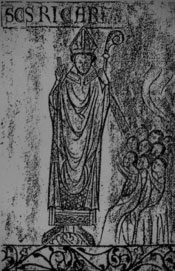
Bishop and leading figure in England during his era, also called Richard de Wyche. Born at Wyche, Worcestershire, England, he was orphaned while a young lad, managed to regain his fortune which had been mismanaged by others, and received an excellent education at Oxford, Paris, and Bologna, Italy. At Oxford, he studied under the famous Robert Grossteste and became friends with St. Edmund Rich. He earned a doctorate in law from the University of Bologna. He was appointed chancellor of Oxford in 1235 and then chancellor to Edmund Rich, who by now was archbishop of Canterbury. After accompanying Edmund into retirement at the Cistercian abbey of Pontigny, France, he departed the community upon Edmund’s death, taught at the Dominican house in Orkans, and was ordained there in 1243. Upon going home to England, he was named chancellor to Edmund’s successor, St. Boniface of Savoy. When King Henry Ill appointed Ralph Neville to the see of Chichester in 1244, Boniface declared the nomination invalid and named Richard to the post, an act which caused an uproar in the kingdom. Finally, in 1245, Pope Innocent IV found in Richard’s favor, but Richard was prevented from entering his palace by the machinations ,of Henry. Only after the king was threatened with excommunication was Richard able to take up his duties. He insisted upon strict adherence to discipline among the clergy, aided the poor, and fearlessly denounced the corruption and vices of the contemporary Church and the royal court. His death came at Dover, in a home for poor priests, while delivering a plea for a crusade. Richard was canonized in 1262, and his tomb became a popular shrine noted for its miracles until the Reformation in England.
Come Grow With Us
Sign up and walk the Catholic journey with millions around the world.
Receive inspiring emails on saints, daily readings, and free faith-building resources—no cost, ever.
Sister Sara Has One Message for Every Catholic Family This June
- 7 Morning Prayers
- Mysteries of the Rosary
- Litany of the Bl. Virgin Mary
- Popular Saints
- Popular Prayers
- Female Saints
- Saint Feast Days by Month
- Stations of the Cross
- St. Francis of Assisi
- St. Michael the Archangel
- The Apostles' Creed
- Unfailing Prayer to St. Anthony
- Pray the Rosary








Copyright 2026 Catholic Online. All materials contained on this site, whether written, audible or visual are the exclusive property of Catholic Online and are protected under U.S. and International copyright laws, © Copyright 2026 Catholic Online. Any unauthorized use, without prior written consent of Catholic Online is strictly forbidden and prohibited.
Catholic Online is a Project of Your Catholic Voice Foundation, a Not-for-Profit Corporation. Your Catholic Voice Foundation has been granted a recognition of tax exemption under Section 501(c)(3) of the Internal Revenue Code. Federal Tax Identification Number: 81-0596847. Your gift is tax-deductible as allowed by law.