St. Thecla
Facts
Author and Publisher - Catholic Online
Printable Catholic Saints PDFs
Shop St. Thecla
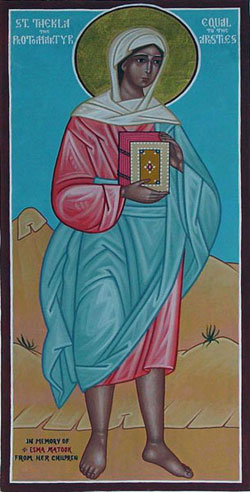
According to a popular second century tale, Acts of Paul and Thecla, she was a native of Iconomium who was so impressed by the preaching of St. Paul on virginity that she broke off her engagement to marry Thamyris to live a life of virginity. Paul was ordered to be scourged and banished from the city for his teaching, and Thecla was ordered burned to death. When a storm providentially extinguished the flames, she escaped with Paul and went with him to Antioch. There she was condemned to wild beasts in the arena when she violently resisted the attempt of Syriarch Alexander to kidnap her, but again escaped when the beasts did no harm to her. She rejoined Paul at Myra in Lycia, dressed as a boy, and was commissioned by him to preach the Gospel. She did for a time in Iconium and then became a recluse in a cave at Meriamlik near Seleucia. She lived as a hermitess there for the next seventy-two years and died there (or in Rome, where she was miraculously transported when she found that Paul had died and was later buried near his tomb). The tale had tremendous popularity in the early Church but is undoubtedly a pious fiction and was labeled apocryphal by St. Jerome. Her feast day is September 23.
More Saints
 New Saints canonized by Pope Francis
FREE Saint Classes Printable Saint PDF's Light a Virtual Saint Candle
Come Grow With Us
Sign up and walk the Catholic journey with millions around the world.
Receive inspiring emails on saints, daily readings, and free faith-building resources—no cost, ever.
URGENT: Catholic Online School needs your help NOW.
- 7 Morning Prayers
- Mysteries of the Rosary
- Litany of the Bl. Virgin Mary
- Popular Saints
- Popular Prayers
- Female Saints
- Saint Feast Days by Month
- Stations of the Cross
- St. Francis of Assisi
- St. Michael the Archangel
- The Apostles' Creed
- Unfailing Prayer to St. Anthony
- Pray the Rosary








Copyright 2026 Catholic Online. All materials contained on this site, whether written, audible or visual are the exclusive property of Catholic Online and are protected under U.S. and International copyright laws, © Copyright 2026 Catholic Online. Any unauthorized use, without prior written consent of Catholic Online is strictly forbidden and prohibited.
Catholic Online is a Project of Your Catholic Voice Foundation, a Not-for-Profit Corporation. Your Catholic Voice Foundation has been granted a recognition of tax exemption under Section 501(c)(3) of the Internal Revenue Code. Federal Tax Identification Number: 81-0596847. Your gift is tax-deductible as allowed by law.
