Because of You, 2.2 Million Students Are Being Formed in the Faith
Because of generous supporters like you, Catholic Online School has already delivered free, faithful Catholic education to over 2.2 million students across 193 countries. In an age of noise and algorithms, you are helping form souls with truth, prayer, Scripture, and Christ.
If everyone who reads this gave just $5 — the cost of a coffee — we could reach even more families and keep this life-changing formation free for all. Be Courageous. Be Catholic. Stand with us today.
DONATE TODAY >Pelagius I
Facts
Author and Publisher - Catholic Online
Printable Catholic Saints PDFs
Shop Pelagius I
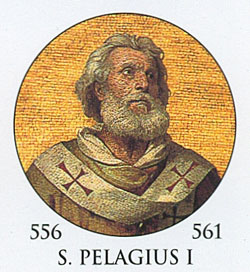
As a deacon, Pelagius translated The Sayings of the Elders, a V Century Greek work into Latin. In 536, he travelled with Pope Agapetus I to Constantinople, where he represented the see of Rome at a synod against the monophysites. Ten years later, Pelagius served as vicar for the pope during a Gothic seige of Rome; when Rome fell to Totila, Pelagius interceded on behalf of its citizens. Totila was so impressed that he sent Pelagius to represent him during peace negotiations with officials at Constantinople. The mission was unsuccessful. Pelagius supported Pope Vigilius's opposition to the emperor's condemnation of the authors of the Three Chapters and shared his exile. When Vigilius relented and condemned the Three Chapters with the men who wrote them, he also excommunicated Pelagius, who was Justinian's candidate to succeed Vigilius. Elected to the papacy in 555, Pelagius was not enthroned for a year because no one would consecrate him. During his five-year papacy, he reorganized papal properties and worked to attract more men to the priesthood. He sought also to reform monastic life. Because church law forbids the pope to use force, Pelagius asked the exarch of Ravenna to repress schismatics.
Come Grow With Us
Sign up and walk the Catholic journey with millions around the world.
Receive inspiring emails on saints, daily readings, and free faith-building resources—no cost, ever.
An important update for our readers.
Please Watch
- 7 Morning Prayers
- Mysteries of the Rosary
- Litany of the Bl. Virgin Mary
- Popular Saints
- Popular Prayers
- Female Saints
- Saint Feast Days by Month
- Stations of the Cross
- St. Francis of Assisi
- St. Michael the Archangel
- The Apostles' Creed
- Unfailing Prayer to St. Anthony
- Pray the Rosary







Copyright 2026 Catholic Online. All materials contained on this site, whether written, audible or visual are the exclusive property of Catholic Online and are protected under U.S. and International copyright laws, © Copyright 2026 Catholic Online. Any unauthorized use, without prior written consent of Catholic Online is strictly forbidden and prohibited.
Catholic Online is a Project of Your Catholic Voice Foundation, a Not-for-Profit Corporation. Your Catholic Voice Foundation has been granted a recognition of tax exemption under Section 501(c)(3) of the Internal Revenue Code. Federal Tax Identification Number: 81-0596847. Your gift is tax-deductible as allowed by law.