Mennonites
FREE Catholic Classes
A Protestant denomination of Europe and America which arose in Switzerland in the sixteenth century and derived its name from Menno Simons, its leader in Holland. Menno Simons was born in 1492 at Witmarsum in Friesland. In 1515 or 1516 he was ordained to the Catholic priesthood and appointed assistant at Pingjum not far from Witmarsum. aater (1532) he was named pastor of his native place, but 12 January, 1536, resigned his charge and became an Anabaptist elder. The rest of his life was devoted to the interests of the new sect which he had joined. Though not an imposing personality he exercised no small influence as a speaker and more particularly as a writer among the more moderate holders of Anabaptist views. His death occurred 13 January, 1559, at Wustenfelde in Holstein. The opinions held by Menno Simons and the Mennonites originated in Switzerland. In 1525 Grebel and Manz founded an Anabaptist community at Zurich. Persecution followed upon the very foundation of the new sect, and was exercised against its members until 1710 in various parts of Switzerland. It was powerless to effect suppression and a few communities exist even at present. About 1620 the Swiss Mennonites split into Amish or Upland Mennonites and Lowland Mennonites. The former differ from the latter in the belief that excommunication dissolves marriage, in their rejection of buttons and of the practice of shaving. During Menno's lifetime his followers in Holland divided (1554) into "Flemings" and "Waterlanders", on account of their divergent views on excommunication. The former subsequently split up into different parties and dwindled into insignificance, not more than three congregations remaining at present in Holland. Division also weakened the "Waterlanders" until in 1811 they united, dropped the name of Mennonites and called themselves "Doopsgezinde" (Baptist persuasion), their present official designation in Holland. Menno founded congregations exclusively in Holland and Northwestern Germany. Mennonite communities existed at an early date, however in South Germany where they were historically connected with the Swiss movement, and are found at present in other parts of the empire, chiefly in eastern Prussia. The offer of extensive land and the assurance of religious liberty caused a few thousand German Mennonites to emigrate to Southern Russia (1788). This emigration movement continued until 1824, and resulted in the foundation of comparatively important Mennonite colonies. In America the first congregation was founded in 1683 at Germantown, Pennsylvania. Subsequently immigration from Germany, Holland, Switzerland, and since 1870 from Russia, considerably increased the number of the sect in North America. There are twelve different branches in the United States in some of which the membership does not reach 1000. Among the peculiar views of the Mennonites are the following: repudiation of infant baptism, oaths, law-suits, civil office-holding and the bearing of arms. Baptism of adults and the Lord's Supper, in which Jesus Christ is not really present, are retained, but not as sacraments properly so-called. Non-resistance to violence is an important tenet and an extensive use is made of excommunication. All these views, however, are no longer universally held, some Mennonites now accepting secular offices. The polity is congregational, with bishops, elders, and deacons. The aggregate membership of the Mennonites is now usually given as about 250,000; of these there are some 60,000 in Holland ; 18,000 in Germany ; 70,000 in Russia ; 1500 in Switzerland ; 20,000 in Canada, and according to Dr. Carroll (Christian Advocate, New York, 27 January, 1910), 55,007 in the United States.
Join the Movement
When you sign up below, you don't just join an email list - you're joining an entire movement for Free world class Catholic education.


-

-
Mysteries of the Rosary
-
St. Faustina Kowalska
-
Litany of the Blessed Virgin Mary
-
Saint of the Day for Wednesday, Oct 4th, 2023
-
Popular Saints
-
St. Francis of Assisi
-
Bible
-
Female / Women Saints
-
7 Morning Prayers you need to get your day started with God
-
Litany of the Blessed Virgin Mary


Sacrifices of Faith: The Pro-Life Legacies of St. Gianna and Jessica Hanna
-
How to love God by caring for our bodies
-
Pope Francis calls for negotiations to End Russia-Ukraine War
-
Pope Francis Contemplates Return to U.S. for United Nations Assembly Address
-
Pope Francis Calls on Faithful to Embrace Faith, Hope, and Charity in New Teaching Series


Daily Catholic
- Daily Readings for Monday, April 29, 2024
- St. Catherine of Siena: Saint of the Day for Monday, April 29, 2024
- Prayer for the Dead # 3: Prayer of the Day for Monday, April 29, 2024
- Daily Readings for Sunday, April 28, 2024
- St. Peter Chanel: Saint of the Day for Sunday, April 28, 2024
- Prayer before a Crucifix: Prayer of the Day for Sunday, April 28, 2024
 Daily Readings for Monday, April 29, 2024
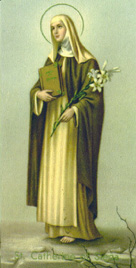 St. Catherine of Siena: Saint of the Day for Monday, April 29, 2024
 Prayer for the Dead # 3: Prayer of the Day for Monday, April 29, 2024
We ask you, humbly: don't scroll away.
Hi readers, it seems you use Catholic Online a lot; that's great! It's a little awkward to ask, but we need your help. If you have already donated, we sincerely thank you. We're not salespeople, but we depend on donations averaging $14.76 and fewer than 1% of readers give. If you donate just $5.00, the price of your coffee, Catholic Online School could keep thriving. Thank you.Help Now >

Copyright 2024 Catholic Online. All materials contained on this site, whether written, audible or visual are the exclusive property of Catholic Online and are protected under U.S. and International copyright laws, © Copyright 2024 Catholic Online. Any unauthorized use, without prior written consent of Catholic Online is strictly forbidden and prohibited.
Catholic Online is a Project of Your Catholic Voice Foundation, a Not-for-Profit Corporation. Your Catholic Voice Foundation has been granted a recognition of tax exemption under Section 501(c)(3) of the Internal Revenue Code. Federal Tax Identification Number: 81-0596847. Your gift is tax-deductible as allowed by law.