United Sees of Macerata and Tolentino
FREE Catholic Classes
Located in the Marches, Central Italy. Macerata is a provincial capital, situated on a hill, between the Chienti and the Potenza rivers, from which there is a beautiful view of the sea. Its name is derived from maceries (ruins), because the town was built on the ruins of Helvia Recina, a city founded by Septimus Severus, and destroyed by Alaric in 408, after which its inhabitants established the towns of Macerata and Recanati. The former is mentioned apropos of the Gothic wars and of Desiderius, King of the Lombards, after which time it fell into decadence. Nicholas IV restored it and, in 1290, established there a university renewed by Paul III in 1540; this pope made Macerata the residence of the governors of the Marches, and thenceforth it was one of the towns most faithful to the papacy. Gregory XI gave the city to Rudolfo Varani di Camerino, a papal general; the people, however, drove him away, wishing to be governed directly by the Holy See. In the fifteenth century, the families of Malatesta of Rimini and Sforza of Milan struggled for the possession of Macerata, from which the latter were definitely expelled in 1441. Later, the town became part of the Duchy of Urbino. In 1797 it was pillaged by the French. It has a fine cathedral, in which there is a mosaic of St. Michael by Calandra and a Madonna by Pinturicchio. There are, also, the beautiful churches of Santa Maria della Pace (1323) and of the Madonna delle Vergini (1550), the latter designed by Galasso da Carpi. The university has only the two faculties of law and medicine.

The episcopal see was created in 1320, after the suppression of that of Recanati, which was re-established in 1516, independently of Macerata, to which last Sixtus V, in 1586, united the Diocese of Tolentino (a very ancient city in the province of Macerata), destroyed by the barbarians. Tolentino had bishops in the fifth century, and the martyrdom of St. Catervus, the apostle of the city, is referred to the time of Trajan. Besides its fine cathedral, this town contains the beautiful church of St. Nicholas of Tolentino , which belongs to the Augustinians, and in which is the tomb of its patron saint (1310). Tolentino is famous as the place where was signed the treaty between Napoleon and Pius VI, which gave Bologna, Ferrara, and Romagna to the Cisalpine Republic. In 1815 was fought between Macerata and Tolentino the battle in which the Austrians defeated Murat and which cost the latter the throne of Naples.
Among the distinguished men of Macerata are G.B. Crescimbeni, a poet of the thirteenth century, and Mario Crescimbeni, a man of letters of the seventeenth century and one of the founders of the Roman Arcadia; Father Matteo Ricci, S.J., astronomer, and missionary to China ; the architect Floriani who constructed the fortifications of Malta. The united sees are suffragan of Fermo and contain 25 parishes, with 46,200 inhabitants; within their territory are 4 religious houses of men, and 9 of women ; they have 4 educational institutes for male students, and 4 for girls, and a monthly theological publication.
 Hi readers, it seems you use Catholic Online a lot; that's great! It's a little awkward to ask, but we need your help. If you have already donated, we sincerely thank you. We're not salespeople, but we depend on donations averaging $14.76 and fewer than 1% of readers give. If you donate just $5.00, the price of your coffee, Catholic Online School could keep thriving. Thank you. Help Now >

Join the Movement
When you sign up below, you don't just join an email list - you're joining an entire movement for Free world class Catholic education.


-

-
Mysteries of the Rosary
-
St. Faustina Kowalska
-
Litany of the Blessed Virgin Mary
-
Saint of the Day for Wednesday, Oct 4th, 2023
-
Popular Saints
-
St. Francis of Assisi
-
Bible
-
Female / Women Saints
-
7 Morning Prayers you need to get your day started with God
-
Litany of the Blessed Virgin Mary


Sacrifices of Faith: The Pro-Life Legacies of St. Gianna and Jessica Hanna
-
How to love God by caring for our bodies
-
Pope Francis calls for negotiations to End Russia-Ukraine War
-
Pope Francis Contemplates Return to U.S. for United Nations Assembly Address
-
Pope Francis Calls on Faithful to Embrace Faith, Hope, and Charity in New Teaching Series


Daily Catholic
- Daily Readings for Monday, April 29, 2024
- St. Catherine of Siena: Saint of the Day for Monday, April 29, 2024
- Prayer for the Dead # 3: Prayer of the Day for Monday, April 29, 2024
- Daily Readings for Sunday, April 28, 2024
- St. Peter Chanel: Saint of the Day for Sunday, April 28, 2024
- Prayer before a Crucifix: Prayer of the Day for Sunday, April 28, 2024
 Daily Readings for Monday, April 29, 2024
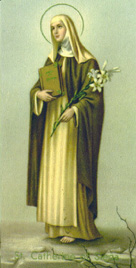 St. Catherine of Siena: Saint of the Day for Monday, April 29, 2024
 Prayer for the Dead # 3: Prayer of the Day for Monday, April 29, 2024


Copyright 2024 Catholic Online. All materials contained on this site, whether written, audible or visual are the exclusive property of Catholic Online and are protected under U.S. and International copyright laws, © Copyright 2024 Catholic Online. Any unauthorized use, without prior written consent of Catholic Online is strictly forbidden and prohibited.
Catholic Online is a Project of Your Catholic Voice Foundation, a Not-for-Profit Corporation. Your Catholic Voice Foundation has been granted a recognition of tax exemption under Section 501(c)(3) of the Internal Revenue Code. Federal Tax Identification Number: 81-0596847. Your gift is tax-deductible as allowed by law.