We ask you, humbly: don't scroll away.
Hi readers, it seems you use Catholic Online a lot; that's great! It's a little awkward to ask, but we need your help. If you have already donated, we sincerely thank you. We're not salespeople, but we depend on donations averaging $14.76 and fewer than 1% of readers give. If you donate just $5.00, the price of your coffee, Catholic Online School could keep thriving. Thank you.Help Now >
St. Gabriel the Archangel
FREE Catholic Classes
"Fortitudo Dei", one of the three archangels mentioned in the Bible .
Only four appearances of Gabriel are recorded: In Daniel 8 , he explains the vision of the horned ram as portending the destruction of the Persian Empire by the Macedonian Alexander the Great, after whose death the kingdom will be divided up among his generals, from one of whom will spring Antiochus Epiphanes. In chapter 9 , after Daniel had prayed for Israel, we read that "the man Gabriel . . . . flying swiftly touched me" and he communicated to him the mysterious prophecy of the "seventy weeks" of years which should elapse before the coming of Christ. In chapter 10 , it is not clear whether the angel is Gabriel or not, but at any rate we may apply to him the marvellous description in verses 5 and 6 . In the New Testament he foretells to Zachary the birth of the Precursor, and to Mary that of the Saviour.
Thus he is throughout the angel of the Incarnation and of Consolation, and so in Christian tradition Gabriel is ever the angel of mercy while Michael is rather the angel of judgment. At the same time, even in the Bible , Gabriel is, in accordance with his name, the angel of the Power of God, and it is worth while noting the frequency with which such words as "great", "might", "power", and "strength" occur in the passages referred to above. The Jews indeed seem to have dwelt particularly upon this feature in Gabriel's character, and he is regarded by them as the angel of judgment, while Michael is called the angel of mercy. Thus they attribute to Gabriel the destruction of Sodom and of the host of Sennacherib, though they also regard him as the angel who buried Moses, and as the man deputed to mark the figure Tau on the foreheads of the he elect ( Ezekiel 4 ). In later Jewish literature the names of angels were considered to have a peculiar efficacy, and the British Museum possesses some magic bowls inscribed with Hebrew, Aramaic, and Syriac incantations in which the names of Michael, Raphael, and Gabriel occur. These bowls were found at Hillah, the site of Babylon, and constitute an interesting relic of the Jewish captivity. In apocryphal Christian literature the same names occur, cf. Enoch, ix, and the Apocalypse of the Blessed Virgin.
We ask you, humbly: don't scroll away.
Hi readers, it seems you use Catholic Online a lot; that's great! It's a little awkward to ask, but we need your help. If you have already donated, we sincerely thank you. We're not salespeople, but we depend on donations averaging $14.76 and fewer than 1% of readers give. If you donate just $5.00, the price of your coffee, Catholic Online School could keep thriving. Thank you.Help Now >
As remarked above, Gabriel is mentioned only twice in the New Testament, but it is not unreasonable to suppose with Christian tradition that it is he who appeared to St. Joseph and to the shepherds, and also that it was he who "strengthened" Our Lord in the garden (cf. the Hymn for Lauds on 24 March). Gabriel is generally termed only an archangel, but the expression used by St. Raphael, "I am the angel Raphael, one of the seven, who stand before the Lord" ( Tobit 12:15 ) and St. Gabriel's own words, "I am Gabriel, who stand before God " ( Luke 1:19 ), have led some to think that these angels must belong to the highest rank; but this is generally explained as referring to their rank as the highest of God's messengers, and not as placing them among the Seraphim and Cherubim (cf. St. Thomas, I, Q. cxii, a.3; III, Q. xxx, a.2, ad 4um).
We ask you, humbly: don't scroll away.
Hi readers, it seems you use Catholic Online a lot; that's great! It's a little awkward to ask, but we need your help. If you have already donated, we sincerely thank you. We're not salespeople, but we depend on donations averaging $14.76 and fewer than 1% of readers give. If you donate just $5.00, the price of your coffee, Catholic Online School could keep thriving. Thank you.Help Now >

Join the Movement
When you sign up below, you don't just join an email list - you're joining an entire movement for Free world class Catholic education.


-

-
Mysteries of the Rosary
-
St. Faustina Kowalska
-
Litany of the Blessed Virgin Mary
-
Saint of the Day for Wednesday, Oct 4th, 2023
-
Popular Saints
-
St. Francis of Assisi
-
Bible
-
Female / Women Saints
-
7 Morning Prayers you need to get your day started with God
-
Litany of the Blessed Virgin Mary

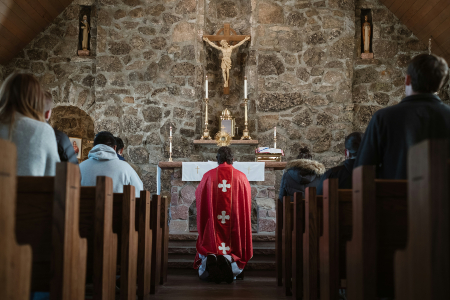
U.S. Catholic Parishes Experience Resurgence of Traditional Practices
-
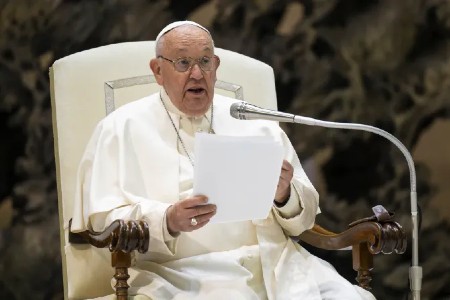
Pope Francis Urges Faith and Prayers for Peace
-
Florida Welcomes Volunteer Chaplains to Public Schools
-
10 Fascinating Details About St. Joseph the Worker: Celebrating His Feast Day - May 1
-
St. Joseph the Worker: Model for Men, Young and Old

Daily Catholic
- Daily Readings for Thursday, May 02, 2024
- St. Athanasius: Saint of the Day for Thursday, May 02, 2024
- The Our Father: Prayer of the Day for Thursday, May 02, 2024
- Daily Readings for Wednesday, May 01, 2024
- St. Marculf: Saint of the Day for Wednesday, May 01, 2024
- To Saint Peregrine: Prayer of the Day for Wednesday, May 01, 2024
 Daily Readings for Thursday, May 02, 2024
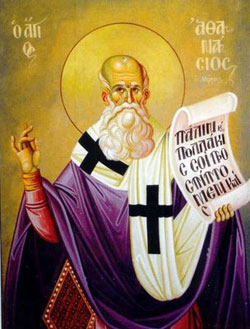 St. Athanasius: Saint of the Day for Thursday, May 02, 2024
 The Our Father: Prayer of the Day for Thursday, May 02, 2024
 Hi readers, it seems you use Catholic Online a lot; that's great! It's a little awkward to ask, but we need your help. If you have already donated, we sincerely thank you. We're not salespeople, but we depend on donations averaging $14.76 and fewer than 1% of readers give. If you donate just $5.00, the price of your coffee, Catholic Online School could keep thriving. Thank you. Help Now >

Copyright 2024 Catholic Online. All materials contained on this site, whether written, audible or visual are the exclusive property of Catholic Online and are protected under U.S. and International copyright laws, © Copyright 2024 Catholic Online. Any unauthorized use, without prior written consent of Catholic Online is strictly forbidden and prohibited.
Catholic Online is a Project of Your Catholic Voice Foundation, a Not-for-Profit Corporation. Your Catholic Voice Foundation has been granted a recognition of tax exemption under Section 501(c)(3) of the Internal Revenue Code. Federal Tax Identification Number: 81-0596847. Your gift is tax-deductible as allowed by law.