Vacancy
FREE Catholic Classes
The state of being vacant, free, unoccupied: a term applied to an office or position devoid of an incumbent, as a vacant benefice, bishopric, parish, professorship, etc. Vacancies occur by the voluntary act of the incumbent or by compulsion. Generally speaking any cleric, even the pope, for just reasons may resign his office, the resignation being effective when duly accepted by the competent superior. As the pope has no superior, Celestine V, who renounced the papacy, published a special Constitution (L. I, tit. 7 in 6°) declaring that the College of Cardinals is competent to accept the formal abdication of the pope. Under certain conditions with approval of proper authority, an exchange of benefices or offices is permitted. Certain acts, licit or illicit, are equivalent to tacit renunciation, for example, when one accepts a promotion, makes a solemn religious profession , violates the canons concerning a plurality of benefices, renounces the clerical state. Under compulsion one loses his incumbency by death or removal. Some vacancies are provided for before they actually occur; for example, coadjutors may be named with the right of succession, the pope may make an appointment to go into effect at the death of the present incumbent, an exercise of the so-called jus praeventionis , at one time quite common. Removal ordinarily is a punishment, and no one should be punished without cause (sine culpa, nisi subsit causa, non est aliquis puniendus. Reg. 23 in 6°). The cause is usually, though not always, a crime committed. When removal is a penalty, the crime for which it is inflicted must be proven juridically. If the reason for dismissal be merely unfitness ( causa non crimonosa ), a juridical trial is not generally obligatory, though certain formalities are necessarily observed to establish the existence of sufficient warrant for removal, as well as to give the occupant an opportunity of being heard. This is particularly true of the administrative removal of parish priests or rectors in accordance with the Decree "Maxima cura" (S.C. Consist., 20 Aug., 1910). This decree permits such removal (without juridical trial) on account of insanity ; inexperience or ignorance of such nature as seriously to impede a pastor in his work; deafness, blindness or other ailment, physical or mental, incapacitating a rector for a long time, unless provision can be made for a coadjutor; hatred or ill will on the part of the people, though unjust and not universal; loss of reputation among men of repute; maladministration of temporal affairs; continual neglect after one or two admonitions of parochial duties of moment; disobedience after warning of the bishop's precepts in grave matters.
We ask you, humbly: don't scroll away.
Hi readers, it seems you use Catholic Online a lot; that's great! It's a little awkward to ask, but we need your help. If you have already donated, we sincerely thank you. We're not salespeople, but we depend on donations averaging $14.76 and fewer than 1% of readers give. If you donate just $5.00, the price of your coffee, Catholic Online School could keep thriving. Thank you.Help Now >
Some, like removable rectors, are transferable at the will of the bishop. Care however should be taken not to transfer such persons against their will to inferior posts, as this would be considered a punishment. Vicars-general and deans lose their office by the death or resignation of the bishop or the cessation for any reason whatever of his jurisdiction. A vicar capitular or administrator of a vacant see retains his office till the papal Bulls appointing a new bishop are duly presented. No serious change of moment in the status of a diocese is permitted during an interregnum in accordance with the prohibition: Ne sede vacante aliquid innovetur (Decr. L., III, tit. 9).
In liturgy a Sunday is said to be vacant when no mention of it is made in the Office or Mass; such are the Sundays that fall on the feast or the Octave of Christmas, St. Stephen, St. John Evangelist, Holy Innocents, Epiphany or the vigil of Epiphany. Days too are liturgically vacant or free when unoccupied by a feast, privileged vigil or privileged ferial office; they are days to which no special Office is assigned.


Join the Movement
When you sign up below, you don't just join an email list - you're joining an entire movement for Free world class Catholic education.


-

-
Mysteries of the Rosary
-
St. Faustina Kowalska
-
Litany of the Blessed Virgin Mary
-
Saint of the Day for Wednesday, Oct 4th, 2023
-
Popular Saints
-
St. Francis of Assisi
-
Bible
-
Female / Women Saints
-
7 Morning Prayers you need to get your day started with God
-
Litany of the Blessed Virgin Mary


Sacrifices of Faith: The Pro-Life Legacies of St. Gianna and Jessica Hanna
-
How to love God by caring for our bodies
-
Pope Francis calls for negotiations to End Russia-Ukraine War
-
Pope Francis Contemplates Return to U.S. for United Nations Assembly Address
-
Pope Francis Calls on Faithful to Embrace Faith, Hope, and Charity in New Teaching Series


Daily Catholic
- Daily Readings for Monday, April 29, 2024
- St. Catherine of Siena: Saint of the Day for Monday, April 29, 2024
- Prayer for the Dead # 3: Prayer of the Day for Monday, April 29, 2024
- Daily Readings for Sunday, April 28, 2024
- St. Peter Chanel: Saint of the Day for Sunday, April 28, 2024
- Prayer before a Crucifix: Prayer of the Day for Sunday, April 28, 2024
 Daily Readings for Monday, April 29, 2024
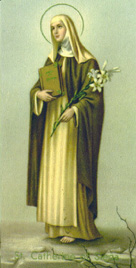 St. Catherine of Siena: Saint of the Day for Monday, April 29, 2024
 Prayer for the Dead # 3: Prayer of the Day for Monday, April 29, 2024


Copyright 2024 Catholic Online. All materials contained on this site, whether written, audible or visual are the exclusive property of Catholic Online and are protected under U.S. and International copyright laws, © Copyright 2024 Catholic Online. Any unauthorized use, without prior written consent of Catholic Online is strictly forbidden and prohibited.
Catholic Online is a Project of Your Catholic Voice Foundation, a Not-for-Profit Corporation. Your Catholic Voice Foundation has been granted a recognition of tax exemption under Section 501(c)(3) of the Internal Revenue Code. Federal Tax Identification Number: 81-0596847. Your gift is tax-deductible as allowed by law.