We ask you, urgently: don't scroll past this
Dear readers, Catholic Online was de-platformed by Shopify for our pro-life beliefs. They shut down our Catholic Online, Catholic Online School, Prayer Candles, and Catholic Online Learning Resources essential faith tools serving over 1.4 million students and millions of families worldwide. Our founders, now in their 70's, just gave their entire life savings to protect this mission. But fewer than 2% of readers donate. If everyone gave just $5, the cost of a coffee, we could rebuild stronger and keep Catholic education free for all. Stand with us in faith. Thank you.Help Now >
St. Odo
Facts
Patron: of rain
Birth: 878
Death: 942
Author and Publisher - Catholic Online
Printable Catholic Saints PDFs
Shop St. Odo
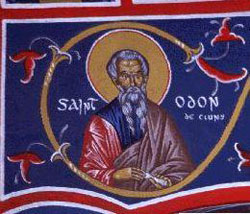
Odo was born near Le Mans, France. He was raised in the households of Count Fulk II of Anjou and Duke William of Aquitaine, received the tonsure when he was nineteen, received a canonry at St. Martin's in Tours, and then spent several years studying at Paris, particularly music, under Remigius of Auxerre. Odo became a monk under Berno at Baume-les-Messieurs near Besancon in 909, was named director of the Baume Monastery school by Berno, who became abbot of the newly founded Cluny, and in 924 was named abbot of Baume. He succeeded Berno as second abbot of Cluny in 927, continued Berno's work of reforming abbeys from Cluny, and in 931 was authorized by Pope John XI to reform the monasteries of northern France and Italy. Odo was called to Rome by Pope Leo VII in 936 to arrange peace between Alberic of Rome and Hugh of Provence, who was besieging the city, and succeeded temporarily by negotiating a marriage between Alberic and Hugh's daughter; Odo returned to Rome twice in the next six years to reconcile Alberic and Hugh. Odo spread Cluny's influence to monasteries all over Europe, encountering and overcoming much opposition, and successfully persuaded secular rulers to relinquish control of monasteries they had been illegally controlling. He died at Tours on the way back to Rome on November 18. He wrote hymns, treatises on morality, an epic poem on the Redemption, and a life of St. Gerald of Aurillac. His feast day is November 18th.
Join the Movement
When you sign up below, you don't just join an email list - you're joining an entire movement for Free world class Catholic education.
Novena for Pope Francis | FREE PDF Download
-

- Easter / Lent
- Ascension Day
- 7 Morning Prayers
- Mysteries of the Rosary
- Litany of the Bl. Virgin Mary
- Popular Saints
- Popular Prayers
- Female Saints
- Saint Feast Days by Month
- Stations of the Cross
- St. Francis of Assisi
- St. Michael the Archangel
- The Apostles' Creed
- Unfailing Prayer to St. Anthony
- Pray the Rosary


Cardinals Request Prayers from Faithful Ahead of Historic May 7 Conclave

How a New Pope Is Elected

Toy Shortages Threaten Christmas Traditions as Trade War Impacts Retailers
Daily Catholic
- Daily Readings for Thursday, May 01, 2025
- St. Marculf: Saint of the Day for Thursday, May 01, 2025
- To Saint Peregrine: Prayer of the Day for Thursday, May 01, 2025
- Daily Readings for Wednesday, April 30, 2025
- St. Pius V, Pope: Saint of the Day for Wednesday, April 30, 2025
- Prayer to Saint Joseph for Success in Work: Prayer of the Day for Wednesday, April 30, 2025
 Daily Readings for Thursday, May 01, 2025
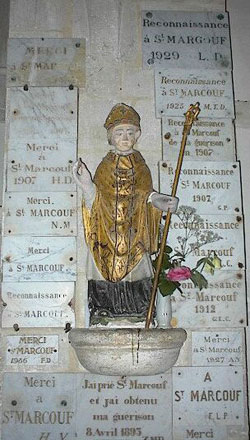 St. Marculf: Saint of the Day for Thursday, May 01, 2025
 To Saint Peregrine: Prayer of the Day for Thursday, May 01, 2025
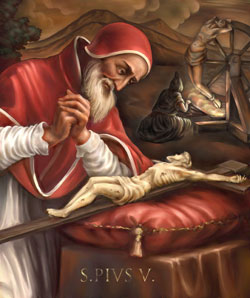 St. Pius V, Pope: Saint of the Day for Wednesday, April 30, 2025

Copyright 2025 Catholic Online. All materials contained on this site, whether written, audible or visual are the exclusive property of Catholic Online and are protected under U.S. and International copyright laws, © Copyright 2025 Catholic Online. Any unauthorized use, without prior written consent of Catholic Online is strictly forbidden and prohibited.
Catholic Online is a Project of Your Catholic Voice Foundation, a Not-for-Profit Corporation. Your Catholic Voice Foundation has been granted a recognition of tax exemption under Section 501(c)(3) of the Internal Revenue Code. Federal Tax Identification Number: 81-0596847. Your gift is tax-deductible as allowed by law.
