 Dear readers, Catholic Online was de-platformed by Shopify for our pro-life beliefs. They shut down our Catholic Online, Catholic Online School, Prayer Candles, and Catholic Online Learning Resources essential faith tools serving over 2.2 million students and millions of families worldwide. Our founders, now in their 70's, just gave their entire life savings to protect this mission. But fewer than 2% of readers donate. If everyone gave just $5, the cost of a coffee, we could rebuild stronger and keep Catholic education free for all. Stand with us in faith. Thank you. DONATE TODAY >
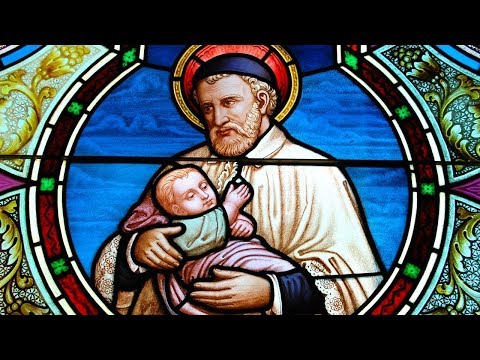
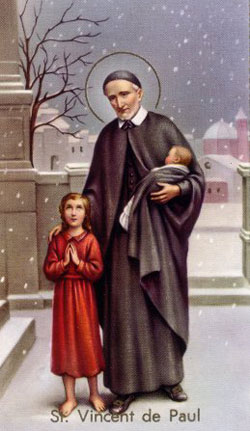
St. Vincent de Paul

Facts
Patron: of charities; horses; hospitals; leprosy; lost articles; Madagascar; prisoners; Richmond, Virginia; spiritual help; Saint Vincent de Paul Societies; Sacred Heart Cathedral Preparatory; Vincentian Service Corps; volunteers
Birth: 1581
Death: 1660
Beatified: August 13, 1729, Rome, Papal States by Pope Benedict XIII
Canonized: June 16, 1737, Rome, Papal States by Pope Clement XII
Author and Publisher - Catholic Online
Printable Catholic Saints PDFs
Shop St. Vincent de Paul
St. Vincent de Paul was born to a poor peasant family in the French village of Pouy on April 24, 1581. His first formal education was provided by the Franciscans. He did so well, he was hired to tutor the children of a nearby wealthy family. He used the monies he earned teaching to continue his formal studies at the University of Toulose where he studied theology.
He was ordained in 1600 and remained in Toulose for a time. In 1605, while on a ship traveling from Marseilles to Narbone, he was captured, brought to Tunis and sold as a slave. Two years later he and his master managed to escape and both returned to France.
St. Vincent went to Avignon and later to Rome to continue his studies. While there he became a chaplain to the Count of Goigny and was placed in charge of distributing money to the deserving poor. He became pastor of a small parish in Clichy for a short period of time, while also serving as a tutor and spiritual director.
From that point forward he spent his life preaching missions to and providing relief to the poor. He even established hospitals for them. This work became his passion. He later extended his concern and ministry to convicts. The need to evangelize and assist these souls was so great and the demands beyond his own ability to meet that he founded the Ladies of Charity, a lay institute of woman, to help, as well as a religious institute of priests – the Congregation of Priests of the Mission, commonly referred to now as the Vincentians.
This was at a time when there were not many priests in France and what priests there were, were neither well-formed nor faithful to their way of life. Vincent helped reform the clergy and the manner in which they were instructed and prepared for the priesthood. He did this first through the presentation of retreats and later by helping develop a precursor to our modern day seminaries. At one point his community was directing 53 upper level seminaries. His retreats, open to priests and laymen, were so well attended that it is said he infused a “Christian spirit among more than 20,000 persons in his last 23 years.”
The Vincentians remain with us today with nearly 4,000 members in 86 countries. In addition to his order of Vincentian priests, St. Vincent cofounded the Daughters of Charity along with St. Louise de Marillac. There are more than 18,000 Daughters today serving the needs of the poor in 94 countries. He was eighty years old when he died in Paris on September 27, 1660.He had “become the symbol of the successful reform of the French Church”. St. Vincent is sometimes referred to as “The Apostle of Charity” and “The Father of the Poor”.
His incorrupt heart can be found in the Convent of the Sisters of Charity and his bones have been embedded in a wax effigy of the Saint located at the Church of the Lazarist Mission. Both sites are located in Paris, France.
Two miracles have been attributed to St Vincent – a nun cured of ulcers and a laywoman cured of paralysis. As a result of the first, Pope Benedict XIII beatified him on August 13, 1729. Less than 8 years later (on June 16, 1737) he was canonized by Pope Clement XIII. The Bull of Canonization recognized Vincent for his charity and reform of the clergy, as well as for his early role in opposing Jansenism.
It has been reported that St. Vincent wrote more than 30,000 letters in his lifetime and that nearly 7,000 had been collected in the 18th century. There are at least five collections of his letters in existence today.
The feast day for St. Vincent, the patron of all charitable societies, is September 27.

Come Grow With Us
Sign up and walk the Catholic journey with millions around the world.
Receive inspiring emails on saints, daily readings, and free faith-building resources—no cost, ever.
This 15-Second Video Will Change How You See Catholic Education.
Watch Now
- 7 Morning Prayers
- Mysteries of the Rosary
- Litany of the Bl. Virgin Mary
- Popular Saints
- Popular Prayers
- Female Saints
- Saint Feast Days by Month
- Stations of the Cross
- St. Francis of Assisi
- St. Michael the Archangel
- The Apostles' Creed
- Unfailing Prayer to St. Anthony
- Pray the Rosary








Copyright 2026 Catholic Online. All materials contained on this site, whether written, audible or visual are the exclusive property of Catholic Online and are protected under U.S. and International copyright laws, © Copyright 2026 Catholic Online. Any unauthorized use, without prior written consent of Catholic Online is strictly forbidden and prohibited.
Catholic Online is a Project of Your Catholic Voice Foundation, a Not-for-Profit Corporation. Your Catholic Voice Foundation has been granted a recognition of tax exemption under Section 501(c)(3) of the Internal Revenue Code. Federal Tax Identification Number: 81-0596847. Your gift is tax-deductible as allowed by law.
