We ask you, urgently: don't scroll past this
Dear readers, Catholic Online was de-platformed by Shopify for our pro-life beliefs. They shut down our Catholic Online, Catholic Online School, Prayer Candles, and Catholic Online Learning Resources essential faith tools serving over 1.4 million students and millions of families worldwide. Our founders, now in their 70's, just gave their entire life savings to protect this mission. But fewer than 2% of readers donate. If everyone gave just $5, the cost of a coffee, we could rebuild stronger and keep Catholic education free for all. Stand with us in faith. Thank you.Help Now >
St. Theodore of Studites
Facts
Death: 826
Author and Publisher - Catholic Online
Printable Catholic Saints PDFs
Shop St. Theodore of Studites
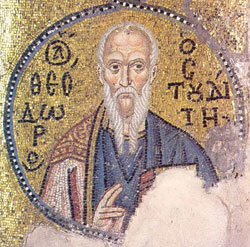
Also Theodore of Studiurn and Theodore of Studios, abbot, monastic reformer, and ardent enemy of iconoclastic policies in the Byzantine Empire. The nephew of St. Pluto, abbot of Saccudium (a monastery in Bithynia, Asia Minor, nenr Mt. Olympus in modem Turkey), he studied under his uncle and entered the community about 780. In 794, he followed St. Pluto as abbot when his uncle abdicated in his favor. Theodore soon distinguished himself for his opposition to the adulterous marriage of Emperor Constantine VI (r. 780-797) and was banished until 797 when the emperor was deposed by his mother, Irene.Two years later, Theodore moved the community from Saccudium to Studites in order to escape the growing influence of the Arabs. The monastery subsequently became one of the most prominent in the whole of the Eastern Church. In 809, Theodore was exiled once more, this time by Emperor Nicephorus I (r. 802-811), marking the start of suffering which continued unceasingly virtually until his death. Recalled in 811, he was forced soon after to speak out against the iconoclastic policies of Emperor Leo V (r. 813-820). In revenge, Leo had Theodore seized, cruelly abused, and exiled. Studites was populated by Iconoclast monks, and Theodore lived in banishment until 820 when Emperor Michael II (r. 820-829) brought him back to Constantinople. Theodore remained unbending and died without ever returning to Studites. He died just outside of Constantinople. Theodore was venerated for his personal holiness, his brilliant abilities as a preacher, and his willingness to champion the rights of the Church, even at the price of deep personal sacrifice. He was also the author of five hundred letters, hymns, sermons, polemics against Iconoclasm, and two cathechisms.
Come Grow With Us
Sign up and walk the Catholic journey with millions around the world.
Receive inspiring emails on saints, daily readings, and free faith-building resources—no cost, ever.
Some children just need to know they’re not alone...
Watch 'Jessie’s Story: A Heart Changed by Faith'
- Easter / Lent
- 5 Lenten Prayers
- Ash Wednesday
- 7 Morning Prayers
- Mysteries of the Rosary
- Litany of the Bl. Virgin Mary
- Popular Saints
- Popular Prayers
- Female Saints
- Saint Feast Days by Month
- Stations of the Cross
- St. Francis of Assisi
- St. Michael the Archangel
- The Apostles' Creed
- Unfailing Prayer to St. Anthony
- Pray the Rosary









Copyright 2026 Catholic Online. All materials contained on this site, whether written, audible or visual are the exclusive property of Catholic Online and are protected under U.S. and International copyright laws, © Copyright 2026 Catholic Online. Any unauthorized use, without prior written consent of Catholic Online is strictly forbidden and prohibited.
Catholic Online is a Project of Your Catholic Voice Foundation, a Not-for-Profit Corporation. Your Catholic Voice Foundation has been granted a recognition of tax exemption under Section 501(c)(3) of the Internal Revenue Code. Federal Tax Identification Number: 81-0596847. Your gift is tax-deductible as allowed by law.
