St. Nicetius
FREE Catholic Classes
A Bishop of Trier, born in the latter part of the fifth century, exact date unknown; died in 563 or more probably 566. Saint Nicetius was the most important bishop of the ancient See of Trier, in the era when, after the disorders of the Migrations, Frankish supremacy began in what had been Roman Gaul. Considerable detail of the life of this vigorous and zealous bishop is known from various sources, from letters written either by or to him, from two poems of Venantius Fortunatus (Poem., Lib. III, ix, X, ed. Leo, in Mon. Germ. Hist.: Auct. antiq., IV (1881), Pt. I, 63-64 sq.) and above all from the statements of his pupil Aredius, later Abbot of Limoges, which have been preserved by Gregory of Tours (De vitis Patrum, xvii; De Gloria Confessorum, xciii-xciv). Nicetius came from a Gallo-Roman family ; his home was apparently in Auvergne. The Nicetius mentioned by Sidonius Apollinaris (Epist. VIII, vi) may have been a relative. From his youth he devoted himself to religious life and entered a monastery, where he developed so rapidly in the exercise of Christian virtue and in sacred learning that he was made abbot. It was while abbot that King Theodoric I (511-34) learned to know and esteem him, Nicetius often remonstrating with him on account of his wrong-doing without, however, any loss of favour. After the death of Bishop Aprunculus of Trier, an embassy of the clergy and citizens of Trier came to the royal court to elect a new bishop. They desired Saint Gallus, but the king refused his consent. They then selected Abbot Nicetius, whose election was confirmed by Theodoric. About 527 Nicetius set out as the new bishop for Trier, accompanied by an escort sent by the king, and while on the journey had opportunity to make known his firmness in the administration of his office.

Trier had suffered terribly during the disorders of the Migrations. One of the first cares of the new bishop was to rebuild the cathedral church, the restoration of which is mentioned by the poet Venantius Fortunatus . Archæological research has shown, in the cathedral of Trier, the existence of mason-work belonging to the Frankish period which may belong to this reconstruction by Nicetius. A fortified castle ( castellum ) with a chapel built by him on the river Moselle is also mentioned by the same poet (Poem., Lib. III, n. xii). The saintly bishop devoted himself with great zeal to his pastoral duty. He preached daily, opposed vigorously the numerous evils in the moral life both of the higher classes and of the common people, and in so doing did not spare the king and his courtiers. Disregarding threats, he steadfastly fulfilled his duty. On account of his misdeeds he excommunicated King Clotaire I (511-61), who for some time was sole ruler of the Frankish dominions; in return the king exiled the determined bishop (560). The king died, however, in the following year, and his son and successor Sigebert, the ruler of Austrasia (561-75), allowed Nicetius to return home. Nicetius took part in several synods of the Frankish bishops : the synod of Clermont (535), of Orléans (549), the second synod of Clermont (549), the synod of Toul (550) at which he presided, and the synod of Paris (555).
Nicetius corresponded with ecclesiastical dignitaries of high rank in distant places. Letters are extant that were written to him by Abbot Florianus of Romain-Moûtier (Canton of Vaud, Switzerland ), by Bishop Rufus of Octodurum (now Martigny, in the Canton of Valais, Switzerland ), and by Archbishop Mappinius of Reims. The general interests of the Church did not escape his watchful care. He wrote an urgent letter to Emperor Justinian of Constantinople in regard to the emperor's position in the controversies arising from Monophysitism. Another letter that has been preserved is to Clodosvinda, wife of the Lombard King Alboin, in which he exhorts this princess to do everything possible to bring her husband over to the Catholic faith. In his personal life the saintly bishop was very ascetic and self-mortifying; he fasted frequently, and while the priests and clerics who lived with him were at their evening meal he would go, concealed by a hooded cloak, to pray in the churches of the city. He founded a school of his own for the training of the clergy. The best known of his pupils is the later Abbot of Limoges, Aredius, who was the authority of Gregory of Tours for the latter's biographical account of Nicetius. Nicetius was buried in the church of St. Maximin at Trier. His feast is celebrated at Trier on 1 October; in the Roman Martyrology his name is placed under 5 December. The genuineness of two treatises ascribed to him is doubtful : "De Vigiliis servorum Dei" and "De Psalmodiæ Bono".

We ask you, humbly: don't scroll away.
Hi readers, it seems you use Catholic Online a lot; that's great! It's a little awkward to ask, but we need your help. If you have already donated, we sincerely thank you. We're not salespeople, but we depend on donations averaging $14.76 and fewer than 1% of readers give. If you donate just $5.00, the price of your coffee, Catholic Online School could keep thriving. Thank you.Help Now >

Join the Movement
When you sign up below, you don't just join an email list - you're joining an entire movement for Free world class Catholic education.


-

-
Mysteries of the Rosary
-
St. Faustina Kowalska
-
Litany of the Blessed Virgin Mary
-
Saint of the Day for Wednesday, Oct 4th, 2023
-
Popular Saints
-
St. Francis of Assisi
-
Bible
-
Female / Women Saints
-
7 Morning Prayers you need to get your day started with God
-
Litany of the Blessed Virgin Mary


Sacrifices of Faith: The Pro-Life Legacies of St. Gianna and Jessica Hanna
-
How to love God by caring for our bodies
-
Pope Francis calls for negotiations to End Russia-Ukraine War
-
Pope Francis Contemplates Return to U.S. for United Nations Assembly Address
-
Pope Francis Calls on Faithful to Embrace Faith, Hope, and Charity in New Teaching Series


Daily Catholic
- Daily Readings for Monday, April 29, 2024
- St. Catherine of Siena: Saint of the Day for Monday, April 29, 2024
- Prayer for the Dead # 3: Prayer of the Day for Monday, April 29, 2024
- Daily Readings for Sunday, April 28, 2024
- St. Peter Chanel: Saint of the Day for Sunday, April 28, 2024
- Prayer before a Crucifix: Prayer of the Day for Sunday, April 28, 2024
 Daily Readings for Monday, April 29, 2024
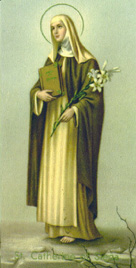 St. Catherine of Siena: Saint of the Day for Monday, April 29, 2024
 Prayer for the Dead # 3: Prayer of the Day for Monday, April 29, 2024
 Hi readers, it seems you use Catholic Online a lot; that's great! It's a little awkward to ask, but we need your help. If you have already donated, we sincerely thank you. We're not salespeople, but we depend on donations averaging $14.76 and fewer than 1% of readers give. If you donate just $5.00, the price of your coffee, Catholic Online School could keep thriving. Thank you. Help Now >


Copyright 2024 Catholic Online. All materials contained on this site, whether written, audible or visual are the exclusive property of Catholic Online and are protected under U.S. and International copyright laws, © Copyright 2024 Catholic Online. Any unauthorized use, without prior written consent of Catholic Online is strictly forbidden and prohibited.
Catholic Online is a Project of Your Catholic Voice Foundation, a Not-for-Profit Corporation. Your Catholic Voice Foundation has been granted a recognition of tax exemption under Section 501(c)(3) of the Internal Revenue Code. Federal Tax Identification Number: 81-0596847. Your gift is tax-deductible as allowed by law.