We ask you, humbly: don't scroll away.
Hi readers, it seems you use Catholic Online a lot; that's great! It's a little awkward to ask, but we need your help. If you have already donated, we sincerely thank you. We're not salespeople, but we depend on donations averaging $14.76 and fewer than 1% of readers give. If you donate just $5.00, the price of your coffee, Catholic Online School could keep thriving. Thank you.Help Now >
Abbey of Mellifont
FREE Catholic Classes
Located three miles from Drogheda, Co. Louth, Diocese of Armagh, it was the first Cistercian monastery established in Ireland. In the year 1140, St. Malachy, en route for Rome, visited St. Bernard at Clairvaux, and was so edified that he resolved to establish a similar monastery in his own diocese of Armagh. He therefore left several of his companions at Clairvaux, to make their novitiate under the direction of St. Bernard. In 1142 they returned to found Mellifont under Christian O'Conarchy, who had been Archdeacon of Down and who became the first abbot. A French monk, Father Robert, an able architect, directed the construction of the monastic buildings according to the plans of the Abbey of Clairvaux. The consecration of the church in 1157 was the occasion of great religious celebrations. So numerous were the postulants that six important monasteries were founded during the first ten years: Bective (1146); Boyle (1148); Monasternenagh (1148); Baltinglas (1148); Schrule (1150); Newry (1153). In 1150 the venerable Abbot Christian was appointed Bishop of Lismore, and Pope Eugene III, who had been his fellow-novice at Clairvaux, named him legate for Ireland. Soon after his death (1186) his name was inscribed in the calendar of the saints, and he has long been venerated as one of the most powerful protectors of his country. His brother Malchus, equally illustrious for his science and sanctity, succeeded him. For sixty years Mellifont rejoiced in great prosperity, and when the English invaded Ireland there were already twenty-five great Cistercian abbeys. During the thirteenth and fourteenth centuries the rivalries between the English and Irish exerted a baneful influence, peace gave way to discord, and in more than one case the general chapter, and even the sovereign pontiff, were forced to intervene. Not until the fifteenth century did Mellifont regain its ancient prestige, which was maintained until its suppression by Henry VIII on 23 July, 1539, when one hundred and fifty monks were compelled to leave with Richard Contour, the last Abbot of Mellifont. The king seized the treasures of the abbey, and the annals were either lost or destroyed, and with them the names of many remarkable men. Several religious continued to live in the environs, which explains why, in 1623, the title of Abbot of Mellifont was granted, by Apostolic Brief , to Patrick Barnewall, and again in 1648 to John Devreux when the title disappears. In 1566 the abbey, with its dependencies, was given to Edward Moore, chief of the family Drogheda, and passed, in 1727, to Balfour of Townley Hall, during whose term of ownership all fell to the speedy decay and desolate ruin of the present day.

 Hi readers, it seems you use Catholic Online a lot; that's great! It's a little awkward to ask, but we need your help. If you have already donated, we sincerely thank you. We're not salespeople, but we depend on donations averaging $14.76 and fewer than 1% of readers give. If you donate just $5.00, the price of your coffee, Catholic Online School could keep thriving. Thank you. Help Now >
We ask you, humbly: don't scroll away.
Hi readers, it seems you use Catholic Online a lot; that's great! It's a little awkward to ask, but we need your help. If you have already donated, we sincerely thank you. We're not salespeople, but we depend on donations averaging $14.76 and fewer than 1% of readers give. If you donate just $5.00, the price of your coffee, Catholic Online School could keep thriving. Thank you.Help Now >
Join the Movement
When you sign up below, you don't just join an email list - you're joining an entire movement for Free world class Catholic education.


-

-
Mysteries of the Rosary
-
St. Faustina Kowalska
-
Litany of the Blessed Virgin Mary
-
Saint of the Day for Wednesday, Oct 4th, 2023
-
Popular Saints
-
St. Francis of Assisi
-
Bible
-
Female / Women Saints
-
7 Morning Prayers you need to get your day started with God
-
Litany of the Blessed Virgin Mary


Sacrifices of Faith: The Pro-Life Legacies of St. Gianna and Jessica Hanna
-
How to love God by caring for our bodies
-
Pope Francis calls for negotiations to End Russia-Ukraine War
-
Pope Francis Contemplates Return to U.S. for United Nations Assembly Address
-
Pope Francis Calls on Faithful to Embrace Faith, Hope, and Charity in New Teaching Series


Daily Catholic
- Daily Readings for Monday, April 29, 2024
- St. Catherine of Siena: Saint of the Day for Monday, April 29, 2024
- Prayer for the Dead # 3: Prayer of the Day for Monday, April 29, 2024
- Daily Readings for Sunday, April 28, 2024
- St. Peter Chanel: Saint of the Day for Sunday, April 28, 2024
- Prayer before a Crucifix: Prayer of the Day for Sunday, April 28, 2024
 Daily Readings for Monday, April 29, 2024
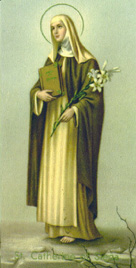 St. Catherine of Siena: Saint of the Day for Monday, April 29, 2024
 Prayer for the Dead # 3: Prayer of the Day for Monday, April 29, 2024


Copyright 2024 Catholic Online. All materials contained on this site, whether written, audible or visual are the exclusive property of Catholic Online and are protected under U.S. and International copyright laws, © Copyright 2024 Catholic Online. Any unauthorized use, without prior written consent of Catholic Online is strictly forbidden and prohibited.
Catholic Online is a Project of Your Catholic Voice Foundation, a Not-for-Profit Corporation. Your Catholic Voice Foundation has been granted a recognition of tax exemption under Section 501(c)(3) of the Internal Revenue Code. Federal Tax Identification Number: 81-0596847. Your gift is tax-deductible as allowed by law.