We ask you, humbly: don't scroll away.
Hi readers, it seems you use Catholic Online a lot; that's great! It's a little awkward to ask, but we need your help. If you have already donated, we sincerely thank you. We're not salespeople, but we depend on donations averaging $14.76 and fewer than 1% of readers give. If you donate just $5.00, the price of your coffee, Catholic Online School could keep thriving. Thank you.Help Now >
John Mayor
FREE Catholic Classes
(MAJOR, MAIR; also called JOANNES MAJORIS and HADDINGTONUS SCOTUS)
A Scotch philosopher and historian, b. at Gleghornie near Haddington, 1496; d. at St. Andrew's, 1550. He studied at Oxford, Cambridge, and Paris, where he was graduated as master of arts in the College of St. Barbe in 1494 and as doctor of theology in the College of Montaigu in 1505. He spent the greater part of his remaining life as professor of logic and theology ; from 1505-18 at the University of Paris, from 1518-23 at the University of Glasgow, from 1523-5 at the University of St. Andrew's, and from 1525-1530 again at Paris. In 1530 he returned to St. Andrew's and was made provost of St. Salvator's College, a position which he occupied until his death. One of the greatest scholastic philosophers of his times, he had among his pupils the future Scotch reformers John Knox , Patrick Hamilton, and George Buchanan. In philosophy he was the chief exponent of the nominalistic or terministic tendency which was then prevalent at the University of Paris , while, as a canonist, he held that the chief ecclesiastical authority does not reside in the pope but in the whole Church. In like manner he held that the source of civil authority lies with the people who transfer it to the ruler and can wrest it from him, even by force, if necessary. He remained a Catholic until his death, though in 1549 he advocated a national Church for Scotland. His numerous literary productions were all written in Latin. His chief work, "Historia majoris Britannae, tam Angliae quam Scotiae" (Paris, 1521 and Edinburgh, 1740), translated into English for the first time by Archibald Constable, "History of the Greater Britain, both England and Scotland" (Edinburgh, 1892), is written in barbarous Latin, but truthfully and faithfully portrays the author's vigour and spirit of independence. His other works are mostly philosophical, viz: a commentary on Peter Lombard's Books of Sentences (Paris, 1508), "Introductorium" or a commentary on Aristotle's dialectics (Paris, 1508), the lectures which he delivered on logic in the College of Montaigu (Lyons, 1516), commentaries on Aristotle's physical and ethical writings (Paris, 1526), "Quaestiones logicales" (Paris, 1528), a commentary on the four Gospels (Paris, 1529). He was also the first to edit the so-called "Reportia Parisiensia" of Duns Scotus (Paris, 1517-8).



Join the Movement
When you sign up below, you don't just join an email list - you're joining an entire movement for Free world class Catholic education.


-

-
Mysteries of the Rosary
-
St. Faustina Kowalska
-
Litany of the Blessed Virgin Mary
-
Saint of the Day for Wednesday, Oct 4th, 2023
-
Popular Saints
-
St. Francis of Assisi
-
Bible
-
Female / Women Saints
-
7 Morning Prayers you need to get your day started with God
-
Litany of the Blessed Virgin Mary


Sacrifices of Faith: The Pro-Life Legacies of St. Gianna and Jessica Hanna
-
How to love God by caring for our bodies
-
Pope Francis calls for negotiations to End Russia-Ukraine War
-
Pope Francis Contemplates Return to U.S. for United Nations Assembly Address
-
Pope Francis Calls on Faithful to Embrace Faith, Hope, and Charity in New Teaching Series


Daily Catholic
- Daily Readings for Monday, April 29, 2024
- St. Catherine of Siena: Saint of the Day for Monday, April 29, 2024
- Prayer for the Dead # 3: Prayer of the Day for Monday, April 29, 2024
- Daily Readings for Sunday, April 28, 2024
- St. Peter Chanel: Saint of the Day for Sunday, April 28, 2024
- Prayer before a Crucifix: Prayer of the Day for Sunday, April 28, 2024
 Daily Readings for Monday, April 29, 2024
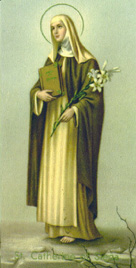 St. Catherine of Siena: Saint of the Day for Monday, April 29, 2024
 Prayer for the Dead # 3: Prayer of the Day for Monday, April 29, 2024
We ask you, humbly: don't scroll away.
Hi readers, it seems you use Catholic Online a lot; that's great! It's a little awkward to ask, but we need your help. If you have already donated, we sincerely thank you. We're not salespeople, but we depend on donations averaging $14.76 and fewer than 1% of readers give. If you donate just $5.00, the price of your coffee, Catholic Online School could keep thriving. Thank you.Help Now >


Copyright 2024 Catholic Online. All materials contained on this site, whether written, audible or visual are the exclusive property of Catholic Online and are protected under U.S. and International copyright laws, © Copyright 2024 Catholic Online. Any unauthorized use, without prior written consent of Catholic Online is strictly forbidden and prohibited.
Catholic Online is a Project of Your Catholic Voice Foundation, a Not-for-Profit Corporation. Your Catholic Voice Foundation has been granted a recognition of tax exemption under Section 501(c)(3) of the Internal Revenue Code. Federal Tax Identification Number: 81-0596847. Your gift is tax-deductible as allowed by law.