We ask you, humbly: don't scroll away.
Hi readers, it seems you use Catholic Online a lot; that's great! It's a little awkward to ask, but we need your help. If you have already donated, we sincerely thank you. We're not salespeople, but we depend on donations averaging $14.76 and fewer than 1% of readers give. If you donate just $5.00, the price of your coffee, Catholic Online School could keep thriving. Thank you.Help Now >
St. Maximinus
FREE Catholic Classes
Bishop of Trier, b. at Silly near Poitiers, d. there, 29 May, 352 or 12 Sept., 349. He was educated and ordained priest by St. Agritius, whom he succeeded as Bishop of Trier in 332 or 335. At that time Trier was the government seat of the Western Emperor and, by force of his office, Maximinus stood in close relation with the Emperors Constantine II and Constans. He was a strenuous defender of the orthodox faith against Arianism and an intimate friend of St. Athanasius, whom he harboured as an honoured guest during his exile of two years and four months (336-8) at Trier. He likewise received with honours the banished patriarch Paul of Constantinople in 341 and effected his recall to Constantinople. When four Arian bishops came from Antioch to Trier in 342 with the purpose of winning Emperor Constans to their side, Maximinus refused to receive them and induced the emperor to reject their proposals. In conjunction with Pope Julius I and Bishop Hosius of Cordova, he persuaded the Emperor Constans to convene the Synod of Sardica in 343 and probably took part in it. That the Arians considered him as one of their chief opponents is evident from the fact that they condemned by name along with Pope Julius I and Hosius of Cordova at their heretical synod of Philippopolis in 343 (Mans, "Sacrorum Conc. nova et ampl. Coll.", III, 136 sq.). In 345 he took part in the Synod of Milan and is said to have presided over a synod held at Cologne in 346, where Bishop Euphratas of Cologne was deposed on account of his leanings toward Arianism. {Concerning the authenticity of the Acts of this synod see the new French translation of Hefele's "Conciliengeschichte", I, ii (Paris, 1907), pp. 830-34.} He also sent Sts. Castor and Lubentius as missionaries to the valleys of the Mosel and the Lahn. It is doubtful whether the Maximinus whom the usurper Magnentius sent as legate to Constantinople in the interests of peace is identical with the Bishop of Trier (Athanasius, "Apol. ad Const. Imp.", 9). His cult began right after his death. His feast is celebrated on 29 May, on which day his name stands in the martyrologies of St. Jerome, St. Bede , St. Ado, and others. Trier honours him as its patron. In the autumn of 353 his body was buried in the church of St. John near Trier, where in the seventh century was founded the famous Benedictine abbey of St. Maximinus, which flourished till 1802.



Join the Movement
When you sign up below, you don't just join an email list - you're joining an entire movement for Free world class Catholic education.


-

-
Mysteries of the Rosary
-
St. Faustina Kowalska
-
Litany of the Blessed Virgin Mary
-
Saint of the Day for Wednesday, Oct 4th, 2023
-
Popular Saints
-
St. Francis of Assisi
-
Bible
-
Female / Women Saints
-
7 Morning Prayers you need to get your day started with God
-
Litany of the Blessed Virgin Mary


Sacrifices of Faith: The Pro-Life Legacies of St. Gianna and Jessica Hanna
-
How to love God by caring for our bodies
-
Pope Francis calls for negotiations to End Russia-Ukraine War
-
Pope Francis Contemplates Return to U.S. for United Nations Assembly Address
-
Pope Francis Calls on Faithful to Embrace Faith, Hope, and Charity in New Teaching Series


Daily Catholic
- Daily Readings for Monday, April 29, 2024
- St. Catherine of Siena: Saint of the Day for Monday, April 29, 2024
- Prayer for the Dead # 3: Prayer of the Day for Monday, April 29, 2024
- Daily Readings for Sunday, April 28, 2024
- St. Peter Chanel: Saint of the Day for Sunday, April 28, 2024
- Prayer before a Crucifix: Prayer of the Day for Sunday, April 28, 2024
 Daily Readings for Monday, April 29, 2024
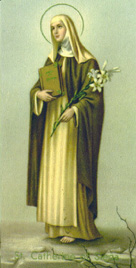 St. Catherine of Siena: Saint of the Day for Monday, April 29, 2024
 Prayer for the Dead # 3: Prayer of the Day for Monday, April 29, 2024

We ask you, humbly: don't scroll away.
Hi readers, it seems you use Catholic Online a lot; that's great! It's a little awkward to ask, but we need your help. If you have already donated, we sincerely thank you. We're not salespeople, but we depend on donations averaging $14.76 and fewer than 1% of readers give. If you donate just $5.00, the price of your coffee, Catholic Online School could keep thriving. Thank you.Help Now >

Copyright 2024 Catholic Online. All materials contained on this site, whether written, audible or visual are the exclusive property of Catholic Online and are protected under U.S. and International copyright laws, © Copyright 2024 Catholic Online. Any unauthorized use, without prior written consent of Catholic Online is strictly forbidden and prohibited.
Catholic Online is a Project of Your Catholic Voice Foundation, a Not-for-Profit Corporation. Your Catholic Voice Foundation has been granted a recognition of tax exemption under Section 501(c)(3) of the Internal Revenue Code. Federal Tax Identification Number: 81-0596847. Your gift is tax-deductible as allowed by law.