We ask you, humbly: don't scroll away.
Hi readers, it seems you use Catholic Online a lot; that's great! It's a little awkward to ask, but we need your help. If you have already donated, we sincerely thank you. We're not salespeople, but we depend on donations averaging $14.76 and fewer than 1% of readers give. If you donate just $5.00, the price of your coffee, Catholic Online School could keep thriving. Thank you.Help Now >
St. John the Almsgiver
FREE Catholic Classes
(JOANNES ELEEMOSYNARIUS; JOANNES MISERICORS).
Patriarch of Alexandria (606-16), b. at Amathus in Cyprus about 550; d. there, 616. He was the son of one Epiphanius, governor of Cyprus, and was of noble descent; in early life he was married and had children, but they and his wife soon died, whereupon he entered the religious life.
On the death of the Patriarch Theodorus, the Alexandrians besought Emperor Phocas to appoint John his successor, which was accordingly done. In his youth John had had a vision of a beautiful maiden with a garland of olives on her head, who said that she was Compassion, the eldest daughter of the Great King. This had evidently made a deep impression on John's mind, and, now that he had the opportunity of exercising benevolence on a large scale, he soon became widely known all over the East for his munificent liberality towards the poor. One of the first steps he took was to make a list of several thousand needy persons, whom he took under his especial care. He always referred to the poor as his "lords and masters", because of their mighty influence at the Court of the Most High. He assisted people of every class who were in need. A shipwrecked merchant was thus helped three times, on the first two occasions apparently without doing him much good; the third time however, John fitted him out with a ship and a cargo of wheat, and by favourable winds he was taken as far as Britain, where, as there was a shortage of wheat, he obtained his own price. Another person, who was not really in need, applied for alms and was detected by the officers of the palace; but John merely said "Give unto him; he may be Our Lord in disguise." He visited the hospitals three times every week, and he freed a great many slaves. He was a reformer who attacked simony, and fought heresy by means of improvements in religious education. He also reorganized the system of weights and measures for the sake of the poor, and put a stop to corruption among the officials. He increased the number of churches in Alexandria from seven to seventy.
John is said to have devoted the entire revenues of his see to the alleviation of those in need. A rich man presented him with a magnificent bed covering; he accepted it for one night, but then sold it, and disposed of the money in alms. The rich man "bought in" the article, and again presented it to John, with the same result. This was repeated several times; but John drily remarked: "We will see who tires first." It was not John. Another instance of his piety was that he caused his own grave to be dug, but only partly so, and appointed a servant to come before him on all state occasions and say "My Lord, your tomb is unfinished; pray give orders for its completion, for you know not the hour when death may seize you." When the Persians sacked Jerusalem in 614, John sent large supplies of food, wine, and money to the fleeing Christians. But eventually the Persians occupied Alexandria, and John himself in his old age was forced to flee to his native country, where he died.
His body was brought to Constantinople, thence to Ofen by King Matthias Corvinus of Hungary ; thence in 1530 to Toll near Presburg, and finally in 1632 to Presburg cathedral. He was the original patron saint of the Hospitallers, and was commemorated by the Greeks on 12 Nov. His life, written by Leontius of Neapolis, in Cyprus, was translated into Latin by Anastasius the Librarian in the ninth century and was referred to at the Seventh General Council .
 Hi readers, it seems you use Catholic Online a lot; that's great! It's a little awkward to ask, but we need your help. If you have already donated, we sincerely thank you. We're not salespeople, but we depend on donations averaging $14.76 and fewer than 1% of readers give. If you donate just $5.00, the price of your coffee, Catholic Online School could keep thriving. Thank you. Help Now >
Join the Movement
When you sign up below, you don't just join an email list - you're joining an entire movement for Free world class Catholic education.


-

-
Mysteries of the Rosary
-
St. Faustina Kowalska
-
Litany of the Blessed Virgin Mary
-
Saint of the Day for Wednesday, Oct 4th, 2023
-
Popular Saints
-
St. Francis of Assisi
-
Bible
-
Female / Women Saints
-
7 Morning Prayers you need to get your day started with God
-
Litany of the Blessed Virgin Mary


Sacrifices of Faith: The Pro-Life Legacies of St. Gianna and Jessica Hanna
-
How to love God by caring for our bodies
-
Pope Francis calls for negotiations to End Russia-Ukraine War
-
Pope Francis Contemplates Return to U.S. for United Nations Assembly Address
-
Pope Francis Calls on Faithful to Embrace Faith, Hope, and Charity in New Teaching Series


Daily Catholic
- Daily Readings for Monday, April 29, 2024
- St. Catherine of Siena: Saint of the Day for Monday, April 29, 2024
- Prayer for the Dead # 3: Prayer of the Day for Monday, April 29, 2024
- Daily Readings for Sunday, April 28, 2024
- St. Peter Chanel: Saint of the Day for Sunday, April 28, 2024
- Prayer before a Crucifix: Prayer of the Day for Sunday, April 28, 2024
 Daily Readings for Monday, April 29, 2024
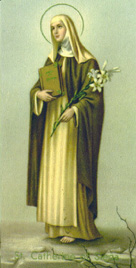 St. Catherine of Siena: Saint of the Day for Monday, April 29, 2024
 Prayer for the Dead # 3: Prayer of the Day for Monday, April 29, 2024

Copyright 2024 Catholic Online. All materials contained on this site, whether written, audible or visual are the exclusive property of Catholic Online and are protected under U.S. and International copyright laws, © Copyright 2024 Catholic Online. Any unauthorized use, without prior written consent of Catholic Online is strictly forbidden and prohibited.
Catholic Online is a Project of Your Catholic Voice Foundation, a Not-for-Profit Corporation. Your Catholic Voice Foundation has been granted a recognition of tax exemption under Section 501(c)(3) of the Internal Revenue Code. Federal Tax Identification Number: 81-0596847. Your gift is tax-deductible as allowed by law.