 Hi readers, it seems you use Catholic Online a lot; that's great! It's a little awkward to ask, but we need your help. If you have already donated, we sincerely thank you. We're not salespeople, but we depend on donations averaging $14.76 and fewer than 1% of readers give. If you donate just $5.00, the price of your coffee, Catholic Online School could keep thriving. Thank you. Help Now >
Pope Alexander III
FREE Catholic Classes
Pope from 1159-81 (Orlando Bandinelli), born of a distinguished Sienese family ; died 3 August, 1181. As professor in Bologna he acquired a great reputation as a canonist, which he increased by the publication of his commentary on the "Decretum" of Gratian, popularly known as "Summa Magistri Rolandi." Called to Rome by Eugene III in the year 1150, his advancement was rapid. He was created Cardinal Deacon, then Cardinal Priest of the title of St. Mark, and Papal Chancellor. He was the trusted adviser of Adrian IV and was regarded as the soul of the party of independence among the cardinals, which sought to escape the German yoke by alliance with the Normans of Naples. For openly asserting before Barbarossa at the Diet of Besançon (1157) that the imperial dignity was a papal beneficium (in the general sense of favour, not feudal sense of fief), he incurred the wrath of the German princes, and would have fallen on the spot under the battle-axe of his life-long foe, Otto of Wittelsbach had Frederick not intervened. For the purpose of securing a submissive pontiff at the next vacancy, the Emperor despatched into Italy two able emissaries who were to work upon the weaknesses and fears of the cardinals and the Romans, the aforesaid Otto and the Archbishop-elect of Cologne, Rainald von Dassel, whose anti-Papal attitude was largely owing to the fact that the Holy See refused to confirm his appointment. The fruits of their activity became patent after the death of Pope Adrian IV (1 September, 1159). Of the twenty-two cardinals assembled, 7 September, to elect a successor all but three voted for Orlando. The contention made later, that the imperialist cardinals numbered nine, may be explained by the surmise that in the earlier ballotings six of the faithful cardinals voted for a less prominent and obnoxious candidate. In opposition to Cardinal Orlando, who took the immortal name of Alexander III, the three imperialist members chose one of their number, Cardinal Octavian, who assumed the title of Victor IV. A mob hired by the Count of Wittelsbach broke up the conclave. Alexander retreated towards the Norman south and was consecrated and crowned, 20 September, at the little Volscian town of Nympha. Octavian's consecration took place 4 October, at the monastery of Farfa. The Emperor now interposed to settle a disturbance entirely caused by his own agents, and summoned both claimants before a packed assembly at Pavia. He betrayed his animus by addressing Octavian as Victor IV and the true Pope as Cardinal Orlando. Pope Alexander refused to submit his clear right to this iniquitous tribunal, which, as was foreseen, declared for the usurper (11 February, 1160). Alexander promptly responded, from the ill-fated Anagni, by solemnly excommunicating the Emperor and releasing his subjects from their oaths of allegiance. The ensuing schism, far more disastrous to the Empire than to the Papacy, lasted for seventeen years and ended after the battle of Legnano (1176) with the unconditional surrender of the haughty Barbarossa in Venice, 1177. (See FREDERICK I.) The childish legend that the Pope placed his foot on the neck of the prostrate Emperor has done valiant service to Protestant tradition since the days of Luther. [See the dissertation of George Remus, Nuremberg, 1625; Lyons, 1728; and Gosselin, "The Power of the Pope during the Middle Ages "(tr. London, 1853) II, 133.] Alexander's enforced exile (1162-65) in France contributed greatly to enhance the dignity of the papacy, never so popular as when in distress. It also brought him into direct contact with the most powerful monarch of the West, Henry II of England. The cautious manner in which he defended the rights of the Church during the quarrel between the two impetuous Normans, King Henry and St. Thomas Becket, though many a time exciting the displeasure of both contestants, and often since denounced as "shifty", was the strategy of an able commander who, by marches and countermarches succeeds in keeping the field against overwhelming odds. It is no disparagement of the Martyr of Canterbury to say that the Pope equalled him in firmness and excelled him in the arts of diplomacy. After Becket's murder the Pope succeeded, without actual recourse to ban or interdict, in obtaining from the penitent monarch every right for which the martyr had fought and bled.
We ask you, humbly: don't scroll away.
Hi readers, it seems you use Catholic Online a lot; that's great! It's a little awkward to ask, but we need your help. If you have already donated, we sincerely thank you. We're not salespeople, but we depend on donations averaging $14.76 and fewer than 1% of readers give. If you donate just $5.00, the price of your coffee, Catholic Online School could keep thriving. Thank you.Help Now >
To crown and seal the triumph of religion, Alexander convoked and presided over the Third Lateran Council (Eleventh Ecumenical), in 1179. Surrounded by over 300 bishops, the much-tried Pontiff issued many salutary decrees, notably the ordinance which vested the exclusive right of papal elections in a two-thirds vote of the cardinals. Throughout all the vicissitudes of his chequered career Alexander remained a canonist. A glance at the Decretals shows that, as an ecclesiastical legislator, he was scarcely second to Innocent III. Worn out by trials, he died at Civita Castellana. When we are told that "the Romans" pursued his remains with curses and stones, the remembrance of a similar scene at the burial of Pius IX teaches us what value to attach to such a demonstration. In the estimation of Rome, Italy, and Christendom, Alexander III's epitaph expresses the truth, when it calls him "the Light of the Clergy, the Ornament of the Church, the Father of his City and of the World." He was friendly to the new academical movement that led to the establishment of the great medieval universities. His own reputation as a teacher and a canonist has been greatly enhanced through the discovery by Father Denifle in the public library of Nuremberg of the "Sententiae Rolandi Bononiensis," edited (Freiburg, 1891) by Father Ambrosius Gietl. The collection of his letters (Jaffé, Regesta RR. Pontif., Nos. 10,584-14,424) was enriched by Löwenfeld's publication of many hitherto unknown (Epistolae Pontif. Rom. ineditae, Leipzig, 1885). Even Voltaire regards him as the man who in medieval times deserved best from the human race, for abolishing slavery, for overcoming the violence of the Emperor Barbarossa, for compelling Henry II of England to ask pardon for the murder of Thomas Becket, for restoring to men their rights, and giving splendour to many cities.


Join the Movement
When you sign up below, you don't just join an email list - you're joining an entire movement for Free world class Catholic education.


-

-
Mysteries of the Rosary
-
St. Faustina Kowalska
-
Litany of the Blessed Virgin Mary
-
Saint of the Day for Wednesday, Oct 4th, 2023
-
Popular Saints
-
St. Francis of Assisi
-
Bible
-
Female / Women Saints
-
7 Morning Prayers you need to get your day started with God
-
Litany of the Blessed Virgin Mary


Sacrifices of Faith: The Pro-Life Legacies of St. Gianna and Jessica Hanna
-
How to love God by caring for our bodies
-
Pope Francis calls for negotiations to End Russia-Ukraine War
-
Pope Francis Contemplates Return to U.S. for United Nations Assembly Address
-
Pope Francis Calls on Faithful to Embrace Faith, Hope, and Charity in New Teaching Series


Daily Catholic
- Daily Readings for Monday, April 29, 2024
- St. Catherine of Siena: Saint of the Day for Monday, April 29, 2024
- Prayer for the Dead # 3: Prayer of the Day for Monday, April 29, 2024
- Daily Readings for Sunday, April 28, 2024
- St. Peter Chanel: Saint of the Day for Sunday, April 28, 2024
- Prayer before a Crucifix: Prayer of the Day for Sunday, April 28, 2024
 Daily Readings for Monday, April 29, 2024
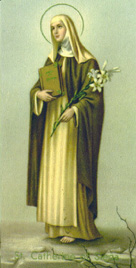 St. Catherine of Siena: Saint of the Day for Monday, April 29, 2024
 Prayer for the Dead # 3: Prayer of the Day for Monday, April 29, 2024
We ask you, humbly: don't scroll away.
Hi readers, it seems you use Catholic Online a lot; that's great! It's a little awkward to ask, but we need your help. If you have already donated, we sincerely thank you. We're not salespeople, but we depend on donations averaging $14.76 and fewer than 1% of readers give. If you donate just $5.00, the price of your coffee, Catholic Online School could keep thriving. Thank you.Help Now >

Copyright 2024 Catholic Online. All materials contained on this site, whether written, audible or visual are the exclusive property of Catholic Online and are protected under U.S. and International copyright laws, © Copyright 2024 Catholic Online. Any unauthorized use, without prior written consent of Catholic Online is strictly forbidden and prohibited.
Catholic Online is a Project of Your Catholic Voice Foundation, a Not-for-Profit Corporation. Your Catholic Voice Foundation has been granted a recognition of tax exemption under Section 501(c)(3) of the Internal Revenue Code. Federal Tax Identification Number: 81-0596847. Your gift is tax-deductible as allowed by law.