We ask you, humbly: don't scroll away.
Hi readers, it seems you use Catholic Online a lot; that's great! It's a little awkward to ask, but we need your help. If you have already donated, we sincerely thank you. We're not salespeople, but we depend on donations averaging $14.76 and fewer than 1% of readers give. If you donate just $5.00, the price of your coffee, Catholic Online School could keep thriving. Thank you.Help Now >
Simon Vigor
FREE Catholic Classes
French bishop and controversialist, b. at Evreux, Normandy, about 1515; d. at Carcassonne, 1 Nov., 1575. Son of Raynaud Vigor, a court physician, he went to Paris about 1520, where his studies included Greek, Hebrew, and Latin; later he devoted himself to theology. Admitted to the College of Navarre in 1540, in the same year he became rector of the University of Paris. In 1545 he became a doctor of theology and was appointed penitentiary of Evereux. Thenceforth he devoted himself to pastoral and controversial preaching with great success. He was called upon to speak at Rouen, Paris, Metz, and elsewhere. When conferences took place at Saint-Germain near Paris (1562) between the Catholics and the Calvinists defended by Theodore Beza and others, Vigor was one of those chosen to defend the Catholic cause in the name of the Sorbonne. In 1563 he was among the twelve theologians representing the Sorbonne at the Council of Trent, where he took part in the discussions on clandestine marriages and indulgences, and distinguished himself by his vast erudition. He was instrumental in cementing amicable relations between Cardinal Hosius of Warsaw, papal legate to the council, and Francisco Torres (Turrianus), and won the confidence of Cardinal de Lorraine whom he accompanied on his visit (Feb., 1563) to Ferdinand I at Innsbruck.

On his return to France Vigor became pastor of the Church of St. Paul-de-Paris, the royal parish, theologian of the chapter of Notre-Dame, and court preacher. He persevered in his combat against the Protestants with an ardour which drew on him for some of his propositions (March, 1564) if not the censure, at least the displeasure, of the Sorbonne. He converted several of them, among others the learned Pierre Pithou, the Varo of France. After preaching a Lent at Amiens, he stated that at his arrival he had found there more than 800 heretics and at his departure there remained only forty. In 1566 he held, together with Claude de Sainctes, against the Calvinist ministers Jean de l'Epine and Sureau de Rosier, a conference of which the acts were printed (Paris, 1582). According to Génébrard the defeat of the ministers was so overwhelming that the subsequent Calvinist synod forbade conferences to be held thenceforth with Catholics. These successes had made Vigor famous when in 1572 Gregory XIII raised him to the See of Narbonne. After his consecration he went to his diocese, and began at once to eradicate the evils his diocese had suffered, in being long without a resident bishop. He never returned to Paris or to his home, being wholly engaged in converting the Protestants of his own and the neighbouring dioceses, in which work death overtook him. After his death the Bishop of Rennes in a letter to Gregory XIII called him the Athanasius or Hilary of his time, and Duval praised him as a model of learning and piety, a pillar of the Roman Church. There were edited after his death five volumes of his "Sermons ou prédications chrétiennes et catholiques" (Paris, 1577-88); several times reprinted.


Join the Movement
When you sign up below, you don't just join an email list - you're joining an entire movement for Free world class Catholic education.


-

-
Mysteries of the Rosary
-
St. Faustina Kowalska
-
Litany of the Blessed Virgin Mary
-
Saint of the Day for Wednesday, Oct 4th, 2023
-
Popular Saints
-
St. Francis of Assisi
-
Bible
-
Female / Women Saints
-
7 Morning Prayers you need to get your day started with God
-
Litany of the Blessed Virgin Mary


Sacrifices of Faith: The Pro-Life Legacies of St. Gianna and Jessica Hanna
-
How to love God by caring for our bodies
-
Pope Francis calls for negotiations to End Russia-Ukraine War
-
Pope Francis Contemplates Return to U.S. for United Nations Assembly Address
-
Pope Francis Calls on Faithful to Embrace Faith, Hope, and Charity in New Teaching Series


Daily Catholic
- Daily Readings for Monday, April 29, 2024
- St. Catherine of Siena: Saint of the Day for Monday, April 29, 2024
- Prayer for the Dead # 3: Prayer of the Day for Monday, April 29, 2024
- Daily Readings for Sunday, April 28, 2024
- St. Peter Chanel: Saint of the Day for Sunday, April 28, 2024
- Prayer before a Crucifix: Prayer of the Day for Sunday, April 28, 2024
 Daily Readings for Monday, April 29, 2024
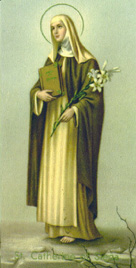 St. Catherine of Siena: Saint of the Day for Monday, April 29, 2024
 Prayer for the Dead # 3: Prayer of the Day for Monday, April 29, 2024
 Hi readers, it seems you use Catholic Online a lot; that's great! It's a little awkward to ask, but we need your help. If you have already donated, we sincerely thank you. We're not salespeople, but we depend on donations averaging $14.76 and fewer than 1% of readers give. If you donate just $5.00, the price of your coffee, Catholic Online School could keep thriving. Thank you. Help Now >
We ask you, humbly: don't scroll away.
Hi readers, it seems you use Catholic Online a lot; that's great! It's a little awkward to ask, but we need your help. If you have already donated, we sincerely thank you. We're not salespeople, but we depend on donations averaging $14.76 and fewer than 1% of readers give. If you donate just $5.00, the price of your coffee, Catholic Online School could keep thriving. Thank you.Help Now >

Copyright 2024 Catholic Online. All materials contained on this site, whether written, audible or visual are the exclusive property of Catholic Online and are protected under U.S. and International copyright laws, © Copyright 2024 Catholic Online. Any unauthorized use, without prior written consent of Catholic Online is strictly forbidden and prohibited.
Catholic Online is a Project of Your Catholic Voice Foundation, a Not-for-Profit Corporation. Your Catholic Voice Foundation has been granted a recognition of tax exemption under Section 501(c)(3) of the Internal Revenue Code. Federal Tax Identification Number: 81-0596847. Your gift is tax-deductible as allowed by law.