St. Francis de Sales

Facts
Patron: of Catholic writers, the Catholic press, the deaf, journalists, adult education
Birth: August 21, 1567
Death: December 28, 1622
Beatified: January 8, 1661 by Pope Alexander VII
Canonized: April 19, 1665 by Pope Alexander VII
Author and Publisher - Catholic Online
Printable PDF of St. Francis de Sales
Shop St. Francis de Sales
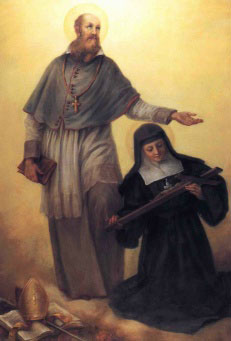
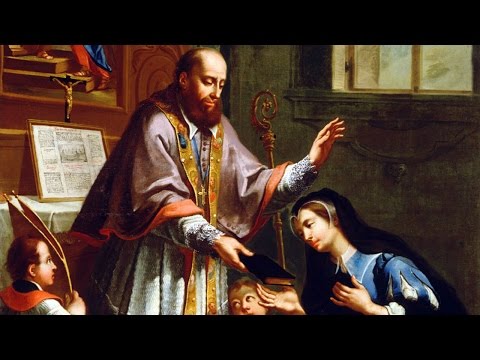
St. Francis de Sales was born to a noble family at Chateau de Sales in the Kingdom of Savoy near Geneva, Switzerland on August 21, 1567. He was a Bishop and Doctor of the Church.
Francis was both intelligent and gentle. From a very early age, he desired to serve God. He knew for years he had a vocation to the priesthood, but kept it from his family. His father wanted him to enter a career in law and politics.
In 1580, Francis attended the University of Paris, and at 24-years-old, he received his doctorate in law at the University of Padua.
All the time, he never lost his passion for God. He studied theology and practiced mental prayers, but kept quiet about his devotion. To please his father, he also studied fencing and riding.
God made his will clear to Francis one day while he was riding. Francis fell from his horse three times that day. Every time he fell, the sword came out of the scabbard, and every time it came out, the sword and scabbard came to rest on the ground in the shape of the Christian cross.
After much discussion and disagreement from his father, Francis was ordained to the priesthood and elected provost of the Diocese of Geneva, in 1593, by the Bishop of Geneva.
During the time of the Protestant reformation, Francis lived close to Calvinist territory. He decided he should lead an expedition to bring the 60,000 Calvinists back to the Catholic Church.
For three years, he trudged through the countryside, had doors slammed in his face and rocks thrown at him. In the bitter winters, his feet froze so badly they bled as he tramped through the snow.
Francis' unusual patience kept him working. No one would listen to him, no one would even open their door. So, Francis found a way to get under the door. He wrote out little pamphlets to explain true Catholic doctrine and slipped them under the doors. This is one of the first records we have of religious tracts being used to communicate the true Catholic faith to people who had fallen away from the Church.
The parents wouldn't come to him, so Francis went to the children. When the parents saw how kind he was as he played with the children, they began to talk to him.
By the time Francis returned home, it is believed he brought 40,000 people to the Catholic Church.
He forged wonderful alliances with Pope Clement VIII and Henry IV of France, and in 1601 Francis joined Henry IV on a diplomatic mission. He was to give Lenten sermons at the Chapel Royal. Henry grew attached to Francis and saw him as a "rare bird" who was devout, knowledgeable and a gentleman.
In 1602, Bishop Granier died and Francis was consecrated Bishop of Geneva, although he continued to reside in Annecy. He only set foot in the city of Geneva twice -- once when the Pope sent him to try to convert Calvin's successor, Beza, and another when he traveled through it.
In 1604, Francis took one of the most important steps in his life -- the step toward extraordinary holiness and mystical union with God.
In Dijon, Francis saw a widow listening closely to his sermon -- a woman he had seen already in a dream. Jane de Chantal was a dedicated Catholic Christian on her own, as Francis was, but it was only when they became friends they began to become saints.
Jane wanted him to take over her spiritual direction, but, not surprisingly, Francis wanted to wait. "I had to know fully what God himself wanted. I had to be sure that everything in this should be done as though his hand had done it." Jane was on a path to mystical union with God and, in directing her, Francis was compelled to follow her and become a mystic himself.
Years after working with Jane, he made up his mind to form a new religious community. In 1610, he founded The Order of Visitation.
Francis was overworked and often ill because of his constant load of preaching, visiting, and instruction -- even catechizing a deaf man so he could take first Communion. He believed the first duty of a bishop was spiritual direction and wrote to Jane, "So many have come to me that I might serve them, leaving me no time to think of myself. However, I assure you that I do feel deep-down- within-me, God be praised. For the truth is that this kind of work is infinitely profitable to me." For him active work did not weaken his spiritual inner peace but strengthened it.
He gave spiritual direction to most people through letters, which attested to his remarkable patience. "I have more than fifty letters to answer. If I tried to hurry over it all, I would be lost. So, I intend neither to hurry or to worry. This evening, I shall answer as many as I can. Tomorrow I shall do the same and so I shall go on until I have finished."
During this time, it was wrongly thought that achieving real holiness of life was a task reserved for only for the clergy and those in religious life, and not for lay men and women. In addition, that only contemplatives, people who withdraw from active participation in the world, could really achieve holiness.
Francis insisted that every Christian was called to holiness and sanctity, lived within their own state in life. In holding that belief, he reflected the teaching of Jesus and the early Church Fathers.
Francis laid the groundwork for the teaching of the Second Vatican Council on what is now called the ?universal call to holiness. It reaffirms the teaching of Jesus and the early Church that every Baptized Christian is called to sanctity, no matter what their career or state in life. In every career and state in life, Christians can become more and more like Jesus Christ. That is, after all, what holiness really means.
Francis gave spiritual direction to lay people who were living real lives in the real world. He had proven with his own life that people could grow in holiness while involved in a very active occupation. He also recognized that Christian marriage and family life is itself a call to holiness.

His most famous book, INTRODUCTION TO THE DEVOUT LIFE, was written for ordinary lay people in 1608, not just the clergy and religious. Written originally as letters, it became an instant success all over Europe -- though some clergy rejected the notion that lay men and women could achieve holiness in the experience of their daily life. Some tore it up because Francis encouraged dancing and jokes!
For Francis, the love of God was like romantic love. He said, "The thoughts of those moved by natural human love are almost completely fastened on the beloved, their hearts are filled with passion for it, and their mouths full of its praises. When it is gone, they express their feelings in letters, and can't pass by a tree without carving the name of their beloved in its bark. Thus, to those who love God can never stop thinking about him, longing for him, aspiring to him, and speaking about him. If they could, they would engrave the name of Jesus on the hearts of all humankind."
The key to love of God was prayer.
"By turning your eyes on God in meditation, your whole soul will be filled with God. Begin all your prayers in the presence of God."
For busy people living in the world, he advised, "Retire at various times into the solitude of your own heart, even while outwardly engaged in discussions or transactions with others and talk to God."
The test of prayer was a person's actions.
"To be an angel in prayer and a beast in one's relations with people is to go lame on both legs."
He believed the worst sin was to judge someone or to gossip about them. Even if we say we do it out of love we're still doing it to look better ourselves. We should be as gentle and forgiving with ourselves as we should be with others.
As he became older and more ill he said, "I have to drive myself but the more I try the slower I go." He wanted to be a hermit but he was more in demand than ever. The Pope needed him, then a princess, then Louis XIII. "Now I really feel that I am only attached to the earth by one foot..." He died on December 28, 1622, after giving a nun his last word of advice: "Humility."
St. Francis de Sales was beatified on January 8, 1661 and canonized on April 19, 1665 by Pope Alexander VII.
He is often featured with the Heart of Jesus and a Crown of Thorns.
In 1923, Pope Pius XI named St. Francis de Sales the patron saint of Catholic writers and the Catholic press because of the tracts and books he wrote. He is also the patron saint of the deaf, journalists, adult education, and the Sisters of St. Joseph. His feast day is celebrated on January 24.


Come Grow With Us
Sign up and walk the Catholic journey with millions around the world.
Receive inspiring emails on saints, daily readings, and free faith-building resources—no cost, ever.
Sister Sara Has One Message for Every Catholic Family This June
- 7 Morning Prayers
- Mysteries of the Rosary
- Litany of the Bl. Virgin Mary
- Popular Saints
- Popular Prayers
- Female Saints
- Saint Feast Days by Month
- Stations of the Cross
- St. Francis of Assisi
- St. Michael the Archangel
- The Apostles' Creed
- Unfailing Prayer to St. Anthony
- Pray the Rosary







Copyright 2026 Catholic Online. All materials contained on this site, whether written, audible or visual are the exclusive property of Catholic Online and are protected under U.S. and International copyright laws, © Copyright 2026 Catholic Online. Any unauthorized use, without prior written consent of Catholic Online is strictly forbidden and prohibited.
Catholic Online is a Project of Your Catholic Voice Foundation, a Not-for-Profit Corporation. Your Catholic Voice Foundation has been granted a recognition of tax exemption under Section 501(c)(3) of the Internal Revenue Code. Federal Tax Identification Number: 81-0596847. Your gift is tax-deductible as allowed by law.
