Because of You, 2.2 Million Students Are Being Formed in the Faith
Because of generous supporters like you, Catholic Online School has already delivered free, faithful Catholic education to over 2.2 million students across 193 countries. In an age of noise and algorithms, you are helping form souls with truth, prayer, Scripture, and Christ.
If everyone who reads this gave just $5 — the cost of a coffee — we could reach even more families and keep this life-changing formation free for all. Be Courageous. Be Catholic. Stand with us today.
DONATE TODAY >St. Wilgefortis
Facts
Patron: of relief from tribulations, in particular by women who wished to be liberated ("disencumbered") from abusive husbands
Author and Publisher - Catholic Online
Printable Catholic Saints PDFs
Shop St. Wilgefortis
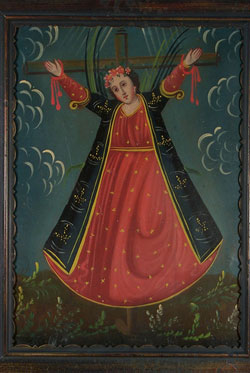
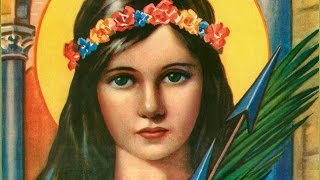
Wilgefortis, also known as Liberata, Kummernis in Germany, in England as Uncumber, and in France as Livrade, among other names, her story is a pious fiction more folktale than religious, according to which she was one of nine daughters of a pagan Portuguese King. When her father wanted her to marry the King of Sicily, despite her vow of virginity, she prayed for help in resisting the marriage, whereupon she grew a beard and mustache and the suit was withdrawn. Her father was so furious he had her crucified. Father Charles Cahier, S.J., wrote, for my part, I am inclined to think that the crown, beard, gown and gown and cross which are regarded as the attributes of this marvelous maiden (in pictorial representations), are only a pious devotion to the famous crucifix of Lucca, somewhat gone astray. This famous crucifix was completely dressed and crowned, as were many others of the same period. In course of time, the long gown caused it to be thought that the figure was that of a woman, who on account of the beard was called Vierge-forte. We may add that the crucifix of Lucca was shod with silver to prevent the wearing away of the wood by the kissing of the feet by pilgrims. This also has been turned to the glorification of St. Wilgefortis. For it is said that a poor minstrel playing an air before the saint's statue was rewarded by her giving him one of her precious shoes. St. Wilgefortis' feast day is July 20.
Come Grow With Us
Sign up and walk the Catholic journey with millions around the world.
Receive inspiring emails on saints, daily readings, and free faith-building resources—no cost, ever.
This could change the future of Catholic Online.
Watch Now
- 7 Morning Prayers
- Mysteries of the Rosary
- Litany of the Bl. Virgin Mary
- Popular Saints
- Popular Prayers
- Female Saints
- Saint Feast Days by Month
- Stations of the Cross
- St. Francis of Assisi
- St. Michael the Archangel
- The Apostles' Creed
- Unfailing Prayer to St. Anthony
- Pray the Rosary










Copyright 2026 Catholic Online. All materials contained on this site, whether written, audible or visual are the exclusive property of Catholic Online and are protected under U.S. and International copyright laws, © Copyright 2026 Catholic Online. Any unauthorized use, without prior written consent of Catholic Online is strictly forbidden and prohibited.
Catholic Online is a Project of Your Catholic Voice Foundation, a Not-for-Profit Corporation. Your Catholic Voice Foundation has been granted a recognition of tax exemption under Section 501(c)(3) of the Internal Revenue Code. Federal Tax Identification Number: 81-0596847. Your gift is tax-deductible as allowed by law.
