St. Severinus Boethius
Facts
Death: 524
Author and Publisher - Catholic Online
Printable Catholic Saints PDFs
Shop St. Severinus Boethius
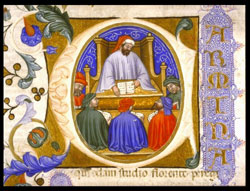
Roman philosopher, theologian, and statesman, one of the last notable philosophers in the classical Roman tradition. Known, in full as Anicius Manlius Torquatus Severinus Boethius, he was born to the ancient noble family of Rome, the Anicii, and studied at Athens and Alexandria, receiving a deep classical education. In 510, he was named a consul under the Ostrogothic king Theodoric and became his magister officiorurn (master of offices) in 520, a post which demonstrated Theodoric’s deep trust and respect for Boethius’ abilities. However, relations between them soon deteriorated, as Boethius was staunchly orthodox in his Christianity while Theodoric was a devoted Arian. When Boethius defended the ex-consul Albinus on charges of treason, Theodoric had him seized, condemned, and put to death. A brilliant philosopher and statesman, Roethius authored translations of Aristotle, the Isagoge by Porphyry, and a Commentary on the Topics of Cicero. He also authored treatises on the Holy Trinity (De Sancti Trinitate) and orthodox Christology, and a biography of the Christian monk and writer Cassiodorus (d. 580). His most famous work, De Consolatione Philosophiac (The Consolation of Philosophy), was written while he was in prison. In it, he proposed that the study of philosophy made attainable knowledge of virtue and God. He is considered a martyr for the Catholic faith and was canonized under the name St. Severinus.

Come Grow With Us
Sign up and walk the Catholic journey with millions around the world.
Receive inspiring emails on saints, daily readings, and free faith-building resources—no cost, ever.
This 15-Second Video Will Change How You See Catholic Education.
Watch Now
- 7 Morning Prayers
- Mysteries of the Rosary
- Litany of the Bl. Virgin Mary
- Popular Saints
- Popular Prayers
- Female Saints
- Saint Feast Days by Month
- Stations of the Cross
- St. Francis of Assisi
- St. Michael the Archangel
- The Apostles' Creed
- Unfailing Prayer to St. Anthony
- Pray the Rosary







Copyright 2026 Catholic Online. All materials contained on this site, whether written, audible or visual are the exclusive property of Catholic Online and are protected under U.S. and International copyright laws, © Copyright 2026 Catholic Online. Any unauthorized use, without prior written consent of Catholic Online is strictly forbidden and prohibited.
Catholic Online is a Project of Your Catholic Voice Foundation, a Not-for-Profit Corporation. Your Catholic Voice Foundation has been granted a recognition of tax exemption under Section 501(c)(3) of the Internal Revenue Code. Federal Tax Identification Number: 81-0596847. Your gift is tax-deductible as allowed by law.